
Categories
Tucson Real Estate MarketPublished June 26, 2026
Best Areas in Tucson for Rental Properties in 2026: A Local Guide to Choosing the Right Fit for Your Goals

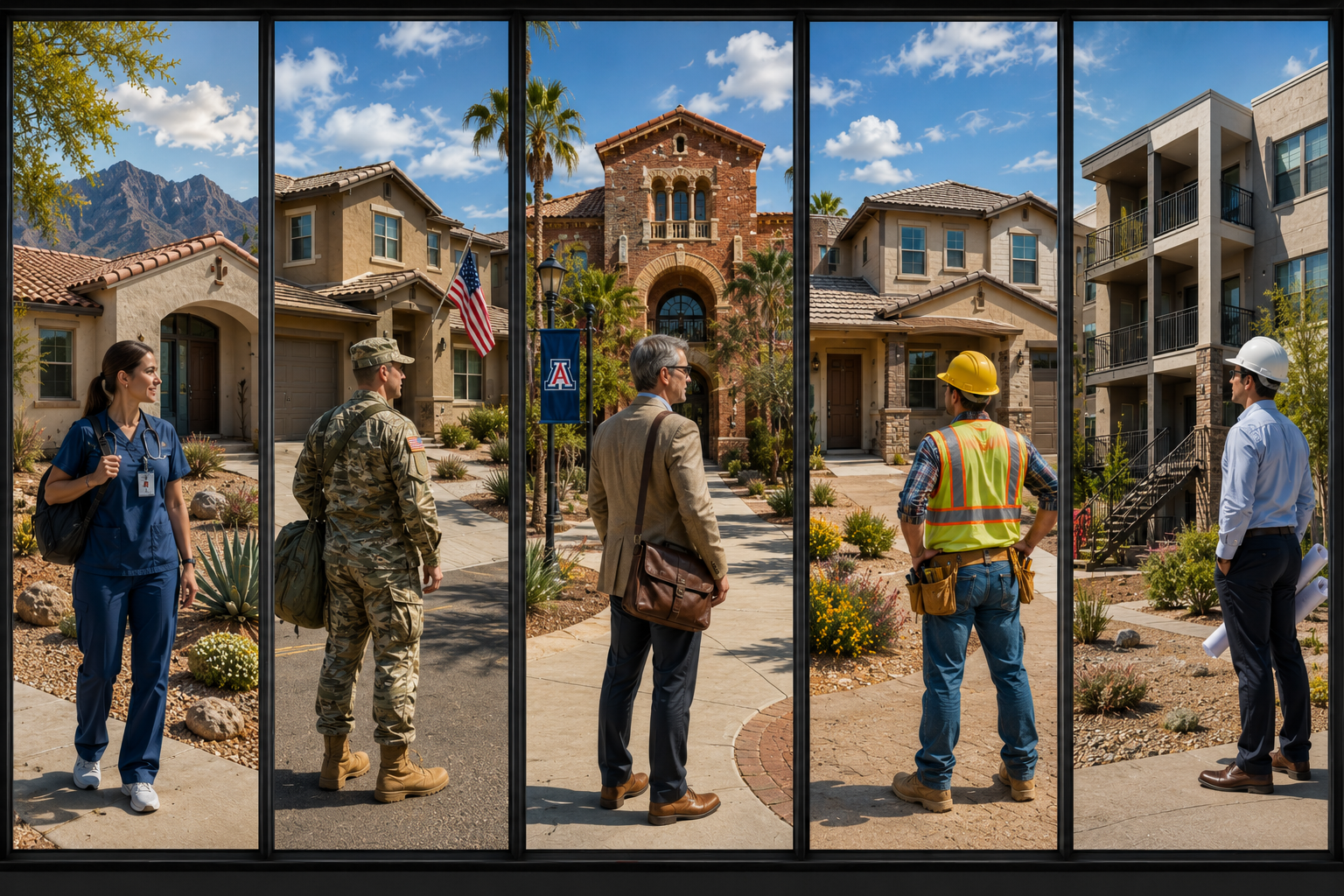
When people search for the best areas in Tucson for rental properties, they’re often looking for a list of neighborhoods. But after working with buyers throughout Southern Arizona, we’ve found that the better question is:
Who is likely to rent the property, and why are they coming to Tucson?
Tucson’s rental market is influenced by several major demand drivers, including the University of Arizona, Davis-Monthan Air Force Base, healthcare employers, aerospace and defense companies, and a growing number of professionals relocating to Southern Arizona. Understanding those renter groups can help first-time investors and homeowners considering a rental property make more informed decisions.
The reality is that there is no single “best” area for every rental property owner. A location that works well for a University of Arizona researcher may not be the same location that appeals to a traveling nurse, an Air Force family, or an engineer relocating for work. The goal is to match the property to the renter profile.
Why Tucson Continues to Attract Renters
Tucson benefits from a diverse mix of education, healthcare, military, aerospace, and industrial employers. The University of Arizona enrolled more than 54,000 students in 2025 and continues to rank among the nation’s leading public research universities, generating more than $1 billion in annual research activity. Those numbers support housing demand that extends well beyond undergraduate students.
Davis-Monthan Air Force Base remains one of Southern Arizona’s largest employers and continues to play an important role in the local economy. At the same time, major healthcare systems, aerospace employers, defense contractors, and industrial companies continue to attract new residents to the region.
For investors, that diversity matters. Tucson is not dependent on a single renter demographic, which creates opportunities across multiple areas of the city.
Start With the Renter, Not the Neighborhood
One of the most common mistakes first-time investors make is choosing a neighborhood before considering who their future renter may be.
For example, someone interested in renting to University of Arizona students may focus on entirely different areas than someone hoping to attract traveling healthcare professionals or military personnel.
Before evaluating neighborhoods, ask yourself:
- Who is most likely to rent this property?
- Is the property best suited for long-term tenants, mid-term tenants, or seasonal renters?
- What employment centers are nearby?
- How important are commute times?
- What amenities would appeal to the intended renter?
Answering those questions often makes the location decision much easier.
University of Arizona-Related Rental Demand
Many investors immediately think about undergraduate students when they hear “University of Arizona housing.” In reality, the university creates housing demand from a much broader group of people.
That includes:
- Undergraduate students
- Graduate students
- Doctoral candidates
- Researchers
- Faculty members
- Administrative staff
- Visiting professors
As a major research institution, the University of Arizona attracts people from around the country and around the world. Some may be looking for housing for a semester, while others may stay in Tucson for several years.
Areas frequently explored by university-related renters include:
- West University
- Jefferson Park
- Sam Hughes
- Blenman-Elm
- Campus-adjacent neighborhoods
- Central Tucson communities with convenient access to campus
Potential Advantages
- Consistent university-related housing demand
- Proximity to campus amenities
- Walkability in some areas
- Variety of housing types
Things to Consider
- Older housing stock in some neighborhoods
- Parking considerations
- Property management requirements
- Turnover that may differ from traditional long-term rentals
Areas Near Davis-Monthan Air Force Base
Davis-Monthan Air Force Base remains one of the largest employment centers in Southern Arizona. In addition to active-duty Airmen, the base supports civilian employees, contractors, engineers, support personnel, and military families.
Recent mission transitions and planned operational changes continue to keep Davis-Monthan an important part of Tucson’s economy. Rather than focusing solely on military housing, investors should recognize that the housing demand associated with the base comes from a wide range of individuals and families.
Areas commonly explored by people connected to Davis-Monthan include:
- Rita Ranch
- Civano
- Southeast Tucson
- East Tucson
- Communities with practical access to the base
Potential Advantages
- Access to a major employment center
- Variety of housing options
- Family-oriented neighborhoods
- Newer housing inventory in some areas
Things to Consider
- Commute patterns
- HOA requirements
- Property age and condition
- Competition from other housing options
Healthcare and Medical Professionals
One of the most overlooked rental segments in Tucson involves healthcare workers.
The region’s major hospitals and healthcare systems support housing demand from:
- Traveling nurses
- Contract healthcare workers
- Physicians
- Medical residents
- Specialists
- Administrative healthcare staff
Unlike traditional student housing or military-related housing, healthcare professionals may need housing for a variety of timeframes. Some assignments last several months, while others may lead to long-term relocation.
This is also where Tucson’s retiree population enters the conversation.
Not every retiree immediately purchases a home after arriving in Tucson. Some rent first while exploring neighborhoods, spending time near healthcare providers, or deciding where they want to live permanently.
Areas commonly considered include:
- Central Tucson
- Northwest Tucson
- Oro Valley
- Areas near major healthcare corridors
Potential Advantages
- Diverse renter profiles
- Long-term and mid-term housing needs
- Demand tied to healthcare employment
Things to Consider
- Furnished versus unfurnished housing strategies
- Proximity to healthcare facilities
- Property management expectations
Aerospace, Defense, and Industrial Growth
Tucson’s economy extends well beyond the university and military sectors.
Major aerospace, defense, and industrial employers continue to support relocation activity throughout Southern Arizona. Companies such as Raytheon, along with employers connected to the Sonoran Corridor, advanced manufacturing, mining technology, and industrial development, contribute to housing demand throughout the region.
Investors researching these renter groups often look at:
- Marana
- Northwest Tucson
- East Tucson
- Sahuarita
- Areas with convenient access to major employment centers
These renters may include engineers, project managers, technicians, contractors, and professionals relocating to Tucson for career opportunities.
Comparing Tucson Rental Areas
| Area |
Common Renter Groups |
Potential Advantages |
Considerations |
|---|---|---|---|
| University Area |
Students, researchers, faculty |
Campus access, walkability |
Parking, turnover |
| Southeast Tucson |
Military, contractors, families |
Access to Davis-Monthan |
Commute and HOA considerations |
| Central Tucson |
Healthcare workers, university staff |
Central location |
Older housing stock |
| Oro Valley |
Healthcare professionals, retirees |
Access to services |
Different price points |
| Marana |
Aerospace, industrial, relocating professionals |
Newer development |
Distance from central Tucson |
| Sahuarita |
Industrial and mining-related workers |
Growing employment access |
Commute considerations |
Common Mistakes First-Time Investors Make
The biggest mistake we see is focusing on the property before understanding the renter.
Other common mistakes include:
- Assuming every renter wants the same thing
- Choosing a location based solely on purchase price
- Ignoring commute patterns
- Overlooking property management needs
- Focusing on trends rather than renter demand
A lower-priced property is not automatically a better rental property. Likewise, a popular neighborhood may not align with the type of renter you hope to attract.
How to Choose the Right Area for Your Goals
Instead of asking, “What is the best area in Tucson for a rental property?” consider asking:
- Who is most likely to rent this property?
- What brings those renters to Tucson?
- How long are they likely to stay?
- What features matter most to them?
- Which areas support those needs?
Those questions often lead to better decisions than simply chasing the latest investment trend.
Final Thoughts
The best rental property location in Tucson depends on understanding who needs housing and why.
For some investors, that may mean exploring neighborhoods near the University of Arizona. For others, it may mean looking at communities around Davis-Monthan Air Force Base, healthcare corridors, Marana’s growth areas, or parts of Northwest Tucson.
The most successful approach is often to start with the renter, understand their needs, and then identify the areas that align with those goals.
If you’re considering purchasing your first rental property in Tucson and have questions about specific areas, renter demographics, or housing trends, the TJK Team is always happy to be a local resource and help you better understand the market.

Tom Krieger
| The TJK Team - Realty Executives Arizona Territory
or another way