
Categories
Home Selling, Seller GuidesPublished June 24, 2026
How to Handle Multiple Offers as a Seller in Tucson, Arizona: A Practical Guide to Choosing the Right Offer

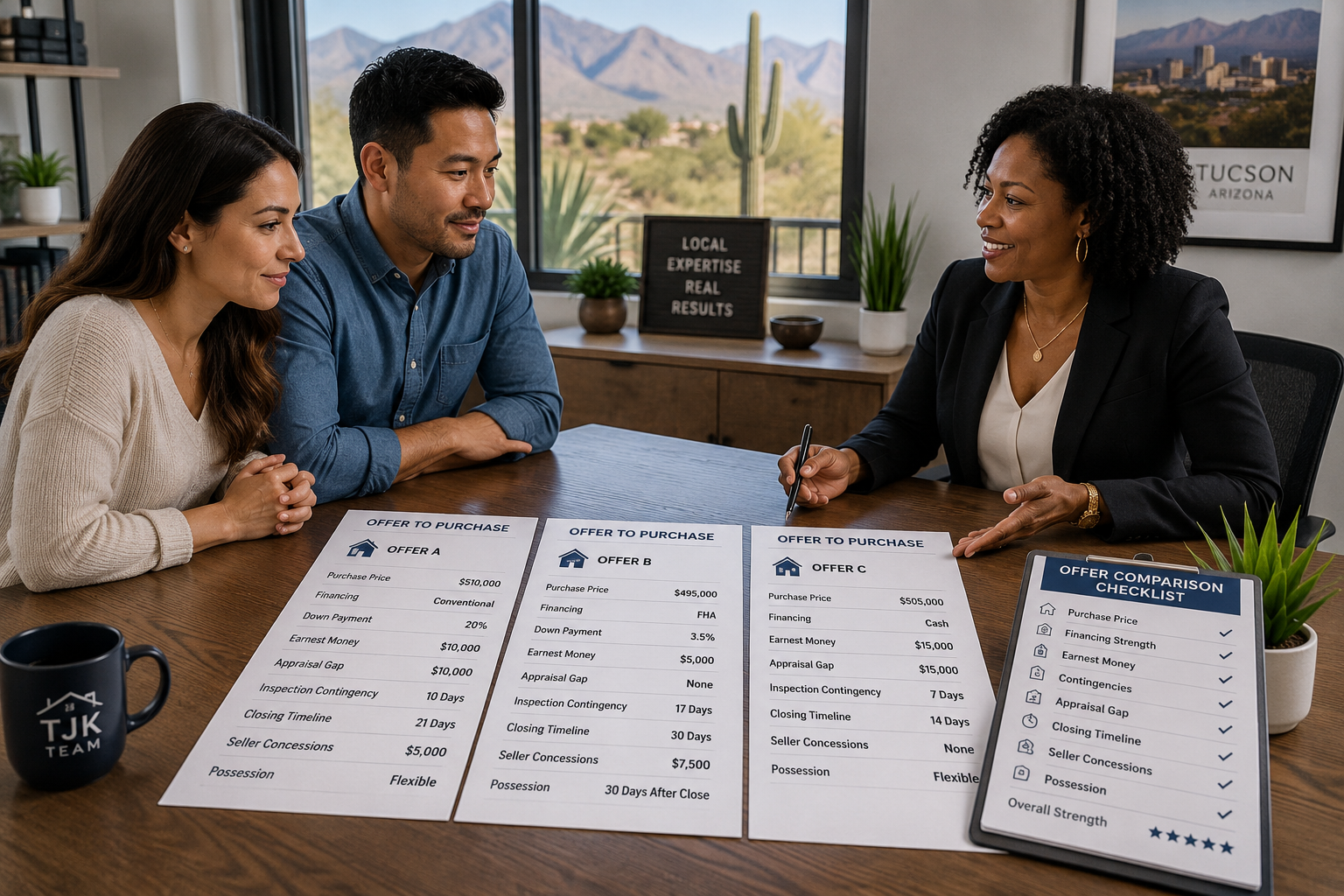
When multiple buyers want the same home, sellers are often faced with a surprising challenge: choosing the best offer. While a higher purchase price may grab attention, the strongest offer is not always the one with the biggest number. Financing terms, contingencies, closing timelines, and overall buyer strength can all play important roles in determining which offer is most likely to reach a successful closing.
For Tucson homeowners—especially first-time sellers and move-up sellers—understanding how to evaluate competing offers can help reduce stress and improve decision-making throughout the selling process.
Why Do Multiple Offers Happen?
Multiple offers typically occur when a home is priced appropriately, presented well, and attracts strong buyer demand. In Tucson, sellers may receive multiple offers when inventory is limited, a property is in a desirable location, or the home offers features buyers are actively seeking.
A multiple-offer situation develops when more than one buyer submits an offer on a property at roughly the same time. While this can be exciting, it can also create uncertainty for sellers who must determine which offer best aligns with their goals.
It's important to remember that receiving multiple offers does not automatically mean every offer is equally strong. Some buyers may offer a higher price but include contingencies that create additional risk. Others may offer slightly less but provide more certainty and flexibility.
According to the National Association of REALTORS® Code of Ethics, REALTORS® are required to present offers and counteroffers objectively and as quickly as possible and to continue presenting offers unless otherwise directed by the seller. This helps ensure sellers can evaluate all available opportunities before making a decision. (Source: NAR Code of Ethics, Standards of Practice 1-6 and 1-7).
The Highest Offer Isn't Always the Best Offer
While purchase price is important, sellers should evaluate the entire offer package. Financing strength, contingencies, appraisal protections, closing timelines, and buyer flexibility can all affect the likelihood of a successful transaction.
One of the most common misconceptions among sellers is that the highest offer automatically wins.
In reality, the goal is often to identify the offer that provides the best combination of price, certainty, and convenience.
Consider two hypothetical offers:
| Offer A |
Offer B |
|---|---|
| $500,000 |
$490,000 |
| FHA Financing |
Conventional Financing |
| 3% Down Payment |
20% Down Payment |
| Extensive Contingencies |
Limited Contingencies |
| 45-Day Close |
21-Day Close |
Although Offer A has a higher purchase price, Offer B may present fewer obstacles and a greater likelihood of reaching closing successfully.
Every seller's priorities are different. Some sellers prioritize maximizing proceeds. Others may place greater value on certainty, timing, or minimizing potential complications.
What Tucson Sellers Should Compare When Reviewing Multiple Offers
The strongest offer often balances purchase price with favorable terms. Sellers should review financing, earnest money, contingencies, appraisal provisions, closing timelines, and possession terms before making a decision.
A side-by-side comparison can help sellers evaluate competing offers more effectively.
| Offer Component |
Why It Matters |
|---|---|
| Purchase Price |
Determines potential proceeds |
| Financing Type |
Impacts likelihood of loan approval |
| Down Payment |
May indicate buyer financial strength |
| Earnest Money Deposit |
Demonstrates buyer commitment |
| Appraisal Terms |
May reduce risk if value concerns arise |
| Inspection Contingencies |
Can affect future negotiations |
| Closing Timeline |
Influences moving plans and scheduling |
| Possession Terms |
May provide additional flexibility |
| Seller Concessions Requested |
Can impact net proceeds |
| Backup Position Willingness |
Provides protection if another contract fails |
Reviewing these factors together often provides a clearer picture than focusing on price alone.
Understanding Financing Strength
Financing can significantly affect transaction risk. Cash offers generally eliminate lender-related issues, while financed offers may require additional review of loan type, down payment, and buyer qualifications.
Not all financing is the same.
When reviewing offers, sellers often consider:
- Cash offers
- Conventional financing
- VA financing
- FHA financing
The financing type itself should not be viewed as inherently good or bad. However, each loan program may have different underwriting requirements, appraisal standards, and timelines.
Some sellers may also review:
- Pre-approval documentation
- Down payment amounts
- Lender reputation
- Ability to close within the desired timeframe
The goal is not to predict whether a buyer will qualify but to understand the overall strength of the financing package.
Appraisal Gaps and Contingencies
Appraisal and inspection contingencies can affect the likelihood of closing and future negotiations. Sellers should understand how these provisions may impact the transaction before accepting an offer.
In competitive situations, buyers sometimes include appraisal gap language.
Generally speaking, an appraisal gap provision indicates that a buyer may be willing to contribute additional funds if the property appraises below the agreed purchase price.
Inspection contingencies are another important consideration.
Some buyers may request:
- Standard inspection periods
- Shortened inspection periods
- Limited repair requests
- As-is purchase language
Every transaction is unique, and sellers should carefully review how contingency language affects their level of risk and flexibility.
Should Sellers Counter Multiple Offers?
Sellers may have several options when multiple offers are received, including accepting an offer, rejecting offers, countering one offer, or requesting improved terms from multiple buyers. The best strategy depends on the seller's priorities and circumstances.
In a multiple-offer scenario, sellers commonly choose among several approaches:
Option 1: Accept the Best Offer
If one offer clearly stands out, a seller may choose to move forward immediately.
Option 2: Counter One Buyer
A seller may negotiate with a specific buyer to improve terms or address concerns.
Option 3: Request Highest and Best Offers
In some situations, buyers may be invited to submit their strongest terms by a specific deadline.
The appropriate strategy depends on the circumstances and should be evaluated carefully with professional guidance.
Why Backup Offers Can Be Valuable
Backup offers may provide protection if the primary contract is canceled. In some situations, maintaining a backup position can help reduce disruption and preserve marketing momentum.
Even after an offer is accepted, transactions can fail for a variety of reasons.
Examples include:
- Financing issues
- Inspection disputes
- Appraisal challenges
- Buyer circumstances changing unexpectedly
The MLS of Southern Arizona recognizes statuses that may allow continued showings and backup offers under certain circumstances, including Active Contingent status.
For some sellers, a qualified backup offer may provide additional peace of mind.
Common Mistakes Sellers Make During Multiple-Offer Situations
Many sellers focus exclusively on purchase price while overlooking factors that affect the probability of closing. Evaluating the full offer package can help avoid unnecessary risk and disappointment.
Some common mistakes include:
Choosing Based Only on Price
A higher offer may not always result in the best outcome.
Ignoring Timeline Considerations
Closing dates and possession terms can have a major impact on a seller's moving plans.
Overlooking Financing Details
Strong financing can sometimes be more valuable than a higher purchase price.
Failing to Compare Net Proceeds
Seller concessions and repair obligations can affect the actual financial outcome.
Making Emotional Decisions
Offers should generally be evaluated based on objective criteria rather than assumptions about individual buyers.
How a Tucson Listing Agent Can Help Organize Multiple Offers
A listing agent can help sellers compare offer terms, identify strengths and weaknesses, coordinate communications, and create a structured review process that supports informed decision-making.
When multiple offers arrive, organization becomes critical.
A listing agent can help sellers:
- Compare offers side-by-side
- Identify potential risks
- Evaluate financing strength
- Understand contingency language
- Review closing timelines
- Coordinate responses and negotiations
- Manage deadlines and documentation
The objective is not simply to select the highest offer but to identify the offer that best supports the seller's goals.
Final Thoughts
Handling multiple offers successfully requires looking beyond purchase price and evaluating the complete picture. Sellers who carefully compare terms, financing, contingencies, and timing are often better positioned to make informed decisions.
Receiving multiple offers is typically a positive sign that a property has attracted strong buyer interest.
However, choosing the right offer involves more than selecting the highest number on the page.
By understanding how financing, contingencies, timelines, and buyer strength work together, Tucson sellers can make more confident decisions and improve the likelihood of a smooth transaction.
Whether you're preparing to sell your first home or planning your next move, having a clear strategy for evaluating offers can make the process significantly less stressful.
If you're considering selling your home in Tucson and would like guidance on preparing for today's market, the TJK Team is happy to help you understand your options and what to expect throughout the process.
Frequently Asked Questions
Is the highest offer always the best offer?
Not necessarily. Financing terms, contingencies, appraisal provisions, and closing timelines may all affect the strength of an offer.
What is an appraisal gap?
An appraisal gap provision generally indicates that a buyer may contribute additional funds if a property appraises below the contract price.
Can a seller accept a backup offer?
Yes. Depending on the circumstances, sellers may choose to accept a backup offer that becomes effective if the primary contract is canceled.
What does "highest and best" mean?
It typically refers to a request for buyers to submit their strongest overall offer, including both price and terms.
How important is earnest money?
Earnest money can demonstrate buyer commitment and may be one factor sellers consider when comparing offers.
Should sellers prioritize cash offers?
Cash offers may reduce certain financing-related risks, but every offer should be evaluated based on the complete package of terms.
Source Section
National Association of REALTORS® Code of Ethics (2026 Edition)
MLS of Southern Arizona Rules & Regulations (November 2025 Edition)
Arizona Department of Real Estate Law Book (2025 Edition)

Tom Krieger
| The TJK Team - Realty Executives Arizona Territory
or another way