
Categories
Home ImprovementPublished February 13, 2026
Understanding the True Cost of Solar for Tucson Homes: Electricity Use, Insurance, and Leasing vs. Buying

Introduction: Why Solar Questions Matter More in Tucson
If you live in Tucson, you already know the sun is one of our most reliable natural resources. That’s why solar comes up so often in conversations about homeownership here—especially when people are comparing monthly costs or trying to manage high summer electric bills.
What often gets lost in those conversations is a simple but important distinction: Solar can reduce how much electricity you buy from the utility, but that doesn’t automatically mean it lowers your total monthly cost.
The difference comes down to how much electricity your home actually uses, how the system is paid for, how Tucson Electric Power (TEP) credits excess production, and how solar affects insurance and resale considerations.
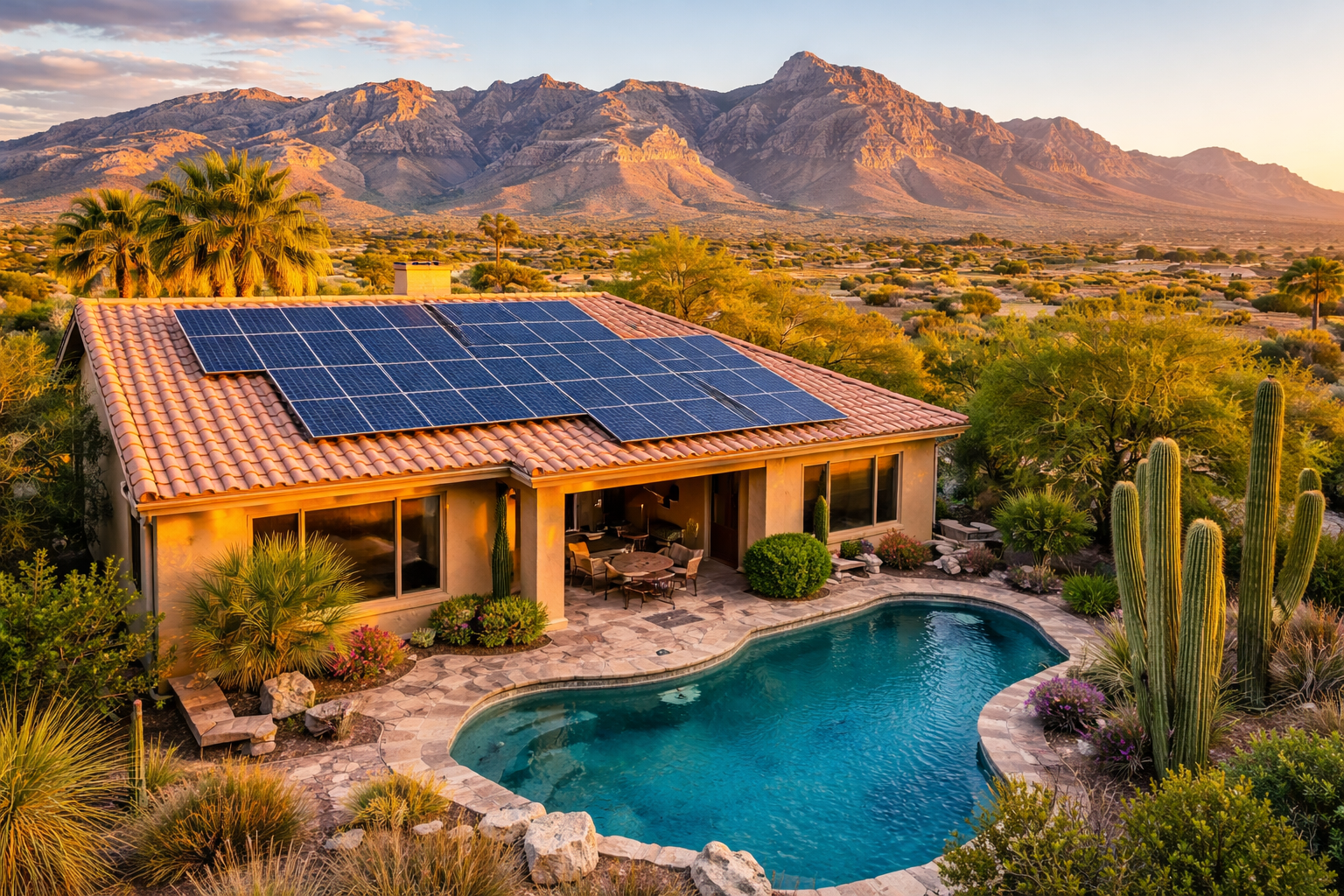
To keep this practical, this article looks at a realistic Tucson scenario: a 3,000-square-foot home with four occupants, an unheated pool, electric forced-air cooling and heating, an electric range, and standard insulation that meets local building codes. From there, we’ll walk through costs, billing, insurance, and the long-term trade-offs between owning and leasing solar.
What a Home Like This Typically Uses for Electricity
Electricity use in Arizona is higher than the national average, largely because cooling plays such a big role in daily life.
For a larger Tucson home—3,000 square feet, four people, electric systems, and a pool—it’s reasonable to think in planning ranges, not exact numbers:
- Estimated annual usage: roughly 22,000–30,000 kWh per year
- Average monthly usage: about 1,800–2,500 kWh
- Peak summer months: often higher, depending on thermostat settings, equipment efficiency, and occupancy
These figures are not guarantees. They’re a way to understand scale. The only way to know a home’s true usage is by reviewing actual utility bills over time.
The Role of an Unheated Pool
Even without heating, a pool uses electricity through its pump and filtration system. Pool pumps can be one of the larger electricity users in a home, especially if the pump is older or runs long cycles. Variable-speed pumps can reduce that load, but run time still matters.
For planning purposes, many Tucson homeowners find that pool operation meaningfully contributes to summer electricity use, even when the pool is not heated.
What Size Solar System This Home Typically Needs
Tucson Electric Power estimates that 1 kilowatt (kW) of solar capacity produces about 1,700 kWh per year in the Tucson area.
Using that estimate:
- A home using 22,000 kWh per year might need about a 13 kW system for a near-full offset
- A home using 30,000 kWh per year might need closer to an 18 kW system
In practice, many systems are designed to offset 70–95 percent of usage rather than 100 percent. Roof orientation, shading, available space, and how electricity is used throughout the day all factor into final system size.
What Solar Installation Costs Look Like in Tucson
Solar pricing varies by installer, equipment choice, roof complexity, and electrical upgrades.
For a home like the one in this example, typical market pricing often falls into these broad ranges:
- Mid-to-high $20,000s for smaller systems
- Low $30,000s to $40,000+ for larger systems
These figures represent market ranges, not quotes, and should be used for planning purposes only.
Incentives: What Homeowners Need to Verify
Arizona offers a state income tax credit equal to 25 percent of the system cost, capped at $1,000 per residence.
At the federal level, the IRS states that the Residential Clean Energy Credit applies to qualifying systems placed in service from 2022 through December 31, 2025, and is not available for property placed in service after December 31, 2025.
Because timing and tax treatment can be complex, homeowners should verify incentive eligibility directly with a tax professional before making assumptions.
Comparing Solar Costs to a TEP Electric Bill
TEP solar customers are billed under time-of-use rate structures, and excess solar production is credited using the Resource Comparison Proxy (RCP) export rate.
This structure means solar works best when electricity is used in the home as it’s produced. Exporting large amounts midday and buying power back during evening peak hours can reduce overall savings.
For a home of this size, planning-range monthly electric bills without solar often fall roughly:
- $200–$350 in milder months
- $450–$800 or more during peak summer months
These ranges depend heavily on behavior and rate plans, and they’re best used as context rather than predictions.
Is It a Fact That Solar Lowers Your Bill?
A clear way to think about it:
Solar often reduces how much electricity you purchase from the utility. Whether it reduces your total monthly out-of-pocket cost depends on system price, payment method, export credits, and usage habits.
A Quiet Cost Driver: Solar Panel Materials
Most modern solar panels use silver for electrical conductivity because it is highly efficient. At the same time, researchers are exploring copper-based alternatives to reduce reliance on silver, though those approaches involve trade-offs.
For homeowners, the takeaway is simple: solar pricing reflects global supply chains and materials as well as local labor. That’s one reason prices change over time.
How Solar Panels Affect Homeowner’s Insurance
Solar panels are typically considered part of the home when permanently attached.
In most cases:
- Solar does not lower insurance premiums
- Premiums may increase if dwelling coverage limits are adjusted to reflect higher replacement cost
Homeowners should contact their insurer before installation to confirm documentation and coverage requirements.
Paying Cash vs. Leasing Over 20 Years
Owning solar often provides the most long-term flexibility, especially when selling, because there is no third-party contract to transfer.
Leasing solar can reduce upfront costs but introduces contract terms, escalators, and resale considerations. Buyers may need to assume the lease or negotiate a buyout.
Neither option is universally better. The right choice depends on how long you plan to stay in the home and how comfortable you are with long-term agreements.
Solar and Resale in the Tucson Market
Locally, buyers tend to respond best when solar systems are owned, paid off, clearly documented, and easy to explain.
Leased systems are not automatically a problem, but they do add another layer to the transaction.
Final Thoughts
Solar can be a helpful tool for managing electricity costs in Tucson, but it is not a one-size-fits-all solution.
The most useful question isn’t whether solar works, but whether it fits your home, your usage patterns, and your long-term plans.
If you would like help thinking through how solar fits into a buying, selling, or ownership plan, I’m happy to talk it through.

Tom Krieger
| The TJK Team - Realty Executives Arizona Territory
or another way