
Categories
Real Estate NewsPublished July 1, 2026
The Truth About Data Centers in Southern Arizona

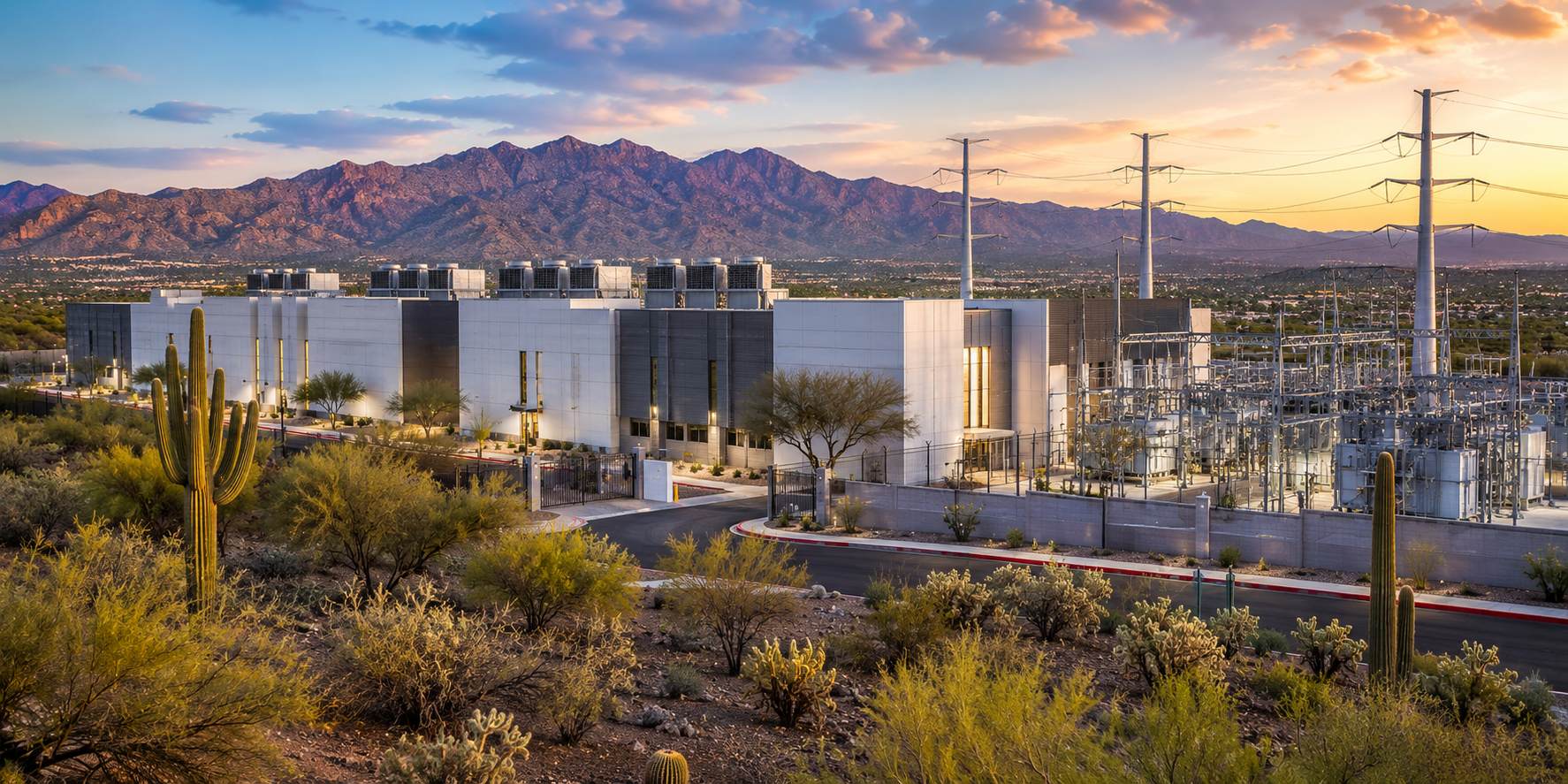
Data Current as of June 2026
If you've been following local news lately, you've probably noticed more conversations about data centers coming to Arizona.
Some people see them as a major economic opportunity. Others worry they'll drive up home prices, strain the electric grid, or put additional pressure on Arizona's already limited water resources.
As someone who follows both the Tucson real estate market and the growth happening across Southern Arizona, I think it's important to separate the facts from the headlines.
The truth is, data centers aren't automatically an economic boom—or a resource disaster.
Like many large development projects, their impact depends on the size of the project, the surrounding infrastructure, and how they're designed.
If you're a homeowner, buyer, or simply curious about how these projects could affect Southern Arizona, here's what you should know.
What Is a Data Center?
Most of us use data centers every single day without realizing it.
They're the facilities that power cloud storage, online banking, streaming services, healthcare systems, artificial intelligence, email, social media, and countless other digital services.
Inside these buildings are thousands of computer servers working around the clock to process and store information.
Although they're massive facilities, modern data centers are highly automated. They're very different from traditional office campuses or manufacturing plants, which means they have a unique economic impact on the communities where they're built.
Will Data Centers Raise Home Prices?
This is probably the question I hear most often.
The honest answer is:
Maybe—but usually not for the reasons many people assume.
Many people picture a new data center bringing thousands of permanent workers into an area.
In reality, that's usually not how these projects work.
During construction, a large data center may employ hundreds—or even thousands—of contractors, engineers, electricians, and skilled tradespeople.
Once construction is complete, however, permanent staffing is often much smaller.
Most facilities employ dozens to a few hundred full-time workers depending on their size and operational needs.
That means data centers generally don't influence housing demand in the same way as:
- Major manufacturing facilities
- Military base expansions
- Universities
- Large corporate headquarters
Instead, any effect on the housing market is usually indirect.
Local housing demand depends on factors such as:
- Regional population growth
- Existing housing inventory
- Additional businesses attracted to the area
- Broader economic development
For Southern Arizona, it's important to view data centers as one piece of a much larger economic picture rather than assuming they'll dramatically change home values on their own.
Do Data Centers Actually Create Jobs?
Yes—but the story is a little more complicated than many headlines suggest.
Construction is where much of the employment happens.
Building one of these facilities often requires:
- Electricians
- Concrete crews
- Engineers
- Utility contractors
- Heavy equipment operators
- Project managers
- Construction trades
Those jobs can last months or even years depending on the size of the project.
Once the facility opens, the workforce becomes much smaller.
Permanent positions often include:
- Data center technicians
- Network engineers
- Facilities managers
- Electrical and mechanical specialists
- Security personnel
- Operations staff
These are often highly skilled technical careers, but they typically number in the dozens or low hundreds—not thousands—at a single location.
The broader economic impact often comes from the contractors, suppliers, maintenance companies, and other businesses that support these facilities over time.
The Biggest Infrastructure Question: Electricity
If there's one concern that's generally supported by the research, it's electricity demand.
Data centers require enormous amounts of power.
According to the U.S. Department of Energy and Lawrence Berkeley National Laboratory, electricity consumption from U.S. data centers has grown dramatically over the past decade and is expected to continue increasing as artificial intelligence and cloud computing expand.
In 2023 alone, U.S. data centers consumed approximately 176 terawatt-hours of electricity, with demand projected to increase substantially over the next several years.
That doesn't automatically mean local residents will experience power shortages or reliability issues.
Before a project moves forward, utilities evaluate factors such as:
- Available generation capacity
- Existing substations
- Transmission infrastructure
- Future demand forecasts
- Planned utility improvements
Whether a specific project affects local electrical capacity depends largely on existing infrastructure and long-term planning.
What About Water?
Here in Southern Arizona, this is often the first question people ask.
And it's a fair one.
The reality is that not every data center uses water the same way.
Some facilities rely primarily on air cooling.
Others use:
- Hybrid cooling systems
- Liquid cooling
- Evaporative cooling
Each technology has different water requirements.
In some cases, water use also occurs indirectly through the electricity generation that powers the facility rather than inside the building itself.
That's why broad national averages don't always tell the full story.
When evaluating a proposed project, it's much more helpful to understand the specific cooling technology and water management plan than to rely on assumptions.
Infrastructure Often Matters More Than Housing
One thing that sometimes gets overlooked is that housing isn't always the biggest local impact.
Infrastructure often plays a much larger role.
Large data center developments may require:
- New electrical substations
- Utility upgrades
- Expanded fiber-optic networks
- Road improvements
- Water infrastructure enhancements
These investments can create opportunities while also raising legitimate questions about long-term planning.
Supporters often point to:
- New private investment
- Expanded tax revenue
- Infrastructure improvements
- Technology-sector growth
Others raise concerns about:
- Electricity demand
- Water use
- Land development
- Long-term sustainability
Both perspectives can have merit depending on the specific project.
What Southern Arizona Homeowners Should Be Asking
Rather than asking whether data centers are "good" or "bad," I think homeowners are better served by asking more specific questions.
For example:
- How many permanent jobs will this facility create?
- What cooling technology will it use?
- How much water is expected to be consumed?
- What utility upgrades are required?
- Who pays for those infrastructure improvements?
- What additional tax revenue will the project generate?
- How does it fit into Southern Arizona's long-term growth plans?
Those answers usually provide far more useful information than broad claims found on social media or in headlines.
Myth vs. Fact
| Myth | Fact |
|---|---|
| Data centers create thousands of permanent jobs. | Construction employment can be significant, but permanent staffing is often much smaller. |
| Every new data center dramatically increases home prices. | Housing impacts vary and are usually indirect. |
| All data centers use the same amount of water. | Water use depends on cooling technology and facility design. |
| Data centers don't affect electricity demand. | They are among the fastest-growing sources of electricity demand in the country. |
| Every data center is either good or bad for a community. | Actual impacts depend on project design, infrastructure, and local planning. |
Final Thoughts
One thing I've learned over the years is that very few development projects are as simple as the headlines make them seem.
Data centers bring real opportunities, including investment, infrastructure improvements, construction activity, and skilled technical jobs.
They also raise legitimate questions about electricity, water resources, and long-term community planning.
As homeowners, buyers, and community members, the best approach isn't to assume every project is automatically beneficial—or automatically harmful.
It's to understand the facts, ask informed questions, and evaluate each proposal based on its own merits.
Southern Arizona continues to grow and evolve, and understanding how projects like these fit into our region's future helps all of us make more informed decisions about where we live, work, and invest.
If you're curious about how major developments could influence Southern Arizona's housing market—or if you're considering buying or selling a home in the Tucson area—our team is always happy to provide local market insight and help you understand what's happening beyond the headlines.
Contact us at 520.222.9611 to start the conversation.
Frequently Asked Questions
Do data centers create jobs?
Yes. Construction employment can be substantial, while permanent operational staffing is generally smaller and focused on skilled technical positions.
Will a new data center increase home prices?
It may contribute to local housing demand, but its impact depends on the size of the project, regional growth, available housing inventory, and other economic factors.
Do data centers use a lot of electricity?
Yes. Data centers are among the fastest-growing sources of electricity demand in the United States, making power infrastructure an important consideration for new projects.
Do all data centers use large amounts of water?
No. Water use varies significantly based on cooling technology, facility design, and operational requirements.
Should Southern Arizona homeowners be concerned?
Rather than relying on assumptions, homeowners should review project-specific information and understand how each development fits into local infrastructure, water planning, and long-term regional growth.

Tom Krieger
| The TJK Team - Realty Executives Arizona Territory
or another way