
Categories
Real Estate NewsPublished January 28, 2026
Will Automation Lower the Cost of Building Homes? A Practical Look

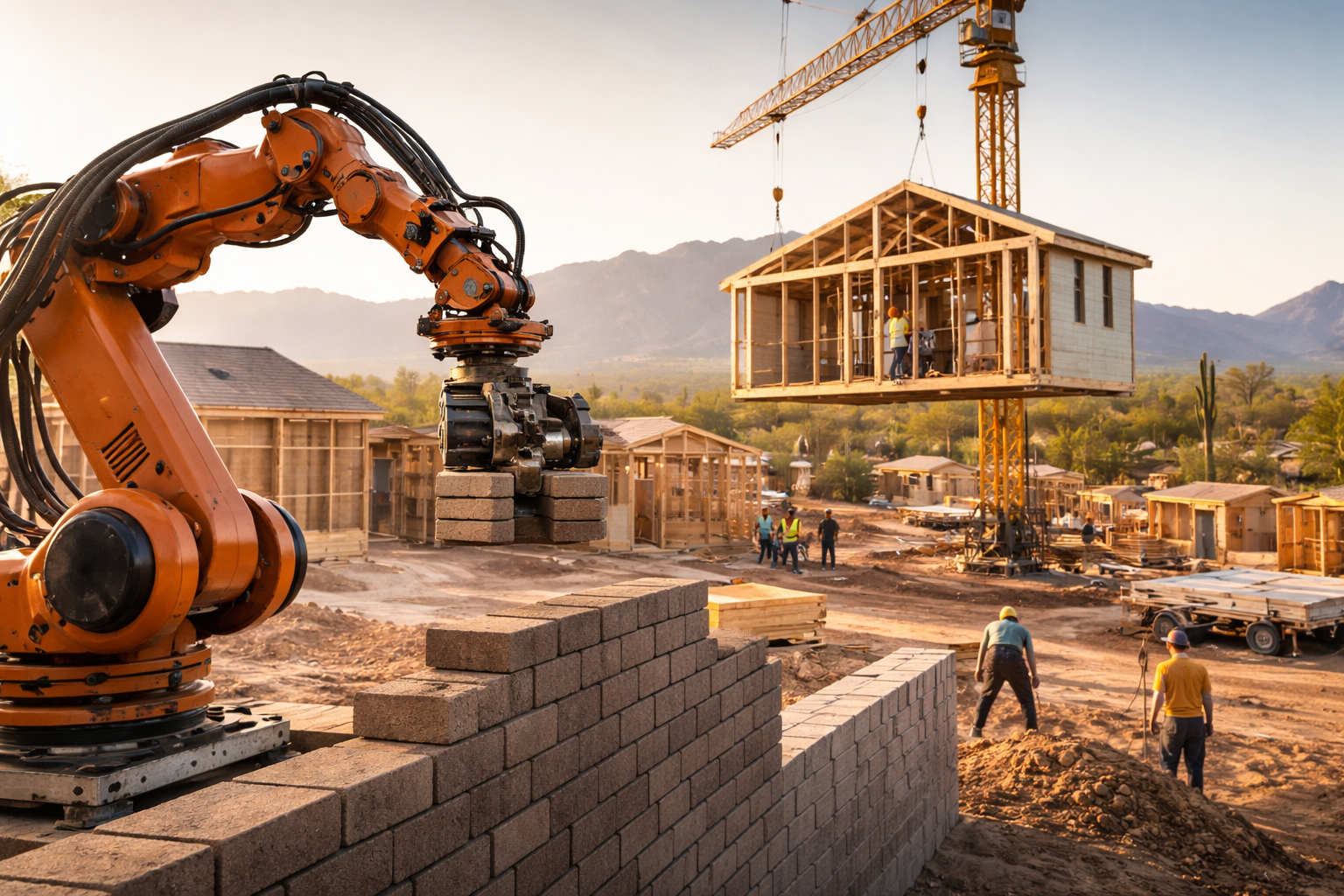
Stories about robots building homes tend to capture attention quickly. Images of automated construction sites and advanced machinery suggest a future where homes are built faster, cheaper, and with far less human labor.
It’s an appealing idea — especially at a time when housing affordability is a growing concern across the country.
But construction is not an industry that changes quickly, and housing costs are influenced by far more than how fast a wall can be framed or a brick can be laid. To understand what automation can realistically do for housing costs, it helps to separate promise from practicality.
Automation is already affecting parts of home construction. But whether it can significantly lower the cost of building homes — and what that would actually mean for buyers — is a more nuanced question.
Why Construction Is Harder to Automate Than It Looks
Automation has transformed manufacturing over the past several decades. Cars, electronics, and appliances are produced in controlled environments where conditions are predictable and repeatable.
Home construction is different.
Every building site is unique. Soil conditions vary. Weather changes daily. Building codes differ by city and state. Materials arrive on different schedules. Skilled trades must coordinate work that often depends on what happened the day before.
These variables make construction far more difficult to automate than factory-based industries. Productivity data from the U.S. Bureau of Labor Statistics consistently shows that construction has lagged manufacturing in long-term productivity gains (U.S. Bureau of Labor Statistics, Construction Productivity).
This doesn’t mean automation has no role — but it does explain why progress has been incremental rather than transformative.
Where Automation Is Already Being Used
Despite these challenges, automation is already part of modern homebuilding in several important ways.
Prefabrication is one of the most established examples. Wall panels, roof trusses, and floor systems are often built off-site in controlled environments, then delivered to the job site for assembly. This improves efficiency, reduces waste, and shortens build times. Research from McKinsey & Company shows that modular and prefabricated construction can improve efficiency and reduce waste, but adoption remains limited by design complexity and local regulations (McKinsey Global Institute, Modular Construction).
Software automation has also made a significant impact. Project management tools, scheduling systems, and digital design platforms help builders coordinate labor, materials, and inspections more efficiently than in the past.
Robotics, in the physical sense, exist as well — but in limited roles. Automated layout tools, bricklaying systems, and robotic assistance for repetitive tasks are being tested and used selectively. These tools tend to supplement human labor rather than replace it entirely. Research from the National Institute of Standards and Technology highlights that most construction robotics remain task-specific and supplemental (NIST, Construction Automation Research).
What Automation Can Realistically Improve
Where automation tends to shine in construction is not in eliminating workers, but in improving consistency and efficiency.
Automation can help reduce errors, limit material waste, and improve safety on job sites. Tasks that are physically demanding or repetitive can be assisted by machines, allowing skilled workers to focus on more complex work.
Over time, these improvements can help builders manage schedules more predictably and reduce certain categories of cost overruns. Automation can also make construction careers more sustainable by reducing physical strain.
What automation generally does not do is remove the need for skilled trades. Homes still require electricians, plumbers, framers, inspectors, and supervisors — people whose judgment and adaptability remain essential.
The Cost Drivers Automation Does Not Solve
One of the most important realities to understand is that labor is only one component of housing costs.
According to the National Association of Home Builders, construction labor represents only a portion of the total cost of building a home, with land, materials, regulation, and financing accounting for a significant share (NAHB, Cost of Constructing a Home).
Automation does little to address:
- The cost of land
- Zoning and permitting requirements
- Building codes and inspections
- Financing and carrying costs
- Infrastructure and utility connections
Materials also represent a major share of construction costs. Lumber, concrete, copper, and other inputs are influenced by global supply chains and demand pressures that automation does not control, as reflected in Producer Price Index data from the Bureau of Labor Statistics (BLS Producer Price Index).
Even if labor becomes more efficient, these other cost drivers often continue to rise. That limits how much automation alone can change the final price of a new home.
Why Faster or Cheaper Builds Don’t Automatically Mean Lower Prices
It’s tempting to assume that if builders can construct homes more efficiently, prices will naturally fall.
In practice, housing prices are influenced by demand as much as cost. Federal Reserve research on housing supply constraints shows that limited inventory and strong demand often absorb cost savings rather than passing them directly to buyers (Federal Reserve Housing Supply Research).
There’s also the concept of replacement cost. New homes often establish pricing benchmarks for surrounding resale homes. If automation reduces some construction costs, it may help stabilize prices over time, but it rarely leads to immediate or dramatic reductions.
Labor Shortages and the Real Pressure Point
One reason automation is gaining attention in construction is demographic reality.
The construction workforce is aging, and fewer younger workers are entering the trades. Bureau of Labor Statistics employment data shows persistent labor shortages in skilled construction roles across many regions (BLS Construction Employment).
Automation is often viewed as a way to supplement a shrinking labor pool rather than replace it. In this context, technology helps builders do more with fewer workers, but it does not eliminate the need for skilled labor.
Understanding this distinction matters. Automation is responding to labor shortages — not creating them.
Tucson and Southern Arizona Context
In Southern Arizona, construction is shaped by local factors that don’t always align with national narratives.
Climate influences building methods and schedules. Labor availability varies by region. Permitting processes and lot availability play a major role in how quickly new homes can be delivered. Regional data from the Arizona Office of Economic Opportunity shows that population growth, land availability, and workforce trends continue to influence housing supply more than construction technology alone (Arizona Office of Economic Opportunity).
Because of this, even meaningful efficiency gains from automation are likely to influence housing costs gradually rather than dramatically at the local level.
A More Practical Way to Think About Automation
A useful way to think about automation in homebuilding is as an efficiency tool, not a solution.
Automation can help builders manage complexity, improve safety, and reduce certain costs at the margins. Over long periods, these improvements may contribute to more stable housing supply.
What automation does not do is override the fundamental drivers of housing prices. Waiting for technology to “fix” affordability often leads to unrealistic expectations.
Housing decisions tend to work best when they’re based on personal timelines, lifestyle needs, and local conditions — not on anticipated technological breakthroughs.
Conclusion
Automation is already part of how homes are built, and its role will likely continue to expand.
But the idea that robots will suddenly make homes inexpensive oversimplifies a complex system. Construction costs are shaped by land, materials, regulation, labor, and demand — many of which automation does not meaningfully change.
Understanding where automation helps, and where its limits remain, can bring clarity to conversations about housing costs and the future of homebuilding.
Questions Homeowners Often Ask
Will robots replace construction workers?
It’s unlikely. Most automation in construction today is designed to assist workers, not replace them. Research consistently shows that construction robotics are task-specific and require human oversight (NIST, Construction Automation Research).
Will automation make new homes cheaper?
Automation may help control certain costs related to efficiency and waste. But because labor is only one component of total housing costs, automation alone is unlikely to make homes dramatically cheaper.
How long before automation meaningfully changes housing costs?
Construction technology adoption tends to be gradual. New tools are implemented over years, and their effects are often incremental rather than transformative.
Does automation affect Tucson differently than other markets?
Local factors matter. Climate, labor availability, permitting, and lot supply all influence how new homes are built in Southern Arizona, often outweighing national automation trends.
Should buyers wait for cheaper new construction?
Waiting on future technology to lower prices can be risky. Housing markets are influenced by many factors beyond construction methods, and personal timing and local conditions usually matter more.
If you’d like to talk through how automation and construction trends relate to your own plans or timeline, I’m always happy to have that conversation.

Tom Krieger
| The TJK Team - Realty Executives Arizona Territory
or another way