
Categories
Local GuidesPublished September 29, 2026
A Guide to Casas Adobes: History, Housing, Shopping, and Recreation

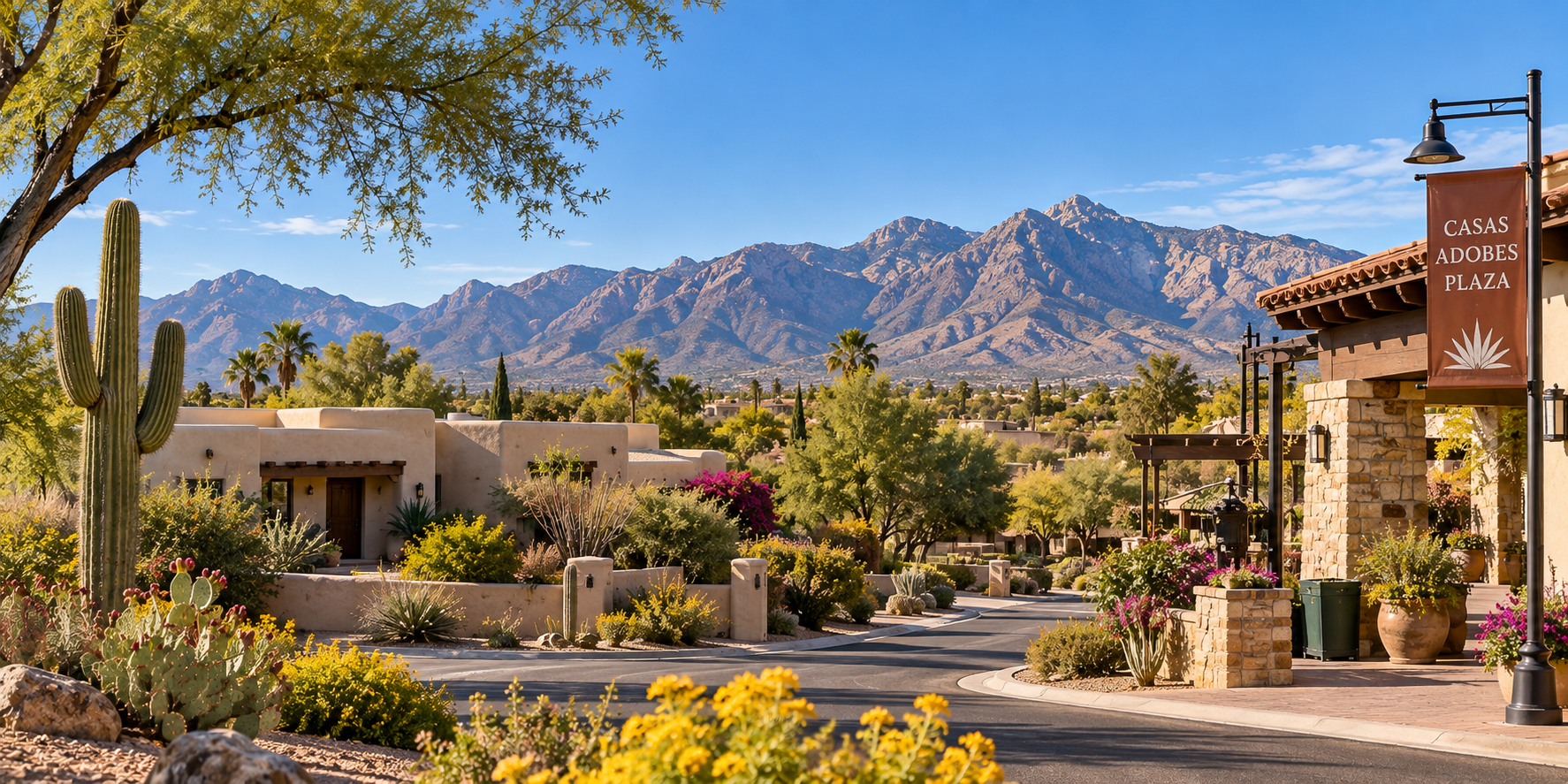
Casas Adobes is one of those Tucson-area names that people use all the time, but it can mean slightly different things depending on whether you're talking about a mailing address, a census boundary, a shopping destination, or the broader north-central part of the Tucson metro.
That can make it confusing if you're new to the area.
Casas Adobes is not an incorporated city.
It is a census-designated place in Pima County, and much of the area people casually call Casas Adobes is part of unincorporated Pima County rather than the City of Tucson.
At the same time, it has a very recognizable identity.
You'll find older and newer subdivisions, custom homes, desert lots, major commercial corridors, established shopping areas, county recreation facilities, and access to some of the north side's best-known cultural and outdoor destinations.
So rather than trying to define Casas Adobes with one sentence, I think it's more useful to look at the pieces that make it what it is.
What Is Casas Adobes?
Casas Adobes is a U.S. Census-designated place in Pima County, north of central Tucson. It is not an incorporated municipality, even though many properties use Tucson mailing addresses. Its identity comes from a combination of residential development, commercial corridors, established shopping areas, desert landscaping, and nearby recreational and cultural resources.
The U.S. Census Bureau identifies Casas Adobes as a census-designated place, or CDP, in Arizona.
A census-designated place is useful for statistical and geographic purposes, but it isn't the same thing as an incorporated city or town.
That distinction matters.
A property can be in the Casas Adobes area and still rely on Pima County for certain governmental functions because the area is largely unincorporated.
That's similar to what we discussed in the broader Tucson-versus-Pima-County conversation:
The mailing address does not always tell you the local government jurisdiction.
So when someone says they live in Casas Adobes, they're usually describing a recognized geographic and community area rather than a separate municipality with its own city government.
Where Is Casas Adobes Located?
Casas Adobes occupies a north-central portion of the Tucson metropolitan area in Pima County, generally north of central Tucson and west of the Santa Catalina foothills. The Census-designated boundary is specific, while everyday use of the name may extend beyond that exact line. Property-specific jurisdiction should always be verified by parcel rather than neighborhood label.
Casas Adobes sits in a part of metropolitan Tucson where the urban landscape starts transitioning toward larger lots, lower-density residential areas, commercial corridors, and desert open space.
Major roads that help define the general area include:
- Oracle Road
- Ina Road
- Orange Grove Road
- La Cholla Boulevard
- River Road
- Magee Road
But this is one of those situations where I would be careful drawing a neighborhood boundary from memory.
The official Census CDP boundary is one thing.
The way local residents use the phrase Casas Adobes is another.
For real estate purposes, that means the safest approach is to verify the specific parcel rather than assuming that a familiar neighborhood name determines jurisdiction, zoning, or services.
How Did Casas Adobes Develop?
Casas Adobes developed as part of Tucson’s broader northward suburban expansion rather than as a traditional incorporated town center. Residential subdivisions, custom homes, commercial corridors, and destination properties grew over time across former desert and lower-density land. Its current form reflects multiple development eras rather than one master-planned period.
Casas Adobes doesn't have a downtown in the traditional sense.
Its history is more tied to the way Tucson expanded north during the 20th century.
As the metropolitan area grew, residential development moved into areas that had previously been more rural, agricultural, or desert in character.
That created a mix you still see today:
Older ranch-style homes.
Custom desert homes.
Mid-century subdivisions.
Later suburban development.
Larger parcels.
Commercial corridors.
And pockets of undeveloped or landscaped desert.
That layered development pattern is one reason Casas Adobes doesn't look uniform.
You can move a short distance and find a very different housing style, lot size, street pattern, or commercial setting.
Why Is the Name “Casas Adobes” So Recognizable?
The Casas Adobes name became closely associated with this part of north Tucson through residential development, local commercial landmarks, and long-standing community usage. Today, it appears in the Census-designated place name, Casas Adobes Plaza, Casas Adobes Park, local businesses, and other geographic references throughout the area.
The name itself has become part of Tucson's north-side identity.
You'll see it attached to:
- The Census-designated place
- Casas Adobes Plaza
- Casas Adobes Park
- Businesses and professional offices
- Real estate descriptions
- Local services and community references
That can make the area feel more like an incorporated town than it technically is.
But from a government standpoint, it is still important to distinguish the community identity from the legal jurisdiction.
That distinction becomes especially relevant when someone is researching zoning, permits, utilities, taxes, or other property-specific questions.
What Kind of Housing Is Found in Casas Adobes?
Housing in Casas Adobes spans multiple development periods and includes ranch-style homes, Southwestern and adobe-influenced architecture, custom homes, subdivision housing, townhomes, and properties on larger desert lots. Housing characteristics vary significantly from one section to another, so buyers should evaluate the specific property rather than assuming the entire area follows one pattern.
This is probably the part of Casas Adobes I find most interesting from a real estate perspective.
There isn't one Casas Adobes house.
You might find a low-slung ranch home from an earlier suburban development era.
A few streets away, there may be a custom Southwestern house on a much larger lot.
Another area may contain townhomes or later subdivision development.
And architecture can vary too.
Depending on the property, you may encounter:
- Ranch-style homes
- Territorial influences
- Pueblo Revival influences
- Adobe or adobe-inspired construction
- Mid-century designs
- Contemporary Southwestern homes
- Later conventional suburban construction
That variation reflects the area's long development timeline.
It also means the age of a home can tell you quite a bit about what to investigate.
Roof systems.
Electrical updates.
HVAC.
Additions.
Pools.
Septic versus sewer connections in some locations.
Renovations.
And permit history.
Two homes in the same broad Casas Adobes area may have very different maintenance histories and infrastructure.
Are All Casas Adobes Homes in the Same Jurisdiction?
No. “Casas Adobes” is a geographic and community label, not a substitute for parcel-level jurisdiction research. Many properties are in unincorporated Pima County, but nearby areas can involve different municipal or service boundaries. Zoning, permitting, utilities, fire service, roads, and taxing districts should be verified for the individual property.
This is one of those real estate details that matters more than people expect.
If a property is described as Casas Adobes, that doesn't automatically answer:
Who handles zoning?
Who issues permits?
Who maintains the road?
Who provides water?
Who provides fire protection?
Which taxing districts apply?
Those answers depend on the actual parcel and service area.
So for a buyer, I would treat Casas Adobes as the geographic starting point.
Then I would verify the property-specific details through official Pima County and applicable service-provider records.
What Is Casas Adobes Plaza?
Casas Adobes Plaza is an established shopping and dining destination in the Casas Adobes area. Its low-scale Southwestern architecture and courtyard-style setting distinguish it from a conventional enclosed mall. Because individual tenants can change, visitors should check the plaza’s current official directory before planning around a specific store or restaurant.
Casas Adobes Plaza is probably the most recognizable commercial landmark associated with the name.
The plaza's appeal is partly architectural.
Rather than feeling like a large indoor shopping center, it has a more open-air Southwestern layout.
You'll find walkways, landscaped areas, low-rise buildings, and a mix of shops and restaurants.
I would be careful publishing a long list of individual tenants because those can change.
But from a local-guide perspective, the important thing is that Casas Adobes Plaza functions as an established commercial center within the area and helps give Casas Adobes a recognizable sense of place.
For the most current tenant information, I would always use the plaza's official directory before visiting.
Where Else Do People Shop in the Casas Adobes Area?
Shopping in Casas Adobes extends beyond a single plaza. Commercial development is concentrated along major corridors such as Oracle Road and Ina Road, where residents can find grocery stores, restaurants, services, retail centers, and everyday businesses. The specific mix changes over time, so current business directories are more reliable than static neighborhood lists.
This is another reason Casas Adobes feels different from a small town built around one downtown.
Shopping is spread across several major roads.
Oracle and Ina are two of the most important commercial corridors.
You'll find retail centers, restaurants, grocery options, professional services, and other everyday businesses distributed through the area.
That pattern is typical of Tucson's later suburban development.
Instead of one traditional commercial center, you get multiple nodes tied together by major arterials.
For a newcomer, that means the shopping environment can feel very convenient geographically—but it is also more automobile-oriented than a compact downtown setting.
What Is Tohono Chul?
Tohono Chul is a 49-acre botanical garden, arboretum, and nature preserve in the Casas Adobes area. Founded in 1985, it focuses on Sonoran Desert plants, conservation, art, culture, education, and public programming. Visitors can explore garden paths, galleries, events, shops, and desert-focused learning spaces throughout the property.
Tohono Chul is one of the area's most distinctive destinations.
Its official site describes it as a 49-acre botanical garden, arboretum, and nature preserve dedicated to the Sonoran Desert.
The organization was founded in 1985 by Richard and Jean Wilson, who chose to preserve the property rather than allow it to be lost to surrounding development.
That history is especially interesting in the context of Casas Adobes.
The surrounding area continued to urbanize.
Tohono Chul remained a preserved desert landscape within that growth.
Today, visitors can explore gardens, trails, art galleries, exhibits, educational programs, events, shops, and dining.
The garden itself includes multiple themed areas, including Sonoran Desert plant collections, desert-adapted landscaping, demonstration gardens, and spaces designed around water conservation and regional ecology.
What Recreation Is Available at Casas Adobes Park?
Casas Adobes Park is a Pima County neighborhood park with a lighted basketball court, playground, ramadas, restrooms, swings, and water fountains. It is open from sunrise to 10 p.m. and provides a straightforward local recreation option rather than a large regional trail system or natural-resource park.
Pima County's Casas Adobes Park is located at 6262 N. Oracle Jaynes Station Road.
The park includes:
- A lighted basketball court
- Playground equipment
- Ramadas
- Restrooms
- Swings
- Water fountains
Pima County currently lists its operating hours as sunrise to 10 p.m.
This isn't a major wilderness destination.
It's a community park.
And I think that's useful to point out because recreation around Casas Adobes comes in several different scales.
You have small neighborhood parks.
Botanical and cultural destinations.
Regional paved pathways.
And nearby trail systems.
What Larger Outdoor Recreation Is Nearby?
Casas Adobes is positioned near several Pima County outdoor-recreation systems, including regional trails, trailheads, natural-space parks, and the Chuck Huckelberry Loop. Access varies by location, and some destinations are outside the formal Casas Adobes CDP, so visitors should verify trailhead rules, parking, hours, and current conditions before going.
Pima County has an extensive recreation network beyond neighborhood parks.
The County's recreation system includes the Chuck Huckelberry Loop, approximately 137 miles of paved pathways and bike lanes connecting communities across the Tucson region.
Pima County also manages numerous trailheads and natural-surface trail systems.
Depending on where someone lives within the broader Casas Adobes area, nearby outdoor options may include connections toward:
- The Loop
- Pima Canyon
- Maeveen Behan Desert Sanctuary
- Arthur Pack-area trails
- Other Pima County trailheads and open-space areas
The important distinction is that nearby doesn't necessarily mean inside Casas Adobes.
For local guides, I think it's better to be precise about that rather than folding every north-side attraction into one neighborhood.
What Is Maeveen Behan Desert Sanctuary?
Maeveen Behan Desert Sanctuary is a Pima County trails park within the Arthur Pack Regional Park area. It provides a network of natural-surface trails used by hikers, mountain bikers, equestrians, and trail runners. It represents a larger open-space recreation option near Casas Adobes compared with a traditional neighborhood park.
Pima County identifies the Maeveen Behan Desert Sanctuary as a trails park within Arthur Pack Regional Park.
That makes it a very different recreational experience from Casas Adobes Park.
Instead of basketball courts and playground equipment, the focus is on natural-surface trails and desert open space.
The County says the trail network accommodates:
- Hiking
- Mountain biking
- Equestrian use
- Trail running
For people exploring the north side, it's another example of how quickly Tucson's built environment transitions into desert recreation.
How Do Housing, Shopping, and Recreation Fit Together in Casas Adobes?
Casas Adobes combines residential areas from multiple development eras with commercial corridors, established shopping destinations, neighborhood parks, cultural attractions, and nearby desert recreation. Its layout is dispersed rather than centered around one downtown, so different parts of the area can have noticeably different housing patterns, lot sizes, road access, and proximity to amenities.
Here's a simple way to put the pieces together:
| Topic | Casas Adobes Overview |
|---|---|
| Jurisdiction | Census-designated place; largely associated with unincorporated Pima County |
| Housing | Mix of ranch homes, Southwestern styles, custom homes, subdivisions, townhomes, and larger-lot properties |
| Development pattern | Multiple eras of suburban and custom development rather than one master-planned buildout |
| Shopping | Casas Adobes Plaza plus commercial corridors along major roads |
| Culture / Gardens | Tohono Chul |
| Community recreation | Casas Adobes Park |
| Regional recreation | Pima County trail systems, regional pathways, and nearby desert open spaces |
| Transportation pattern | Major arterials connect residential and commercial areas |
| Property research | Jurisdiction, zoning, utilities, roads, and services should be checked parcel by parcel |
That mix is really the defining characteristic.
Casas Adobes isn't one subdivision.
It isn't one architectural style.
And it isn't one commercial center.
It's a larger, layered part of the Tucson metro that developed over time.
What Should Buyers Research About a Casas Adobes Property?
Buyers should research the individual property rather than relying on the Casas Adobes label alone. Useful due diligence includes parcel jurisdiction, zoning, permits, utilities, road responsibility, septic or sewer arrangements where applicable, HOA restrictions, roof and system history, flood information, and other property-specific conditions relevant to the home.
This is where the local-guide conversation meets the real estate process.
Because housing varies so much, I wouldn't make broad assumptions.
An older custom home may have very different due-diligence questions than a newer subdivision property.
Depending on the home, useful research might include:
- Year built
- Permit history
- Additions or remodels
- Roof type and maintenance history
- Electrical and plumbing updates
- Water provider
- Sewer or onsite wastewater system
- Road maintenance
- HOA or deed restrictions
- Floodplain information
- Zoning
- Solar ownership or lease status
- Pool history
- Accessory structures
None of those questions is unique to Casas Adobes.
But the area's mix of ages, lot sizes, jurisdictions, and housing types makes parcel-specific research especially useful.
Is Casas Adobes Part of the City of Tucson?
Casas Adobes is not itself an incorporated city, and the Census-designated place is distinct from the City of Tucson. Many properties associated with Casas Adobes are in unincorporated Pima County, even though they may use Tucson mailing addresses. Buyers should verify the jurisdiction of a specific parcel before assuming City of Tucson rules or services apply.
This is probably the most common geographic misunderstanding.
A home can be described as:
Casas Adobes
and have an address that says:
Tucson, Arizona
without necessarily being inside Tucson city limits.
That's why the distinction between mailing address and government jurisdiction matters.
For general conversation, saying someone lives in Tucson makes perfect sense.
For zoning, permitting, taxes, utilities, or property research, use official parcel information.
Frequently Asked Questions About Casas Adobes
Is Casas Adobes a city?
No. Casas Adobes is a U.S. Census-designated place in Pima County, not an incorporated municipality.
Is Casas Adobes part of Tucson?
Casas Adobes is part of the Tucson metropolitan area, but it is not the same thing as the incorporated City of Tucson. Many properties are in unincorporated Pima County and may still use Tucson mailing addresses.
What types of homes are in Casas Adobes?
Housing varies and can include ranch-style homes, Southwestern and adobe-influenced homes, custom houses, conventional subdivisions, townhomes, and properties on larger lots.
Is all of Casas Adobes the same age?
No. The area developed over multiple periods, so different sections contain homes and subdivisions from different eras.
What is Casas Adobes Plaza?
Casas Adobes Plaza is an established open-air shopping and dining destination associated with the area. Individual businesses can change, so check the current official directory before visiting for a specific tenant.
What is Tohono Chul?
Tohono Chul is a 49-acre botanical garden, arboretum, and nature preserve founded in 1985. It includes Sonoran Desert gardens, trails, art, education, shops, dining, and public programs.
Does Casas Adobes have parks?
Yes. Casas Adobes Park is a Pima County park with a playground, lighted basketball court, ramadas, swings, restrooms, and water fountains.
Are there hiking trails near Casas Adobes?
Yes. Pima County operates numerous trailheads and trail systems across the north Tucson area, including destinations such as Maeveen Behan Desert Sanctuary and regional pathways. Specific access and rules should be checked with Pima County.
Is Casas Adobes walkable?
That depends heavily on the specific location and trip. The area developed around major arterial roads and dispersed residential and commercial areas, so pedestrian conditions vary significantly from one part of Casas Adobes to another.
What should buyers verify when looking at homes in Casas Adobes?
Verify the specific parcel's jurisdiction, zoning, permit history, utilities, road responsibility, wastewater arrangement where applicable, HOA or deed restrictions, flood information, and the condition and history of the property itself.
Final Thoughts
Casas Adobes is a good example of why Tucson-area communities can be difficult to describe with one label.
It's not an incorporated city.
It's not one subdivision.
It's not one architectural style.
And it's not built around a single downtown.
Instead, it's a layered part of the Tucson metro shaped by decades of residential growth, major commercial corridors, established local destinations, and the Sonoran Desert landscape around it.
You can spend the morning walking through desert gardens at Tohono Chul.
Drive a few minutes and shop or eat around Casas Adobes Plaza.
Pass older ranch homes and custom desert properties.
Then continue toward larger trail systems and open-space recreation.
That mix is really the story of Casas Adobes.
For anyone researching the area from a real estate perspective, the most important thing is to separate the community name from the individual property.
Understand the broader area.
Then verify the parcel.
That's usually where the useful answers begin.
Local Area Information Note
This article provides general educational information about Casas Adobes and nearby Tucson-area resources. Census boundaries, businesses, operating hours, recreation access, government services, zoning, utilities, and property conditions can change. Verify current destination information with the managing organization and property-specific information with Pima County, applicable service providers, and appropriate professionals.

Tom Krieger
| The TJK Team - Realty Executives Arizona Territory
or another way