
Categories
Homeowner GuidePublished September 22, 2026
How Old Is My Tucson Home? How to Research Your Property’s History

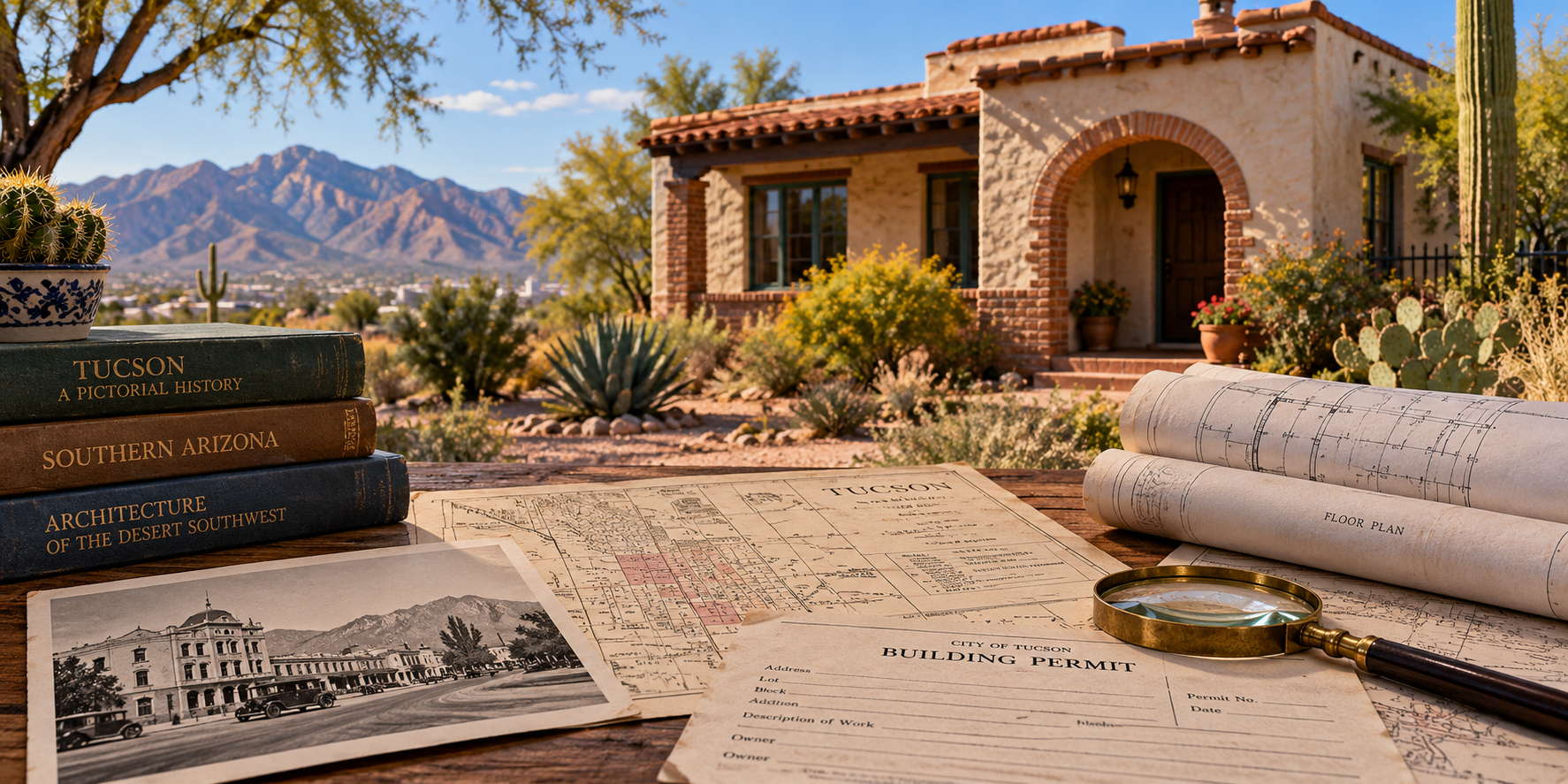
One of the things I love about older Tucson homes is that they often make you curious.
You notice an unusual doorway.
A room feels like it may have been added later.
The kitchen obviously belongs to a different era than the rest of the house.
Or maybe the property record says the home was built in 1948, but something about the architecture makes you wonder whether the story is more complicated.
So where do you start?
The first thing I would tell any homeowner is this:
The “year built” is a starting point, not necessarily the entire history of the property.
A home may have additions, remodels, converted porches, accessory buildings, parcel changes, or other alterations that happened decades after the original structure was constructed.
And depending on the home's age, the records available today may be incomplete.
Fortunately, Tucson and Pima County have several official resources that can help you piece together the story.
You may not find every answer.
But with a parcel number, a little patience, and a willingness to compare several records, you can often learn quite a bit about how your property changed over time.
Where Should You Start Researching the Age of a Tucson Home?
Start with the property’s Assessor Parcel Number and current parcel record. The Pima County Assessor provides parcel-level information and historical tools that can establish a useful baseline for your research. From there, compare permit records, maps, recorded documents, historic-preservation information, and archival sources rather than relying on a single database as the complete history.
For most Tucson-area homes, I would begin with the Pima County Assessor.
The Assessor's parcel tools allow you to search property information and provide features including parcel details, history, genealogy, and images. Pima County Assessor Parcel Detail
Your Assessor Parcel Number, often shortened to APN or parcel number, is especially useful because addresses can change or be formatted differently over time.
Think of the Assessor record as your starting file.
Write down:
- Parcel number
- Address
- Recorded property characteristics
- Available historical information
- Any information about structures or improvements
- Anything that doesn't match what you see today
The Assessor itself advises property owners and buyers to verify the accuracy of recorded property characteristics rather than simply assuming every field is correct. Pima County Assessor
That mindset is useful throughout this process.
You're gathering evidence.
Not treating one database entry as the final word.
Is the Assessor’s “Year Built” Always the Exact Construction Date?
An Assessor year-built entry can be a useful clue, but it should not automatically be treated as conclusive proof of the exact day or complete period when a property developed. Assessment records are created for property-administration purposes, and an older home may have additions, remodels, accessory structures, or incomplete historical documentation that require other records to understand.
This distinction matters.
If the Assessor says 1956, that's a very useful piece of information.
But the next question should be:
What does 1956 represent for this particular property?
It may correspond with the original residence.
But what about the enclosed porch?
The detached workshop?
The second bathroom?
The guest house?
The garage that appears to have been converted into living space?
Those pieces may have their own timelines.
And if you're researching a particularly old property, you'll sometimes find that the paper trail gets thinner the farther back you go.
That's why I wouldn't try to settle the entire history of a home with one field from one source.
Use the Assessor record to establish a baseline.
Then look for documents that can either support it or add another chapter.
Can Building Permits Help You Understand a Tucson Home’s History?
Yes. Building permits can help identify documented construction, additions, alterations, mechanical work, and other permitted activity associated with a property. The availability of records depends on jurisdiction and age, however, and the absence of an easily located permit does not by itself prove that work was performed without authorization or establish when a change occurred.
This is usually my next stop.
If the property is inside the City of Tucson, the City's Property Research Online, or PRO, is an excellent research tool.
City Planning and Development Services says PRO can be searched by address or Assessor Parcel Number and includes parcel information and development activity. City of Tucson Permits
The City also reports that nearly all development records from 2006 to the present are available through PRO, while its broader records collection includes building permits and residential plans dating to the mid-1950s, subject to record availability. City of Tucson Records
That can be incredibly useful.
A permit history might help you identify when:
- An addition was constructed
- A carport became enclosed
- Electrical work was documented
- HVAC equipment was installed or replaced
- A water heater was permitted
- A patio or porch was added
- Other significant permitted changes occurred
For records that aren't already online, the City directs users to submit a records request through Tucson Development Center Online. City of Tucson Records Requests
What If the Property Is in Unincorporated Pima County?
Properties in unincorporated Pima County use County rather than City of Tucson development-record systems. Pima County provides parcel-based permit-history tools, historical permit cards, approved development documents, and a formal building-records request process. Because Tucson mailing addresses can exist outside city limits, confirm jurisdiction before deciding which permitting agency to research.
This connects directly to something we've discussed before:
A Tucson mailing address does not necessarily mean City of Tucson jurisdiction.
Before searching City permit records, confirm where the property actually sits.
For applicable properties in unincorporated Pima County, County Development Services provides several historical resources.
Its Approved Development Project Drawings resource includes historical development approvals, plans, permits, subdivision plats, and links to historical permit cards through its parcel information system.
Pima County also has a formal Residential and Commercial Building Records request process.
There's an important limitation worth knowing: the County states that residential plans built before 2007 may not be available because of the state retention schedule.
That's a perfect example of why missing records require caution.
If you can't find an old plan, that doesn't automatically tell you why it isn't there.
It may simply no longer be available.
Does a Missing Permit Mean Work Was Unpermitted?
No. Failing to locate a permit in an online search does not, by itself, prove that work was completed without a required permit. Older records may be stored separately, unavailable online, associated with different addresses or parcel identifiers, or no longer retained. Property-specific permit questions should be verified with the government agency that has jurisdiction.
This is one of the most important cautions in the entire research process.
It's tempting to search a database, find nothing, and conclude:
“This addition must have been unpermitted.”
That's too big a leap.
Maybe the permit exists in an older format.
Maybe the address changed.
Maybe the document isn't digitized.
Maybe the record is connected to another parcel identifier.
Maybe the agency no longer has the plans.
For City properties, Tucson says records not available through PRO can be requested through its records process. City of Tucson Records
For County jurisdiction, use the County records process.
If whether an improvement was legally permitted matters to a purchase, sale, renovation, appraisal, or other property decision, verify the facts with the applicable agency and appropriate professionals.
Absence from a quick online search is not the same thing as proof.
What Can Old Maps Tell You About a Tucson Property?
Historic maps can help show whether buildings existed at a location during a particular period, how lots and streets were arranged, and how surrounding development changed. They generally provide historical clues rather than complete construction histories. Coverage also varies significantly by location and date, particularly for properties that were outside Tucson’s earlier developed areas.
Maps are where property research starts becoming really fun.
One especially useful resource for older parts of Tucson is the Sanborn Fire Insurance Map collection maintained by the Library of Congress.
The Library has digitized Tucson Sanborn material from 1919 as well as map sheets updated through 1949. Library of Congress — 1919 Tucson Sanborn Map and Library of Congress — 1919–1949 Tucson Sanborn Map
Sanborn maps were created for fire-insurance purposes, so they can contain building-level information about developed areas.
For the right property, an old map might help answer questions such as:
- Was a structure shown on the lot at that time?
- Was the footprint different?
- Were there detached buildings?
- How was the property related to nearby streets?
- Was the surrounding area already developed?
But there is a big limitation:
Not every Tucson property appears on historic Sanborn coverage.
Much of today's metropolitan Tucson developed long after those early maps were created.
So if your 1970s home isn't on a 1919 map, you've learned exactly what you would expect to learn.
Can Historic Aerial Images Help?
Historical aerial imagery can help establish when development appeared on a property, how the building footprint changed, and how surrounding streets or subdivisions evolved. Aerial photographs usually cannot identify the exact purpose or legality of a change, but comparing images from different years can provide a valuable visual timeline when other records are incomplete.
This is one of my favorite research techniques.
If you can find aerial photographs from multiple decades, compare them side by side.
Maybe the house is visible in one image but not the earlier one.
Maybe a detached structure appears later.
Maybe the swimming pool shows up between two image dates.
Maybe the neighborhood changes from open desert to a fully built subdivision.
Those visual clues can help narrow your questions.
They can't always answer them.
For example, an aerial image may show that an addition appears sometime between two photograph dates.
It does not necessarily tell you:
- Who built it
- Exactly when construction occurred
- Whether a permit was required
- Whether it was approved
- What the room was originally used for
That's where aerial photography and permit research can complement each other.
One gives you the visual evidence.
The other may give you documentation.
How Can Historic-Preservation Records Help?
If a Tucson property lies within a historic district or has an individual historic designation, preservation records may provide unusually detailed information about architecture, construction periods, neighborhood development, and contributing status. An older house is not automatically a designated historic property, however, so historic status should be verified through official City or State preservation resources.
This is another distinction worth making clearly:
Old and historically designated are not the same thing.
The City of Tucson provides historic-resource information through its Historic Preservation program and MapTucson. The City says its historic layers include National Register properties, Historic Preservation Zones, Neighborhood Preservation Zones, and other historic resources. City of Tucson Historic Preservation
If your property is in a National Register district, the research can get especially interesting.
The City publishes nomination documents for many districts, and those materials can include:
- Historic context
- Architectural descriptions
- Maps
- Photographs
- Development history
- Inventories of contributing properties
For example, Tucson's official National Register district page includes nomination and inventory documents for areas such as Armory Park, Blenman-Elm, Catalina Vista, Sam Hughes, and many others. City of Tucson National Register Historic Districts
That can provide context you would never find in a standard property record.
Does Being 50 Years Old Automatically Make a Tucson Home Historic?
No. Age alone does not mean a house is listed on the National Register, located within a historic district, or individually designated as historic. Historic designation involves specific criteria and documentation. Tucson does apply certain historic-review procedures to older structures in particular circumstances, but homeowners should verify the property’s actual designation and applicable requirements.
This is another common misconception.
A 1950s house can be interesting.
It can retain beautiful original architecture.
It can be important to the history of its neighborhood.
But none of that automatically means it has a formal historic designation.
The City explains that National Register properties must meet significance and integrity criteria related to history, people, architecture, archaeology, or other qualifying characteristics. City of Tucson National Register Designations
The City also notes that historic approval is required before demolition of a building or structure 50 years and older, which is a procedural requirement and should not be confused with automatically declaring every 50-year-old structure historically designated. City of Tucson Historic Preservation
If historic status matters to your plans, check the actual property.
Don't assume it from age or architectural style.
What Can the Pima County Recorder Tell You?
The Pima County Recorder maintains recorded documents that can add another layer to property research, including documents connected to real-property transactions and other recorded matters. Recorded-document research can help build a timeline, but interpreting ownership interests, deeds, easements, restrictions, or title issues can involve legal questions that should not be resolved from a casual document search alone.
The Recorder is another place people sometimes confuse with the Assessor.
They serve different purposes.
The Pima County Recorder provides a public recorded-document search, and historic record images can also be researched through the Recorder's office.
Recorded documents may help you find additional pieces of the property's paper trail.
But here's where I would slow down.
Reading an old recorded document and understanding its legal effect are two different things.
If you're researching for curiosity, that's one thing.
If you're trying to determine:
- Legal ownership
- Easement rights
- Deed restrictions
- Boundary rights
- Title defects
- Whether an old document still affects the property
those are no longer simply house-history questions.
That's when the appropriate title, legal, surveying, or other qualified professional may need to get involved.
Can You Research Previous Owners?
Public property and recorded-document resources may contain names associated with previous transactions, but researching a home’s history does not require building personal profiles of former residents. For most homeowners, the more useful approach is following recorded property events, construction records, maps, and archival material while respecting the privacy of individuals who previously lived there.
You may naturally encounter previous owners' names while looking through recorded documents or historical material.
That's part of working with public records.
But I would keep the focus on the property.
Maybe an archival photograph identifies a former owner in connection with the house.
Maybe a historic-district nomination explains who commissioned a residence because that information is relevant to the property's significance.
That's different from trying to assemble personal information about everyone who ever lived there.
For a homeowner simply curious about the history of the house, the useful questions are usually:
What changed?
When did it change?
What did the property look like before?
Was it part of a larger historical development pattern?
That keeps the research focused and respectful.
What Can University Archives Add to Your Research?
University and archival collections can provide historical photographs, maps, neighborhood documentation, manuscripts, newspapers, and other materials that add context unavailable in modern property databases. These sources are especially useful when researching older Tucson neighborhoods, local architecture, or the development of an area, although finding material for one specific address can require patience.
This is where the research can move beyond paperwork and become a real history project.
The University of Arizona Libraries Special Collections preserves archival materials related to Tucson, Southern Arizona, and the broader region.
Depending on the property or neighborhood, archival collections may help you understand:
- What the area looked like decades ago
- When streets or subdivisions developed
- Historic architecture
- Major local development patterns
- People or institutions connected to historically significant properties
- Earlier land uses
Not every house will have an old photograph waiting in an archive.
Most won't.
But you may find something nearly as interesting:
context.
Understanding what Tucson looked like when your house was built can help explain why the home was designed the way it was.
Which Property-History Resource Should You Use First?
Start with current parcel data, then move into permit records before expanding into historic maps, preservation files, recorded documents, and archival collections. Each source answers a different question, and none should be expected to provide the entire story by itself. The strongest property history usually comes from comparing multiple records that independently support the same timeline.
| Resource | What It May Help You Find | Important Limitation |
|---|---|---|
| Pima County Assessor | Parcel number, property characteristics, historical parcel information | Administrative data may not tell the home's full construction history |
| City of Tucson PRO | Development activity, permits, plans, code-related records | Applies to City jurisdiction; older records may require separate requests |
| Pima County Development Services | County permit history, historical permit cards, plans | Record availability varies; some older residential plans may not remain available |
| Library of Congress Sanborn Maps | Historic building footprints and development patterns in covered areas | Limited to certain dates and geographic areas |
| Historic Preservation Records | District history, architectural context, contributing status | Most older homes are not individually designated historic properties |
| Pima County Recorder | Recorded property documents | Legal interpretation may require professional assistance |
| University Archives | Photos, maps, manuscripts, neighborhood context | A specific address may not appear in the collection |
| Historic Aerial Imagery | Visual changes to structures and surrounding development | Usually cannot establish permits, ownership, or exact construction dates |
I would treat this table as a sequence rather than a menu.
Start simple.
Then go deeper if the questions keep getting more interesting.
How Do You Build a Timeline of Your Tucson Home?
Build a property timeline by recording each fact alongside its source rather than combining everything from memory. Start with the reported construction period, then add permits, map appearances, recorded documents, remodels, aerial-image changes, and historic references. When sources conflict, keep both entries until stronger documentation explains the difference instead of choosing whichever date seems more likely.
This is the part that keeps your research from becoming a pile of browser tabs.
Create a simple timeline.
For example:
| Approximate Date | What You Found | Source |
|---|---|---|
| 1948 | Recorded year associated with house | Assessor record |
| 1949 | Building footprint appears on map | Historic map |
| 1963 | Addition permit located | Permit record |
| 1978 | Detached structure appears | Aerial imagery |
| 1996 | Remodel documented | Permit record |
| 2018 | HVAC replacement | Permit/service record |
Your actual timeline may be much messier.
That's okay.
You might even find conflicting dates.
Don't “fix” them by guessing.
Record what each source says.
Sometimes a later document will explain the difference.
What If the Records Contradict Each Other?
Conflicting property-history records are not unusual, especially with older homes. Different agencies created records for different administrative purposes, and dates may refer to different structures, improvements, assessments, permits, or updates. When two sources disagree, preserve both pieces of information and look for additional documentation rather than assuming one source must automatically be wrong.
This is where house research starts feeling a little like detective work.
Suppose the Assessor shows one year.
A historic inventory shows another.
A map seems to suggest something existed earlier.
What do you do?
Don't force an answer.
Ask what each record was actually documenting.
Maybe one date refers to the main residence.
Maybe another reflects a major addition.
Maybe an assessment record was updated later.
Maybe the historical researcher had access to documentation you haven't found yet.
A disagreement isn't necessarily a dead end.
Sometimes it's the clue that leads you to the most interesting part of the story.
Frequently Asked Questions About Researching a Tucson Home
Where can I find the year my Tucson house was built?
Start with the Pima County Assessor's parcel information. Treat the recorded year as a useful starting point and compare it with permit records, maps, historic documentation, and other available sources when you want a more complete history.
Is the Pima County Assessor's year-built information always definitive?
It should not automatically be treated as the complete construction history of a property. Recorded characteristics are useful, but additions, alterations, accessory structures, older documentation, or conflicting records may require additional research.
Can I look up old Tucson building permits?
Yes. For properties within City of Tucson jurisdiction, Property Research Online provides development activity and many building records. The City says its broader records include permits dating to the mid-1950s. Records not online may require a formal request.
What about permit records in unincorporated Pima County?
Pima County Development Services provides permit-history and historical development resources. The County notes that some residential plans built before 2007 may not be available because of the state retention schedule.
Does no permit record mean an addition was illegal?
No. A missing online record does not prove that work was unpermitted. Older documents may not be digitized, may need to be requested separately, may have been indexed differently, or may no longer be retained.
Can old maps show when my house was built?
They can help establish whether a building appeared at a location by a certain map date, but they usually don't provide a complete construction history. Library of Congress Sanborn maps can be particularly useful for some older parts of Tucson.
How do I know whether my Tucson house is historic?
Check official City of Tucson historic-preservation resources and MapTucson. An older house is not automatically a formally designated historic property.
Can I research previous owners of my home?
Recorded documents and archival materials may contain names associated with previous ownership or transactions. Keep in mind that legal interpretation of deeds, title, easements, or ownership interests should be left to appropriate professionals.
What if my house predates available permit records?
Use multiple historical sources. Assessor records, Sanborn maps where available, recorded documents, historic-district research, archival photographs, maps, and aerial imagery may help fill in parts of the timeline.
What's the best way to organize everything I find?
Create a dated timeline and note the source beside every entry. If two sources conflict, keep both until additional documentation clarifies the discrepancy.
Final Thoughts
Researching an older Tucson home can start with a very simple question:
How old is this house?
But sometimes that's only the beginning.
You start with a year.
Then you find a permit.
Then an old map shows a smaller building footprint.
Then you discover the neighborhood developed in a way you never realized.
And suddenly you're not just looking at a house.
You're looking at a piece of Tucson's development history.
That's what I enjoy about this kind of research.
You don't have to uncover a famous architect or a dramatic historical event for the process to be worthwhile.
Sometimes it's enough to learn:
That room wasn't always there.
The street looked completely different in 1950.
The original house was much smaller.
This neighborhood developed during a particular chapter of Tucson's growth.
Just remember that old-property research rarely comes from one perfect record.
The most reliable picture usually comes from putting several sources together and being comfortable saying:
“This is what the records appear to show.”
That's a much better approach than forcing certainty where the historical record doesn't provide it.
Property Research Note
This article provides general educational information and is not intended as legal, title, surveying, permitting, tax, historic-preservation, or construction advice. Public records can be incomplete, differently indexed, or created for different administrative purposes. A missing record does not by itself establish that work was unpermitted, and an Assessor year should not automatically be treated as the complete construction history of a property. Property-specific questions should be verified with the appropriate government agency and qualified professionals.

Tom Krieger
| The TJK Team - Realty Executives Arizona Territory
or another way