Categories
Homeowner Guide, Southern Arizona DevelopmentPublished October 2, 2026
How Can I Research Future Development Near My Tucson Home?

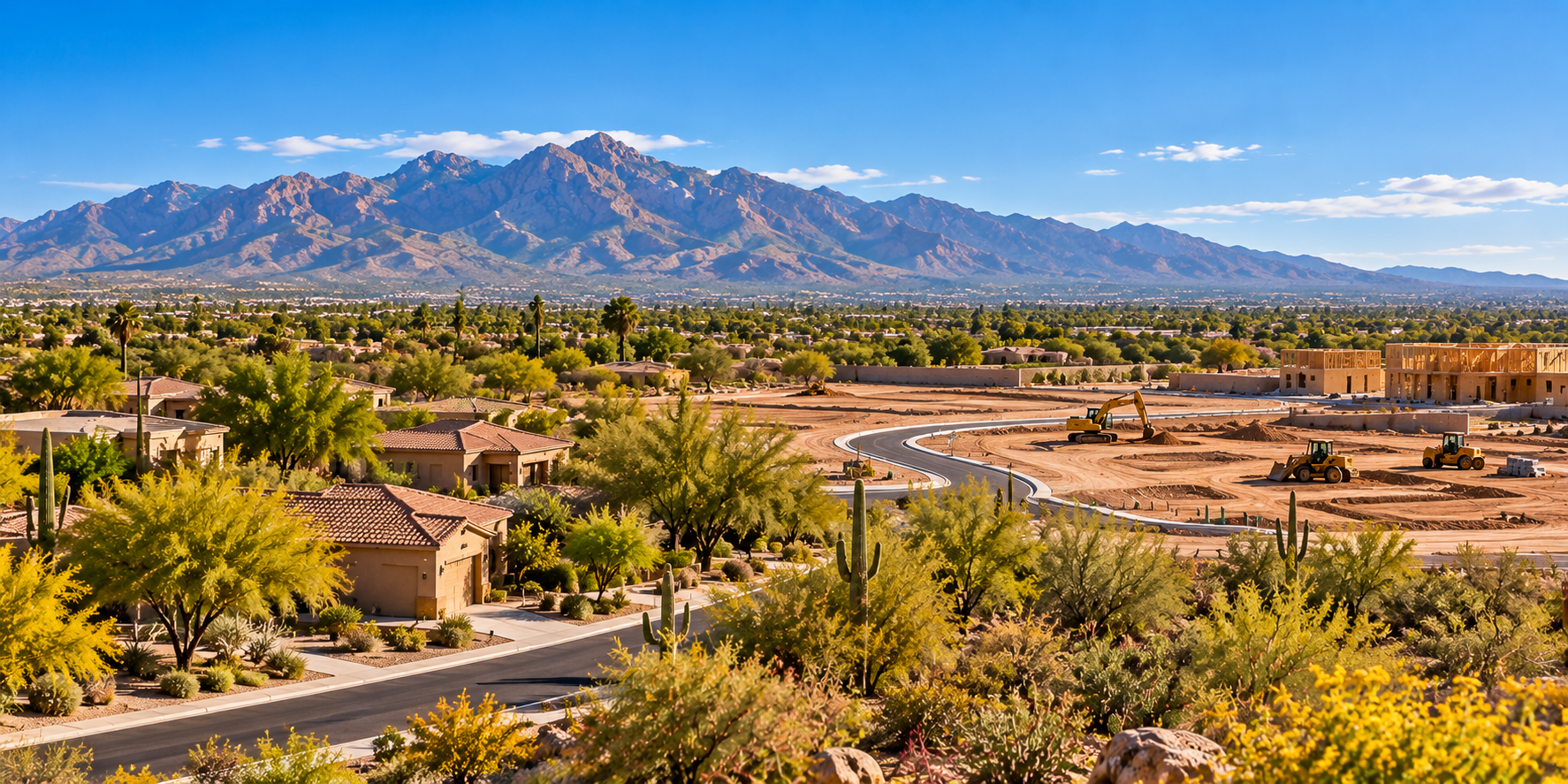
You notice a vacant parcel down the street. A zoning sign goes up near your neighborhood. Someone mentions apartments, a shopping center, or a new subdivision coming nearby. And naturally, the first question is:
What's actually being built there?
This comes up frequently in real estate, and one of the biggest mistakes is relying on neighborhood rumors or assuming that an early proposal is a finished project. The good news is that Tucson-area homeowners and buyers have access to quite a few public tools for researching development. You can look up parcels, check zoning, find development activity, review permits and plans, follow rezoning cases, and research transportation projects. The key is knowing where to look—and understanding what the records actually tell you.
Start by Determining Whether the Property Is in Tucson or Unincorporated Pima County
Before researching a development project, determine which government has jurisdiction over the property. A Tucson mailing address does not necessarily mean the parcel is inside Tucson city limits. Development within the City of Tucson is generally researched through City systems, while unincorporated properties are generally researched through Pima County Development Services and County mapping tools.
If you've read our guide on the difference between Tucson, Pima County, and unincorporated Tucson, you already know why.
A Tucson mailing address and City of Tucson jurisdiction are not the same thing.
That distinction determines where you should look for zoning, permits, development plans, and other records.
For properties inside Tucson city limits, the City of Tucson Planning and Development Services Department provides several research tools.
For unincorporated properties, Pima County Development Services and Pima County's GIS resources are generally the better starting point.
If you're researching a parcel and aren't sure where it falls, identify the parcel first rather than guessing based on the street address.
Step 1: Find the Parcel You Want to Research
Start with the exact parcel rather than a general neighborhood description. An address or Assessor Parcel Number can help identify the property and connect it to zoning, permits, plats, development records, and other public information. This is especially helpful when researching vacant land, where a project name or conventional street address may not yet exist.
If you're wondering what's happening with a piece of land, the parcel itself is your starting point.
For Pima County, the Parcel Information Search allows searches using information such as a street address or parcel code.
Pima County notes that its parcel information incorporates Assessor records and other sources and directs users to the Pima County Assessor for official Assessor information.
If the property is inside Tucson, the City's Property Research Online, or PRO, can also locate parcel information and development activity.
According to the City of Tucson's Research Tools, PRO can be searched using an address or Assessor Parcel Number, and properties can also be located visually on a map.
This is why I wouldn't start by searching Google for something like:
"What's being built near Ina and Oracle?"
That might lead you to news stories or speculation.
Instead, identify the actual parcel you're curious about.
Once you have that, your research becomes much more specific.
Step 2: Check the Existing Zoning
Zoning tells you how a parcel is currently classified under the applicable land-use regulations, but it does not necessarily tell you exactly what will be constructed there. A zoning district can allow multiple uses and may be subject to additional standards, approvals, overlays, or development requirements, so zoning should be treated as one part of the research.
Zoning is important. But it's also one of the easiest things to misunderstand. If you look up a vacant parcel and discover its zoning designation, that does not necessarily tell you:"This is what they're building."
It tells you the property's zoning classification. That's a different question. Within the City of Tucson, MapTucson allows users to research zoning districts and other mapped information. The City says the system can be searched by address, parcel, street intersection, neighborhood, school, or subdivision.
Pima County's PimaMaps provides another useful set of layers. The County says PimaMaps can display information including:
- Zoning
- Permits
- Plats
- Floodplains
- Wastewater infrastructure
- Fire districts
- Topography
- Aerial photography
When you click a parcel, Pima County says you can access additional information including Assessor records, subdivision plats, building permits, imagery, and the County zoning designation.
That's much more useful than looking at an empty lot and trying to guess what it might become.
Step 3: Look for Development Activity and Permit Records
Development and permit records can show whether a property has moved beyond general zoning into a more specific review process. In Tucson, Property Research Online provides parcel and development activity information, while City development reports track permit and review activity. In Pima County, approved project drawings and permit records can provide additional project-specific documentation.
Once you know the parcel and zoning, I would start looking for activity.
For City properties, Property Research Online is especially useful.
The City says PRO includes development activity associated with parcels, and approved and issued construction plans, permits, and documents after 2009 can be accessed there. The City's Research Tools page also provides Development Activity Reports and an active-project Development Activity Map. That gives you another way to see whether something has entered the City's development-review process.
The City also notes that nearly all Tucson development records from 2006 to the present are available through PRO. Older and additional records may be available through the City's records process. City of Tucson Records
For County properties, Pima County provides an Approved Development Project Drawings search.
Depending on the project, available records can include:
- Subdivision plats
- Development concept permits
- Site construction permits
- Building/site construction permits
- Development plans
- Tentative plats
- Landscape and native plant plans
- Historical development approvals
That can take you much further than a zoning map alone.
Step 4: Learn the Difference Between Proposed, Approved, Permitted, and Under Construction
Development records represent different stages of a project. A rezoning request means a change has been requested, not necessarily approved. An approval indicates that a governmental decision has occurred, while permits can indicate further project review. Actual construction represents another stage. Even approved projects can be modified, delayed, replaced, or never completed as originally envisioned.This distinction is probably the most important part of the entire process.
When someone tells me: "They're building something there."
My next question is: What stage is it actually in?
Here's a useful framework:
| Development Stage | What It Generally Means |
|---|---|
| Existing zoning | The parcel currently has a particular zoning classification |
| Pre-application / early discussion | A potential project may be exploring a land-use or development process |
| Rezoning request | Someone has formally requested a zoning change |
| Public hearing / review | The request is moving through an applicable public process |
| Approved rezoning | The zoning change has received the required governmental approval |
| Development plan / plat | More detailed project information may have entered or completed review |
| Permit activity | Specific work may have moved further into permitting |
| Permit issued | Applicable work has received a permit, subject to its requirements |
| Under construction | Physical work is occurring on the site |
These stages are not interchangeable.
For example, the City of Tucson describes rezoning as a public process that changes the zoning of a property or group of properties.
The City's process includes multiple steps, and the applicable decision does not occur simply because someone has submitted a proposal.
So if you find a rezoning request, the accurate statement is: A rezoning has been requested.
Not: This project is definitely being built. That language matters.
Step 5: Check Rezoning Cases and Public Hearings
Rezoning and certain other land-use requests can involve public review and hearings. In Tucson, the Zoning Examiner conducts hearings on rezoning requests on behalf of Mayor and Council, and the City publishes agendas and case materials. These records can help homeowners distinguish an active proposal from an approved land-use change.
Sometimes that zoning sign you noticed is actually the most useful clue.
If a Tucson property needs a zoning change, you may be able to find the case through the City's land-use and public-hearing resources.
The City of Tucson Zoning Examiner conducts public hearings on rezoning requests on behalf of Mayor and Council and considers certain other land-use applications.
The City's page includes agendas and case materials for hearings.
Those documents can be incredibly helpful because they may provide more detail than the sign on the property.
Depending on the case and stage, you might find:
- Case numbers
- Property locations
- Existing zoning
- Requested zoning
- Staff reports
- Preliminary development information
- Hearing materials
- Recommendations or decisions
The City's Entitlements information also explains the general process for rezoning, plan amendments, and other discretionary land-use applications.
Again, read the status carefully.
A hearing scheduled for a rezoning request is evidence that a request is being considered.
It isn't proof that the requested project has already been approved.
Step 6: Review Plans and Drawings When They're Available
Project plans can provide more detail than zoning alone, including proposed site layout, lots, buildings, access, landscaping, or infrastructure. Availability depends on the project and its review stage. Plans should also be read in context: a preliminary proposal, approved plan, and issued construction document do not necessarily represent the same level of project certainty.
This is where the research can get really interesting.
A zoning designation might tell you very little about the physical layout. A project drawing can tell you much more.
For example, depending on the project, you might be able to see:
- Proposed streets
- Building footprints
- Lots
- Parking areas
- Entrances
- Landscape areas
- Drainage features
- Open space
- Project boundaries
Pima County's Approved Development Project Drawings system specifically includes categories such as subdivision plats, development concept permits, site construction permits, tentative plats, and landscape plans.
Within Tucson, PRO and the City's records system can provide plans and construction documents when they are publicly available. City of Tucson Research Tools
But pay attention to what you're viewing.
A preliminary development plan isn't necessarily the same thing as final construction documents.
The date matters.
The status matters.
And later revisions may matter too.
Step 7: Don't Forget Roads and Infrastructure Projects
Not every future change near a home is a private development. Road widening, intersections, sidewalks, drainage improvements, bicycle and pedestrian facilities, utility work, and state highway projects can also affect the surrounding area. City of Tucson, Pima County, and ADOT maintain official project resources that can help homeowners research documented transportation projects
Sometimes the big change coming near a property isn't a subdivision or shopping center.
It's a road project.
For roads within the City, the Tucson Department of Transportation and Mobility provides project information and a Capital Improvement Project dashboard.
Its Transportation and Mobility Projects page also identifies current, upcoming, and completed projects.
For County roads, Pima County's Current & Future Roadway Projects separates projects into categories such as:
- Under construction
- Under design
- Proposed
That's exactly the type of terminology I want homeowners to notice.
A project under construction is very different from one that is under design or proposed.
If you're near an interstate or state highway, check the Arizona Department of Transportation as well.
The agency publishes project information and construction updates for state-controlled transportation projects.
Step 8: Use Public Records When the Online Tools Don't Tell the Whole Story
Online mapping and permit systems do not necessarily contain every record a homeowner may want. When documents are missing, public-records procedures can provide another research path. The City of Tucson directs requests for development and building-permit records not already available through Property Research Online to Tucson Development Center Online.
Sometimes you'll find exactly what you're looking for online.
Sometimes you won't.
The City of Tucson Records Department says its available records can include building permits, commercial and residential building plans, certificates of occupancy, and subdivision house plot plans.
Nearly all development records from 2006 forward are available through PRO, according to the City.
For records that aren't there, the City directs users to submit a request through Tucson Development Center Online.
That is another reason not to conclude: "I couldn't find anything, so nothing is happening."
An online search is useful. It isn't necessarily the end of the research process.
What Should I Look for When Reading a Development Record?
Focus on the parcel, case number, project description, application date, current status, zoning, requested changes, hearing dates, approval dates, permit status, and revision dates. These details provide more context than a project name alone and can help distinguish an old proposal from an active case or an approved project from one still under review.
I like to approach these records almost like a checklist.
When you find something, write down:
| Research Item | Why It Matters |
|---|---|
| Parcel number | Confirms you're researching the correct property |
| Case or permit number | Helps you track the official record |
| Application date | Shows when the process began |
| Existing zoning | Establishes the current classification |
| Requested zoning | Shows what change is being sought, if any |
| Project description | Explains what the applicant has proposed |
| Current status | Helps distinguish pending, approved, issued, or completed activity |
| Hearing date | Shows where the case may be in a public process |
| Approval date | Helps establish whether a decision has occurred |
| Plan revision date | Helps determine whether you're looking at the latest version |
| Permit status | Provides additional context about project progression |
Take screenshots or save the documents when appropriate.
And note the date you researched them.
Development activity changes over time.
What Can't These Tools Tell Me?
Public development records can document zoning, applications, approvals, permits, plans, and government projects, but they cannot guarantee what will ultimately be built or when. Financing, ownership decisions, redesigns, later approvals, market conditions, construction schedules, and other factors can change a project's outcome after an initial proposal or approval.
This is the limitation I want homeowners to remember.
Government records can help answer:
What has been proposed?
What has been requested?
What has been approved?
What permits exist?
What plans are available?
Is construction underway?
They can't necessarily answer:
Will this project definitely be completed exactly as shown?
That's a much bigger claim.
Even the City of Tucson includes a disclaimer with Property Research Online explaining that its online parcel and permit information is provided from multiple sources and isn't guaranteed to be accurate, correct, or complete.
So use public records as evidence of the documented status—not as a crystal ball.
A Simple Research Process for Tucson Homeowners
A practical Tucson-area development search starts by identifying the parcel and jurisdiction, then checking zoning, development activity, permits, plans, rezoning or hearing records, and transportation projects. Finally, confirm the status and date of every record. This sequence helps separate documented information from rumors, outdated proposals, and assumptions about what may eventually be built.
If I were researching an empty parcel near my own house, here's the order I would use:
- Identify the parcel.
- Determine City of Tucson versus unincorporated Pima County jurisdiction.
- Check current zoning.
- Look for development and permit activity.
- Search for rezoning or entitlement cases.
- Review available plans and drawings.
- Check nearby transportation projects.
- Read the status and dates carefully.
- Request additional public records if necessary.
- Recheck later if the project is still preliminary.
Most importantly, I would write down what the records actually say.
If the record says proposed, call it proposed.
If it says under review, call it under review.
If it's approved, say approved.
If there's an issued permit, say that.
And if construction is actually underway, then you have a much stronger indication that the physical project is moving forward.
Frequently Asked Questions About Researching Tucson Development
Tucson-area homeowners can research nearby development through City of Tucson and Pima County parcel, zoning, permit, planning, and public-hearing resources. The correct system depends on jurisdiction, and the terminology in each record matters. Zoning, applications, approvals, permits, and construction represent different stages and should not be treated as interchangeable.
How do I find out what's being built near my Tucson house?
Start by identifying the parcel and determining whether it is within City of Tucson or unincorporated Pima County jurisdiction. Then search the applicable zoning, development activity, permit, and planning systems.
Can I research a vacant lot?
Yes. An address or parcel number can help you locate the property. Pima County's Parcel Information Search and PimaMaps can be especially useful for identifying vacant parcels and related records.
Does zoning tell me exactly what will be built?
No. Zoning identifies a property's land-use classification and applicable framework, but it doesn't necessarily identify the exact project that will ultimately be built.
Where can I find Tucson rezoning cases?
The City of Tucson's Planning and Development Services resources include Entitlements information and Zoning Examiner agendas and case materials for applicable rezoning proceedings.
How do I check Tucson building permits?
For properties within the City of Tucson, Property Research Online provides parcel, permit, and development activity information. The City says approved and issued construction plans, permits, and documents after 2009 can be accessed through PRO.
How do I research development in unincorporated Pima County?
Pima County's PimaMaps, Parcel Information Search, Development Services resources, and Approved Development Project Drawings are useful starting points.
Can an approved development still change?
Yes. Approval of a particular land-use action or plan does not necessarily guarantee that the entire project will ultimately be constructed exactly as initially envisioned. Later revisions, additional approvals, permitting, ownership decisions, and other factors may affect what happens.
How can I research a future road project?
Check the City of Tucson Department of Transportation and Mobility for City projects, Pima County's transportation project resources for County projects, and ADOT for applicable state highway projects.
If I can't find a permit, does that mean nothing is planned?
Not necessarily. A project may be at an earlier stage, the record may be stored elsewhere, or additional records may need to be requested. It is better to say that you did not locate a record than to conclude that no project exists.
Should I rely on neighborhood social media for development information?
It can alert you that something may be worth researching, but official planning, zoning, permit, hearing, and project records are stronger sources for determining the documented status of a development.
Final Thoughts
Seeing an empty parcel or a zoning sign near your home can naturally make you curious. But you don't have to rely entirely on rumors.
Tucson and Pima County have public tools that let you dig into the actual records.
Start with the parcel.
Figure out the jurisdiction.
Check the zoning.
Look for development activity, permits, plans, and public hearings.
Then pay close attention to the words used to describe the project's status.
Proposed is not the same as approved.
Approved is not necessarily the same as permitted.
And permitted isn't always the same as completed.
That distinction can make all the difference when you're trying to understand what's really happening near a Tucson property.
And when the online information isn't clear enough, that's the point where I would go directly to the applicable City, County, or state agency—or consult the appropriate qualified professional for property-specific questions.
Development Research Information Note
This article is for general educational purposes and is not legal, zoning, engineering, or land-use advice. Development proposals, zoning cases, plans, permits, transportation projects, and construction schedules can change. Verify current project status and property-specific information with the City of Tucson, Pima County, ADOT, or other applicable agencies. For interpretation of development rights, zoning requirements, or legal issues affecting a specific property, consult the appropriate qualified professional.

Tom Krieger
| The TJK Team - Realty Executives Arizona Territory
or another way