
Categories
Homeowner GuidePublished October 6, 2026
Understanding Stucco Cracks in Tucson Homes: What's Common and What Deserves Attention

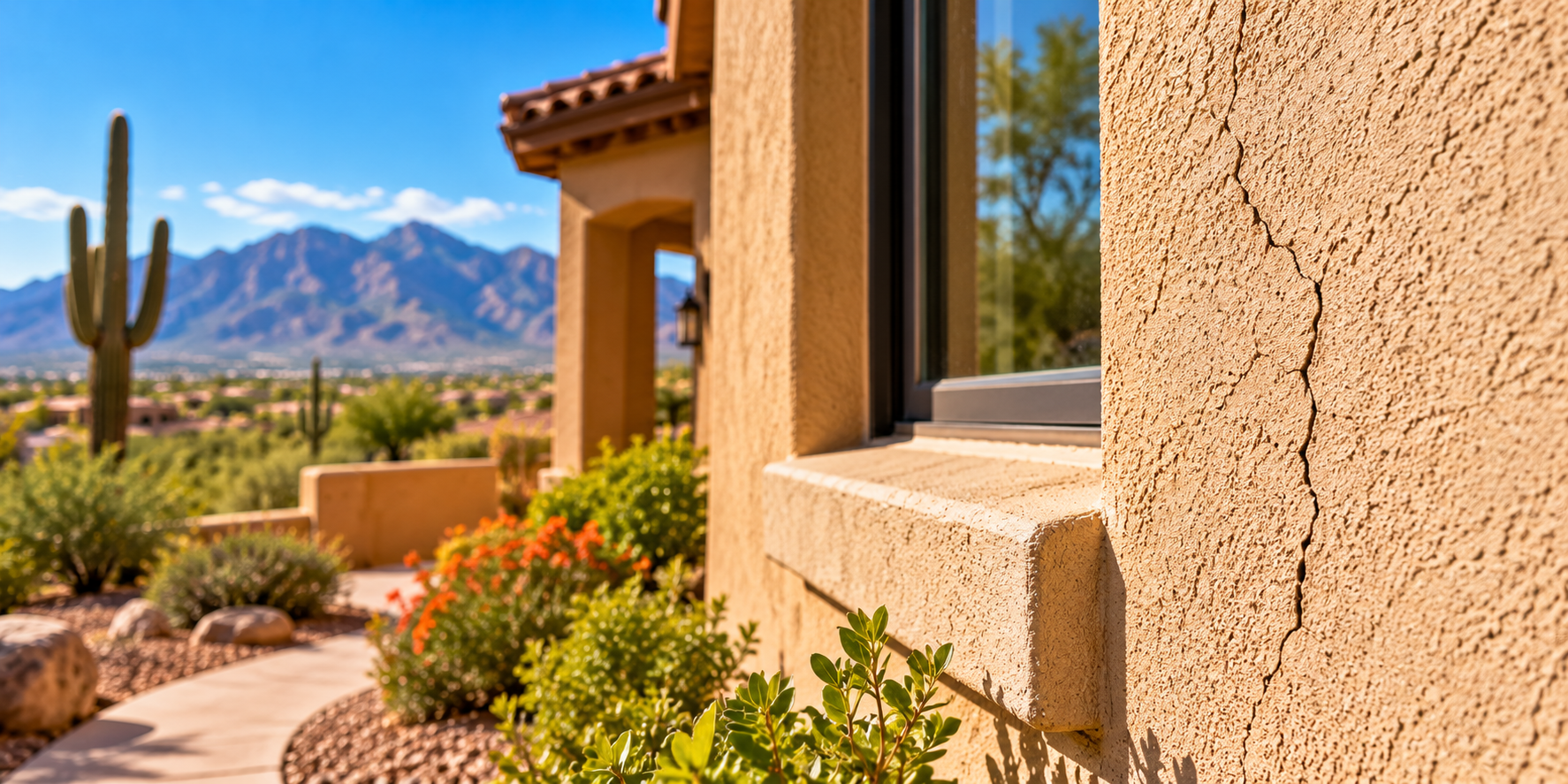
If you own a stucco home in Tucson, chances are you've looked at an exterior wall at some point and thought:
Was that crack there before?
Stucco is such a familiar part of Tucson architecture that cracks can be easy to notice—and surprisingly difficult to interpret.
Some cracks may be limited to the exterior finish. Others deserve a closer look because they're changing, recurring, associated with moisture, or appearing alongside other signs of movement.
The important thing is not to diagnose a house from one crack.
Instead, I like to think of stucco cracks as something to observe, document, maintain, and investigate further when the circumstances call for it.
Here's what Tucson homeowners should know.
Why Do Tucson Homes Have So Much Stucco?
Stucco and similar exterior finishes are common on Tucson homes, but the construction behind the finish can vary by property, age, and building method. That matters when evaluating cracks because what you see on the surface is only one part of the exterior wall system. A crack's appearance alone does not establish its underlying cause.
Stucco just looks at home in Tucson.
You'll see it on older houses, newer subdivisions, Southwestern-style homes, contemporary homes, and just about everything in between.
But here's something homeowners sometimes overlook:
Not every stucco-clad house is constructed exactly the same way.
The materials behind the finish, installation method, age of the home, previous repairs, wall openings, and other construction details can all matter when someone is trying to understand why a particular crack developed.
That's one reason I would be cautious about looking at a picture online and saying:
"Mine looks like that, so it must be the same problem."
It may not be.
For current construction, both the City of Tucson and Pima County use locally adopted building codes and amendments. The City of Tucson Building Codes page states that the 2024 International Residential Code and other 2024 International Codes became effective in 2026. Pima County's Building Permits Resources likewise identifies the 2024 building codes as current effective January 1, 2026.
Those codes establish current construction requirements.
They don't tell us why the crack on a particular existing house formed. For that, we need to look more closely at the house itself.
Are Stucco Cracks Automatically a Serious Problem?
No. A visible stucco crack should not automatically be labeled a structural problem, but it also should not automatically be dismissed as cosmetic. The significance depends on the individual home and surrounding conditions. Location, pattern, changes over time, recurrence, moisture, and other symptoms can provide useful information when deciding whether professional evaluation is appropriate.
This is the middle ground I want homeowners to remember.
A crack isn't automatically a crisis.
But "stucco cracks are normal" isn't a diagnosis either.
If you're looking at a crack, ask a few basic questions:
- Where is it?
- Is it isolated or are there several?
- Does it appear to be changing?
- Has someone repaired this area before?
- Does the crack keep returning?
- Is there staining or another sign of moisture nearby?
- Are there other changes elsewhere around the house?
Those observations don't tell you the cause.
What they can do is help you decide whether you're dealing with something you can document and monitor or something that deserves professional attention.
What Should I Do When I First Notice a Stucco Crack?
When you first notice a crack, document its location and appearance rather than relying on memory. Take clear photographs, record the date, note nearby windows, doors, rooflines, penetrations, or moisture staining, and check the area periodically for visible change. Documentation can be useful if a contractor, inspector, or engineer later evaluates the condition.
My first suggestion is incredibly simple:
Take a picture.
Actually, take several.
Get one close enough to show the crack and another from farther away so you can tell exactly where it is on the house.
Then note the date.
This gives you something much better than:
"I think it's getting bigger."
You can actually compare what you're seeing over time.
I would also photograph the surrounding wall.
For example, is the crack:
- Near a window?
- Near a door?
- At a corner?
- Near the roofline?
- Near a wall penetration?
- Close to an area where water drains?
- In an area that has obviously been patched before?
You're not trying to diagnose it yourself.
You're creating a record.
That can be useful whether you're maintaining your own home, preparing for a professional evaluation, or trying to explain the condition to someone later.
Which Stucco Cracks Deserve More Attention?
A crack deserves additional attention when it is changing, recurring after repair, accompanied by moisture or deterioration, or appearing alongside other changes in the building. Those observations do not prove a structural defect, but they are reasonable reasons to stop treating the issue as purely cosmetic and consider evaluation by an appropriately qualified professional.
There isn't one visual rule that lets every homeowner sort cracks into "fine" and "serious."
That's why I'm intentionally not giving you a universal crack-width measurement.
A number by itself doesn't explain the wall assembly, the cause, whether the condition is active, or what's happening elsewhere in the house.
Instead, I would pay attention to context and change.
| What You Notice | General Next Step |
|---|---|
| Very fine surface cracking with no obvious change | Document it and continue to observe the area; maintain the finish as appropriate |
| Crack near a window, door, corner, or other opening | Document the location and watch for changes or related symptoms |
| Crack that appears to be changing | Consider professional evaluation rather than assuming it is cosmetic |
| Crack that returns after being repaired | Consider investigating why it is recurring before repeatedly patching it |
| Cracking plus other visible movement-related changes | Consider evaluation by an appropriately qualified professional |
| Cracking with staining, deterioration, or other evidence of moisture | Investigate the moisture source and obtain appropriate evaluation |
| Widespread or unusual cracking that concerns you | Have the condition evaluated rather than relying on an online diagnosis |
Notice what that table doesn't say.
It doesn't say:
This type of crack means foundation damage.
Or:
That type is always harmless.
A professional evaluating the actual property has access to information we don't have from a photograph or blog post.
Why Does the Location of a Crack Matter?
Location provides context because exterior walls include openings, corners, joints, transitions, penetrations, and connections to other building components. A crack near one of those features may deserve different investigation than an isolated mark in an uninterrupted wall area. Location is useful evidence, but it still does not identify the cause by itself.
When I look at a crack, I'm not just looking at the line.
I'm looking at where the line is.
Windows and doors interrupt a wall.
Corners change geometry.
Rooflines meet walls.
Pipes, vents, fixtures, and other components penetrate exterior finishes.
Different materials can meet one another.
That's why a good photograph should include the surrounding area instead of only a close-up of the crack.
The location gives an inspector or contractor more context.
But again, context isn't the same as diagnosis.
A crack near a window doesn't automatically tell us why it formed. It's simply information worth documenting.
What About Cracks That Keep Coming Back After Repair?
Repeated cracking in the same area is worth investigating because a cosmetic repair may address the visible surface without explaining why the crack formed. Recurrence does not establish a specific structural problem, but it can be a useful sign that homeowners should investigate the underlying condition before continuing to patch the same area repeatedly.
This is one I would pay attention to.
Maybe a crack was patched.
Then it returned.
So it was patched again.
And now you're looking at it for the third time.
At that point, I would want to know more than:
What's the best patching material?
I would want to ask:
Why does this particular area keep cracking?
The answer might require someone to look at the actual wall and surrounding construction.
Repeatedly covering the visible symptom doesn't necessarily explain what is happening underneath it.
That doesn't mean a recurring crack automatically indicates a major defect.
It means the recurrence itself is useful information.
Why Should Moisture Around Stucco Get My Attention?
Cracking accompanied by staining, deterioration, or other signs of moisture deserves attention because exterior wall systems are intended to manage weather and water. The visible crack may or may not be the source of the moisture. Homeowners should avoid assuming the cause and instead investigate both the exterior condition and the source of the moisture.
This is where I would shift from simply watching a crack to asking more questions.
If you're seeing a crack and something that looks like moisture-related deterioration, don't assume the crack itself explains everything.
Water can come from different places.
The visible symptom may not identify the source.
Look at the larger area.
Is there staining?
Is the finish deteriorating?
Is the condition near a roof or drainage area?
Is there plumbing or another penetration nearby?
Has the area been repaired before?
Those are questions to bring to the appropriate professional.
And if you're seeing active water intrusion inside the home, that's not something I would put on a "maybe I'll check again in six months" list.
Should I Just Patch a Stucco Crack?
Patching can be part of exterior maintenance, but repairing the visible crack is not the same as determining why it developed. If the crack is changing, recurring, associated with moisture, or accompanied by other concerning observations, investigating the underlying condition before repeatedly making cosmetic repairs can provide better information about the appropriate next step.
There's nothing wrong with maintaining your exterior finish.
But I like to separate two questions:
How do I repair the visible crack?
and
Why did the crack happen?
Sometimes homeowners jump straight to the first one.
If the condition keeps returning, however, the second question becomes much more important.
This is also where choosing the right professional matters.
The Arizona Registrar of Contractors licenses and regulates residential and commercial contractors in Arizona and specifically encourages consumers to check a contractor's license.
The ROC provides an online contractor search where homeowners can research licensing information.
So if you're hiring someone for work that requires an Arizona contractor's license, that's a good verification step before work begins.
When Would I Consider a Home Inspector, Contractor, or Structural Engineer?
Different professionals answer different questions. A home inspector can document visible conditions within the scope of an inspection, a qualified contractor can evaluate work within the contractor's area of expertise, and a registered structural engineer can evaluate structural questions. The appropriate professional depends on what is observed and what question the homeowner needs answered.
This is another place where I think homeowners sometimes expect one person to answer every question.
They don't all have the same role.
A Home Inspector
A home inspector may identify and document visible conditions during an inspection and recommend further evaluation where appropriate.
That's particularly relevant during a real estate transaction because the inspection is intended to give the buyer information about the property—not to turn every visible condition into a structural diagnosis.
A Contractor
A qualified contractor can evaluate work within that contractor's area of expertise and discuss appropriate repair options.
Before hiring a contractor, homeowners can verify Arizona licensing through the Arizona Registrar of Contractors.
A Structural Engineer
When the question is specifically about structural performance or movement, a structural engineer may be the appropriate professional to evaluate that issue.
Arizona regulates professional engineering through the Arizona State Board of Technical Registration, so homeowners should verify the registration status of a professional before relying on engineering services.
The important part is matching the professional to the question.
If what you really want to know is:
"Is there a structural issue here?"
that's different from:
"How should this exterior finish be repaired?"
What If I'm Buying a Tucson Home and See Stucco Cracks?
Buyers should document visible stucco cracks and use the inspection and due-diligence period to gather appropriate information rather than assuming a crack is harmless or serious. Depending on what is observed, a home inspector may recommend additional evaluation. Buyers should rely on qualified professionals for property-specific conclusions and review applicable transaction documents and disclosures.
This is where I become especially careful with language.
As a real estate agent, I'm not going to walk up to a crack and tell you:
"Don't worry about that. It's cosmetic."
I'm also not going to tell you:
"That's definitely structural."
Neither conclusion should come from guessing.
If we're touring a house and something catches your attention, we can document it.
During the inspection process, you can ask questions.
And if the inspector recommends additional evaluation, you can decide how you want to proceed within the terms and timelines of your transaction.
The goal isn't to panic over every imperfection.
It's to get the right information before making decisions about the property.
What If I'm Selling a Tucson Home With Stucco Cracks?
Sellers who notice stucco cracks before listing can document the condition and consider appropriate evaluation or maintenance rather than making unsupported assumptions about the cause. If repairs are performed, keeping invoices and related documentation can help preserve a record of the work. Sellers should also follow applicable disclosure obligations and obtain appropriate advice for property-specific questions.
If you're preparing to sell, walking around the outside of your house before photos and showings is always useful.
You may notice cracks you've stopped seeing because you walk past them every day.
If you decide to have something evaluated or repaired, keep the paperwork.
That might include:
- Contractor invoices
- Repair descriptions
- Inspection reports
- Engineering reports, if applicable
- Warranty information
- Dates of work
Good documentation helps tell the factual story of what was evaluated and what work was performed.
And when disclosure questions arise, don't try to solve them by deciding on your own that something "doesn't count."
Property-specific disclosure questions are better handled using the applicable transaction documents and appropriate professional guidance.
How Do Tucson's Current Building Codes Fit Into This?
Current building codes establish minimum requirements for new permitted construction and applicable alterations; they are not a diagnostic tool for explaining every crack in an existing house. Tucson and Pima County currently use 2024 International Codes with local amendments. A home's age, permit history, construction method, and applicable code at the time of work may differ.
As of 2026, the City of Tucson identifies the 2024 International Residential Code and other 2024 International Codes as adopted, with local amendments.
Pima County also identifies the current 2024 Building Codes and 2023 National Electrical Code as effective January 1, 2026.
That's useful context.
But I don't want homeowners to make the leap from:
"Here's today's building code."
to:
"Therefore, I know why my 30-year-old wall cracked."
Those aren't the same thing.
An existing house may have been built under an earlier code.
It may have been remodeled.
Repairs may have occurred.
Materials and construction details can differ.
Current codes establish requirements for applicable current work; they don't retroactively diagnose an existing condition.
A Simple Stucco-Crack Checklist for Tucson Homeowners
When you notice a stucco crack, document it, look at the surrounding wall, check for visible change or moisture, review previous repairs if known, and monitor the condition. If it changes, returns after repair, accompanies other building changes, or raises concerns you cannot resolve, obtain evaluation from an appropriately qualified professional.
Here's the process I would use at my own home:
- Take clear photos.
- Photograph the entire surrounding wall.
- Write down the date.
- Note the crack's location.
- Look for staining, deterioration, or other visible symptoms.
- Check whether that area has been repaired before.
- Compare photographs periodically rather than relying on memory.
- If the condition changes or concerns you, get the appropriate professional involved.
- Verify contractor licensing before applicable repair work.
- Keep records of evaluations and repairs.
That's much more useful than standing three feet from the wall trying to decide whether a crack "looks bad."
Frequently Asked Questions About Stucco Cracks in Tucson Homes
Stucco cracks should be evaluated in context rather than classified from appearance alone. Homeowners can document and monitor minor-looking conditions, but changing or recurring cracks, moisture-related deterioration, and cracks accompanied by other building changes deserve closer attention. Qualified inspectors, contractors, and structural engineers can provide different types of property-specific evaluation.
Are stucco cracks common in Tucson homes?
Stucco-clad homes are common throughout the Tucson area, and homeowners may encounter cracking in exterior finishes. The presence of a crack alone does not establish its cause or severity.
Does a stucco crack mean I have foundation problems?
Not necessarily. A visible stucco crack by itself is not enough information to diagnose a foundation or structural problem. If structural movement is a concern, an appropriately qualified professional should evaluate the property.
Can I tell whether a crack is serious based on its width?
Width can be one observation, but this guide intentionally does not provide a universal measurement that classifies a crack as harmless or serious. Location, pattern, change over time, recurrence, moisture, surrounding construction, and other symptoms can also matter.
Should I monitor a small stucco crack?
Documenting a crack with dated photographs can help you determine whether its visible appearance changes over time. If it changes, recurs after repair, or is associated with other symptoms, consider professional evaluation.
What if the crack keeps returning after I patch it?
Recurring cracking is worth investigating because repairing the visible surface doesn't necessarily identify why the crack developed.
Should I worry about a crack near a window or door?
The location is worth documenting because windows and doors are openings in the exterior wall. The location alone, however, does not diagnose the cause. Watch for change and other symptoms and seek appropriate evaluation if concerned.
What if I see staining around a stucco crack?
Cracking accompanied by staining, deterioration, or other evidence of moisture deserves additional attention. The visible crack may or may not be the source of the moisture, so the underlying source should be investigated.
Who should I call about a stucco crack?
That depends on the question. A home inspector can document visible conditions within the inspection scope, a qualified contractor can evaluate applicable repair work, and a structural engineer can evaluate structural questions.
How do I check whether an Arizona contractor is licensed?
Use the Arizona Registrar of Contractors' contractor search to research licensing information before hiring a contractor for work requiring a license.
Should a buyer be concerned if a Tucson home has stucco cracks?
A buyer should document the condition and obtain appropriate information rather than assuming the crack is either harmless or serious. A home inspection and, when appropriate, additional professional evaluation can provide property-specific information.
Final Thoughts
Stucco cracks are one of those things that can look very dramatic when you first notice them.
But the line you see on the wall is only part of the story.
Instead of immediately deciding:
"That's nothing."
or:
"That's a major structural problem."
start with information.
Photograph it.
Look at where it is.
Check for moisture and other visible changes.
Find out whether it has been repaired before.
Watch whether it changes.
And if the condition keeps returning, appears to be changing, is associated with moisture, or simply gives you reason to want a professional opinion, get the appropriate person involved.
That's a much better approach than trying to diagnose your Tucson home from a crack chart on the internet.
Home Maintenance Information Note
This article is for general educational purposes only and is not a home inspection, engineering opinion, construction recommendation, or structural diagnosis. The cause and significance of cracking can vary by property and construction. Homeowners, buyers, and sellers should consult appropriately qualified professionals for evaluation and repair recommendations specific to a property.

Tom Krieger
| The TJK Team - Realty Executives Arizona Territory
or another way