
Categories
Neighborhood GuidesPublished November 17, 2026
Exploring Tucson's Mercado District: Shops, Housing, and West Side History

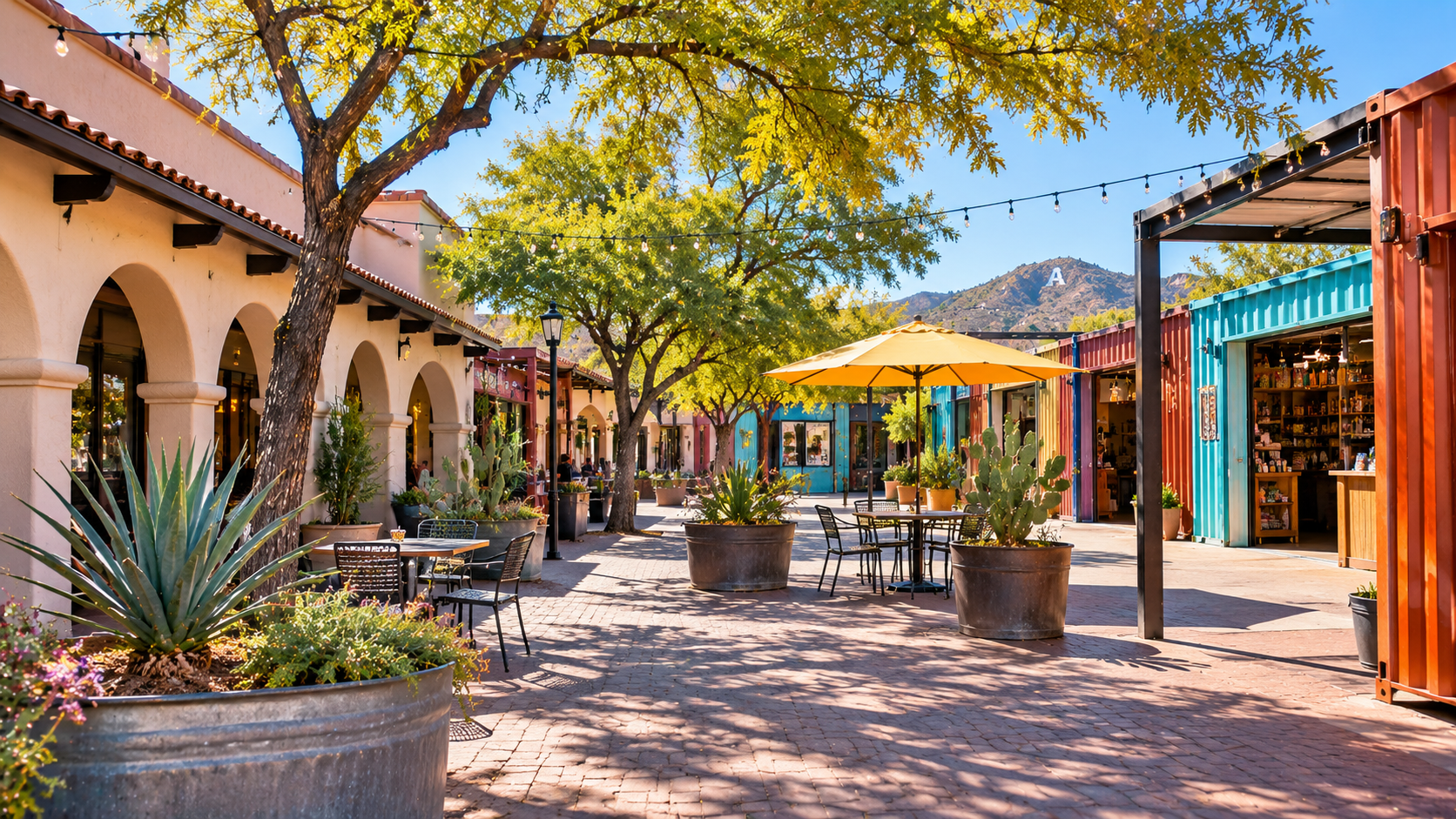
There are places around Tucson where you can learn quite a bit about the city just by taking a walk.
For me, the Mercado District is one of those places.
Just west of downtown, you'll find an open-air market, small businesses, restaurants, residential streets, and the western end of the Sun Link streetcar route. But what makes this area especially interesting is the connection between its modern development and the much older history of Tucson's west side.
You can stop for coffee, browse a few shops, admire the architecture, and be only a short distance from the Santa Cruz River corridor, where people have lived and farmed for thousands of years.
Whether you've visited before or have only passed by on Congress Street, here's a closer look at how the Mercado District fits into Tucson's story.
What Is Tucson's Mercado District?
Tucson's Mercado District is a mixed-use area in Menlo Park, just west of downtown and near the Santa Cruz River. It combines restaurants, locally operated shops, public gathering spaces, single-family homes, and apartments. Mercado San Agustín and MSA Annex are two of its commercial destinations, and the Sun Link streetcar connects the district with central Tucson.
The first thing to know is that the Mercado District is more than one marketplace.
The name refers to a broader development that includes places to shop and eat, as well as residential properties and public spaces.
Its commercial areas are concentrated around South Avenida del Convento, where you'll find Mercado San Agustín, MSA Annex, and The Monier.
The district's layout is intentional. Rather than separating every use into a different part of town, the plan brings housing, retail, dining, and transportation together.
The City of Tucson's planning records include a dedicated Menlo Park Mercado District Planned Area Development and a master plan for the neighborhood.
That planning history helps explain why the streets, buildings, and gathering areas feel connected.
Understanding the Different Parts of the District
| Area | Primary Features | What You'll Notice |
|---|---|---|
| Mercado San Agustín | Public market, shops, restaurants, central courtyard | Storefronts arranged around an open-air gathering space |
| MSA Annex | Shops, food and beverage businesses, event space | Businesses housed in modified shipping containers |
| The Monier | Apartments with ground-floor commercial spaces | Multi-story building with a street-level colonnade |
| Residential streets | Single-family homes and other residential development | Buildings placed close to streets and sidewalks |
| Other apartment developments | Residential buildings with different floor plans and housing arrangements | Additional housing options near the commercial district and streetcar |
These are distinct parts of the larger area, and their current uses are described on the Mercado District's official website and housing page.
I think that distinction makes a visit more interesting. You're not simply walking through a shopping center. You're seeing how a neighborhood was planned to combine several everyday activities in a relatively compact area.
How Does the Mercado District Connect to West Side Tucson History?
The modern Mercado District occupies part of Tucson's historic west side, near the Santa Cruz River and Sentinel Peak. Archaeological research documents thousands of years of settlement and agriculture in this corridor. The current district is much newer, with planning beginning in the 2000s, so its architecture and businesses should not be confused with the area's ancient history.
One of my favorite things about learning Tucson history is discovering how much of it connects to places we still visit.
The Mercado District sits near a particularly important part of that story.
The Santa Cruz River Came First
Long before there was a modern downtown, a streetcar, or a public market, the Santa Cruz River supported settlement and agriculture in the Tucson Basin.
According to Archaeology Southwest's Tucson Origins research, people were growing maize near present-day Sentinel Peak more than 4,000 years ago. Archaeologists have also identified irrigation canals in the floodplain dating back approximately 3,500 years.
Those discoveries are part of the history of Indigenous communities whose connections to this region extend into the present.
The river's history is also more complicated than the mostly dry channel many Tucson residents recognize today.
Archaeology Southwest's research on the Santa Cruz River describes how the river and its floodplain changed over time, including the effects of irrigation practices, flooding, and changes in the water table.
The important point is that Tucson's west side was part of a settled and cultivated landscape long before the modern Mercado District was planned.
A New District With a Much Older Setting
The current Mercado District took shape through a separate, much more recent planning process.
According to the Mercado District's development history, the initial vision began in 2003, with planning informed by Menlo Park neighborhood discussions about vacant land near West Congress Street.
The development process included community design workshops and ideas associated with New Urbanism, an approach that emphasizes connected streets, public spaces, and a mixture of uses.
The Gadsden Company was formed in 2006 to continue and expand the development effort.
So when you see architecture that references older urban building styles, it's useful to remember that much of the district itself is modern.
The historic context comes from the surrounding landscape and the communities that shaped this part of Tucson over many generations.
For anyone who enjoys local history, that contrast is worth understanding.
What Can You Find at Mercado San Agustín and MSA Annex?
Mercado San Agustín is an open-air public market with shops and restaurants arranged around a courtyard. Nearby MSA Annex expands the district's commercial offerings through businesses operating in modified shipping containers and an associated event space. Both are part of the larger Mercado District, but they have different architectural designs and visitor experiences.
If you're visiting for the first time, I'd suggest allowing enough time to explore both.
They're close to each other, but they don't look or feel identical.
Mercado San Agustín: The Courtyard Marketplace
Mercado San Agustín is located at 100 South Avenida del Convento.
The marketplace is organized around an open-air courtyard, with businesses facing the shared space.
It's the kind of layout that makes it easy to stop for something to eat, look through a shop, and spend some time outside without moving your car between destinations.
According to the Mercado District's current business directory, businesses listed at Mercado San Agustín include:
- La Estrella, a bakery
- Seis Kitchen, serving Mexican cuisine
- Presta Coffee Roasters, a coffee shop
- MAST, a lifestyle boutique
- La Cabaña, a shop featuring traditional arts
Those are examples rather than a complete tenant list, and it's always a good idea to check current hours before visiting.
What stands out to me is how the courtyard ties the different storefronts together. The building arrangement encourages visitors to see the market as a connected space rather than a row of unrelated businesses.
MSA Annex: A Different Approach to Commercial Space
A short walk away, at 267 South Avenida del Convento, you'll find MSA Annex.
The Mercado District describes MSA Annex as an expansion of Mercado San Agustín featuring locally operated shops, dining businesses, services, and event space.
Its most recognizable feature is the architecture: modified shipping containers used as commercial spaces.
The container structures create a different setting from the more traditional courtyard design of Mercado San Agustín. Businesses currently listed in the official district directory include Why I Love Where I Live, a gift shop; Transit Cycles, a bicycle shop; and Desierto Books, a bookstore.
Because businesses and hours can change, I would use the district's current directory as a starting point rather than relying on an older list.
Don't Overlook The Monier
Between Mercado San Agustín and MSA Annex is The Monier, at 160 South Avenida del Convento.
The Mercado District's housing information describes it as a residential and commercial building designed with references to classic prewar apartment architecture.
The building includes apartments above street-level shops, services, and restaurants.
It adds another layer to the district's design: housing and commercial activity sharing the same building rather than occupying completely separate developments.
What Types of Housing and Architecture Are in the Mercado District?
The Mercado District includes single-family homes, apartment communities, and mixed-use buildings with residences above commercial spaces. Its planning emphasizes connected streets, public spaces, and relatively compact building arrangements. Individual properties differ in design, ownership, rental terms, and amenities, so buyers and renters should evaluate specific properties rather than assume every residence offers the same features.
As someone who spends a lot of time looking at homes and neighborhoods around Tucson, I find the Mercado District interesting from an architectural perspective.
It's different from many residential developments where houses are separated from shopping areas by major roads and large parking lots.
Here, the relationship between buildings and the street is part of the design.
Single-Family Homes With an Urban Layout
The district's single-family housing description explains that its plan was influenced by New Urbanism.
That approach helps explain why some homes sit close to sidewalks and neighboring buildings.
Instead of assuming every Tucson home will have a large front setback or a wide separation from the street, the Mercado District offers examples of a more compact residential layout.
It's a useful reminder that Tucson housing includes many different architectural and planning approaches.
Apartments and Mixed-Use Buildings
The district also includes several apartment developments.
The Mercado District's residential directory identifies The Monier, West End Station, and Sentinel Plaza among its housing components.
These properties serve different residential purposes and offer different building configurations.
The Monier, for example, combines apartments with ground-floor commercial space.
West End Station is described by the district as an apartment community near the streetcar line.
The broader area also includes additional development plans, including The Bautista. The district's website has described that project as incorporating residential and commercial space near the Santa Cruz River, but its construction and occupancy status should be confirmed directly before making any current availability claims.
What Should Homebuyers Pay Attention To?
If you're considering a property in or near the Mercado District, I'd look beyond the building's appearance.
Some useful questions include:
- Is the property a single-family home, condominium, or rental apartment?
- What parking arrangements come with the property?
- Are there applicable association rules or fees?
- How close is the residence to commercial businesses or event spaces?
- What are the property's outdoor spaces and maintenance responsibilities?
- How do the floor plan, storage, and access arrangements fit your needs?
Those questions are useful in many Tucson neighborhoods, but they become especially relevant when homes, shops, and public spaces are located close together.
And if you're evaluating a specific property, current listing information, governing documents, and property records matter more than a general description of the district.
The Pima County Assessor is one official resource for researching property records.
How Does the Streetcar Connect the Mercado District to Downtown Tucson?
The Sun Link streetcar serves the Mercado District at the western end of its route. The line connects the area with downtown Tucson, Fourth Avenue, Main Gate Square, and the University of Arizona. Riders can use the streetcar to visit multiple central Tucson destinations, although current schedules, stop locations, and service notices should be checked before traveling.
The streetcar is an important part of understanding how the district was planned.
Rather than being an isolated shopping destination, the Mercado area is connected to several other parts of central Tucson.
According to Sun Tran's official Sun Link information, the streetcar operates along a 3.9-mile route with 23 stops.
It connects the Mercado District with downtown, Fourth Avenue, Main Gate Square, and the University of Arizona.
That makes it possible to combine a Mercado visit with other destinations without driving between each one.
A Simple Way to Explore
You could begin at Mercado San Agustín, walk over to MSA Annex, and then use the streetcar to continue toward downtown.
Or you could start downtown and ride west to the Mercado District.
I like that the transportation connection makes the area part of a larger outing.
Of course, public transit schedules can change, and service may be affected by special events or construction.
Before you go, check Sun Tran's current ride guides, maps, and schedules.
What Should You Know Before Exploring the Mercado District?
Visitors can explore the Mercado District by starting at Mercado San Agustín and continuing to MSA Annex and nearby streets. Shops and restaurants maintain their own hours, while markets and events follow separate schedules. Checking the official business directory, event calendar, streetcar information, and parking details before visiting can make planning easier.
One of the simplest ways to get to know this part of Tucson is to spend some time walking around.
You don't need an elaborate itinerary.
Start with the courtyard at Mercado San Agustín, take a look at the businesses, and then continue along Avenida del Convento toward MSA Annex.
As you walk, notice how the buildings change.
The marketplace has one architectural approach. The shipping-container businesses have another. The nearby apartments and residential streets introduce still more variation.
That contrast is part of what makes the area interesting to explore.
A Few Practical Tips
Check business hours individually. A marketplace can have several businesses with different opening and closing times. The Mercado District business directory is a useful place to start.
Look for scheduled events. The district hosts markets and other activities, but dates and formats vary. Check the official Mercado District website for current announcements.
Plan for the weather. Much of the experience involves outdoor walking, so bring water and prepare for the day's conditions.
Consider the streetcar. If you're combining the Mercado with downtown or Fourth Avenue, the Sun Link route may be a convenient option.
Take time to notice the surrounding area. The district's relationship to the Santa Cruz River, Sentinel Peak, and Menlo Park adds context to what you're seeing.
And if you want to learn more about the area's deeper history, the Archaeology Southwest Tucson Origins project is an excellent educational resource.
Frequently Asked Questions About Tucson's Mercado District
Common questions about Tucson's Mercado District involve its location, the difference between Mercado San Agustín and MSA Annex, available housing, streetcar access, and nearby history. The district combines modern commercial and residential development with a setting near the historic Santa Cruz River corridor. Current business hours, events, and housing availability should be verified separately.
Where is Tucson's Mercado District located?
The Mercado District is west of downtown Tucson in the Menlo Park area, near the Santa Cruz River. Its main commercial destinations are located along South Avenida del Convento.
Is Mercado San Agustín the same as MSA Annex?
No. Mercado San Agustín is an open-air courtyard marketplace at 100 South Avenida del Convento. MSA Annex is a separate nearby commercial area at 267 South Avenida del Convento, featuring businesses housed in modified shipping containers. Both belong to the larger Mercado District. See the official district overview.
What kinds of shops are in the Mercado District?
The district includes businesses offering food, coffee, clothing, gifts, books, traditional arts, and other products and services. Individual tenants may change, so check the official business directory for current listings.
Are there homes in the Mercado District?
Yes. The district includes single-family homes, apartment communities, and mixed-use residential buildings. Property types and availability vary. The Mercado District housing page provides an overview.
Does the Tucson streetcar go to the Mercado District?
Yes. The Sun Link streetcar serves the Mercado District and connects it with downtown Tucson, Fourth Avenue, Main Gate Square, and the University of Arizona.
Is the Mercado District a historic neighborhood?
The modern Mercado District is a relatively recent planned development. However, it sits near the Santa Cruz River corridor, where archaeological evidence documents thousands of years of settlement and agriculture. The Tucson Origins research explains that deeper history.
Can you visit both Mercado San Agustín and MSA Annex in one trip?
Yes. They are located near each other along South Avenida del Convento, making it practical to explore both during one visit. Check individual business hours before heading out.
Where can I learn more about Mercado District development plans?
The City of Tucson's Planned Area Development records include the Menlo Park Mercado District planning documents. Those records provide a starting point for understanding the area's planned development.
Final Thoughts
What I appreciate about the Mercado District is that it gives you several ways to learn about Tucson in one relatively compact area.
You can explore locally operated businesses, look at different approaches to architecture and housing, ride the streetcar, and learn about a part of the city whose history reaches far beyond the modern buildings.
And while the district itself is a newer development, its location near the Santa Cruz River connects it to a much longer story.
If you're curious about Tucson's neighborhoods, I think the Mercado District is worth exploring with that broader perspective in mind.
Pay attention to the details: the courtyard, the building materials, the residential streets, the streetcar stops, and the surrounding landscape.
They all help explain how this part of Tucson has developed—and how its past and present meet.
For anyone researching housing in the area, I'm always happy to help explain the different property types, available listing information, and the questions worth asking before making a decision.
Important Note: This article is for general educational purposes. Business tenants, operating hours, event schedules, transit service, development status, and housing availability can change. Verify current details with the appropriate official sources before making plans or real estate decisions.

Tom Krieger
| The TJK Team - Realty Executives Arizona Territory
or another way