
Categories
Homeowner GuidePublished September 3, 2026
What to Check Around Your Tucson Home After Monsoon Season

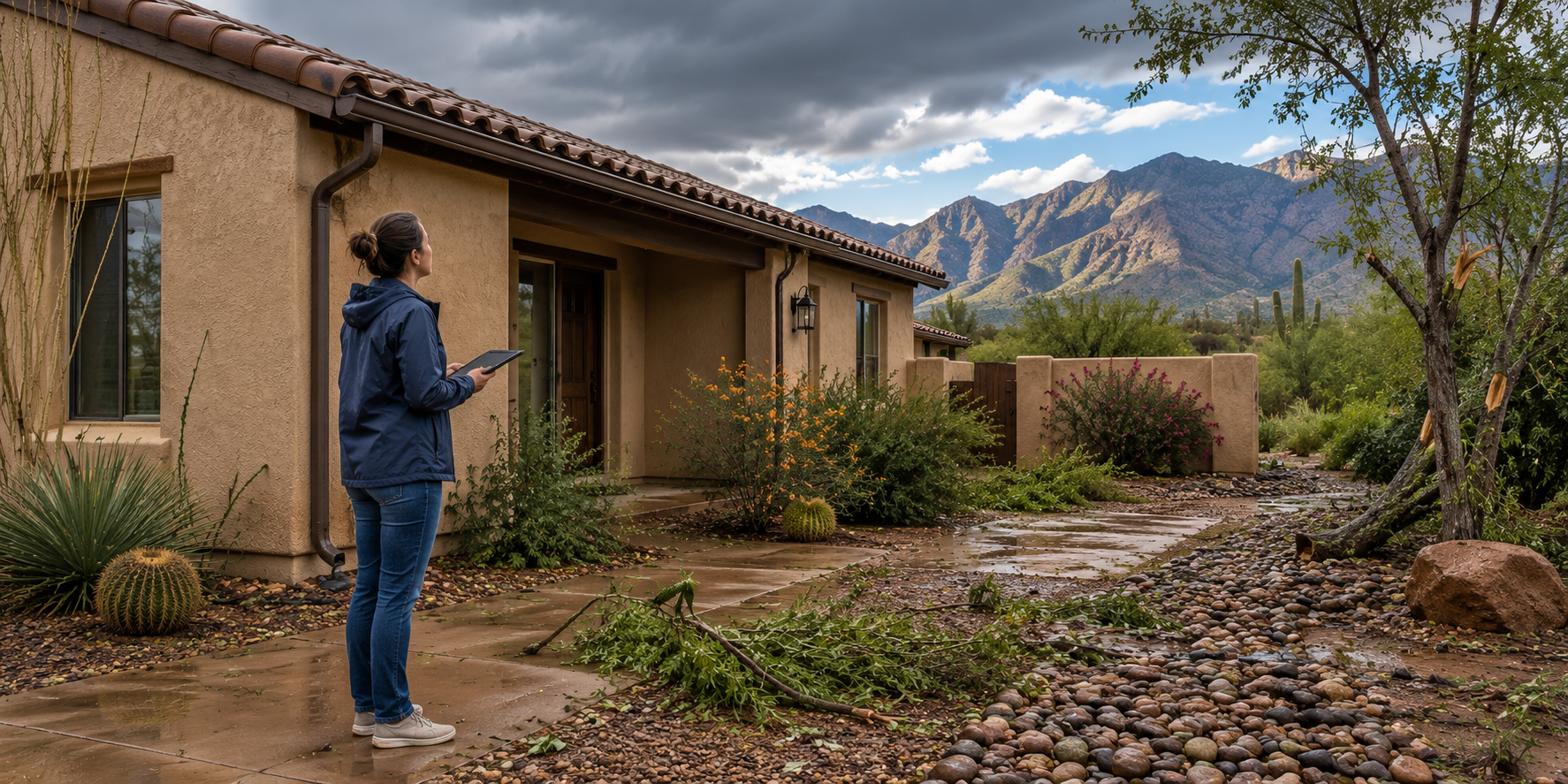
Monsoon season is one of those times of year when Tucson homes can experience a lot in a relatively short period.
Weeks of intense summer sun can suddenly give way to thunderstorms, strong wind, blowing dust, lightning, and heavy bursts of rain.
Then the storm passes, the sun comes back out, and everything can look perfectly normal again.
That's exactly why the end of monsoon season is a useful time to take a closer look around your property.
I'm not talking about climbing onto your roof or trying to diagnose structural problems yourself.
I'm talking about a simple, thoughtful walk around your home.
What changed?
Is there debris somewhere it wasn't before?
Did water leave an erosion pattern?
Does a roof edge look different?
Is a tree leaning or missing a large branch?
Is there staining inside that you don't remember seeing before?
The National Weather Service Tucson notes that monsoon thunderstorms can bring damaging winds, falling trees, flying debris, downed power lines, and storm-related property damage.
Not every storm leaves obvious damage, and not every unusual-looking condition means there's a serious problem.
The goal is simply to notice changes while they're still relatively fresh in your memory.
Here's where I would start.
Why Should Tucson Homeowners Check Their Property After Monsoon Season?
Tucson's summer monsoon can expose homes and landscaping to strong winds, intense rainfall, blowing debris, lightning, and rapidly moving runoff. A post-monsoon property check gives homeowners an opportunity to notice visible changes, document concerns, clear ordinary debris where it is safe to do so, and identify conditions that may deserve evaluation by an appropriate professional.
One of the challenges with storm-related home issues is that they aren't always dramatic.
Sometimes a tree falls.
Sometimes a roof visibly loses material.
Sometimes water enters the house.
Those are hard to miss.
But other changes can be much quieter.
Water may have repeatedly traveled through one section of the yard and left new erosion.
Debris may have accumulated near a drainage opening.
A roof tile may look displaced.
A section of stucco may show staining that wasn't there earlier in the summer.
None of those observations tells you exactly what happened.
But they're useful information.
The National Weather Service Tucson specifically recommends taking photographs when storm-related losses occur. Even when you're simply documenting a condition for your own records, photographs can make it easier to compare what you're seeing now with what the property looked like previously.
Start With a Safe Walk Around the Property
A post-monsoon home check can begin from the ground without climbing onto roofs, ladders, walls, or other elevated surfaces. Walk around the property during daylight, look for visible changes, and avoid hazards such as downed power lines, unstable trees, standing water near electrical equipment, damaged structures, or areas where footing may be unsafe.
Before we get into the house itself, safety comes first.
The National Weather Service warns people to stay away from downed power lines and to assume a downed line is live.
That's not something to investigate.
It's something to avoid and report.
The same common-sense approach applies elsewhere.
A large tree that's partially uprooted isn't something to stand underneath while you inspect it.
A damaged wall shouldn't become a climbing platform.
And a wet roof is definitely not the place for a homeowner inspection.
For most people, the best post-monsoon check starts with a slow walk around the house.
Bring your phone.
Take pictures.
And pay attention to what looks different.
What Should You Look for on the Roof?
From a safe location on the ground, Tucson homeowners can look for visible changes such as displaced or missing roofing material, debris, damaged roof edges, unusual conditions around visible penetrations, or changes in drainage areas. Roof condition can't be reliably determined from the ground alone, so apparent damage or leaks may warrant professional evaluation.
Roofing is one of the first places people think about after storms.
That's understandable.
It's also one of the places where homeowners can get themselves into trouble trying to inspect too closely.
You do not need to walk on your roof to pay attention to it.
From the ground, you may be able to notice:
- A tile that appears displaced
- Missing or damaged shingles
- Debris on a low-slope roof
- Changes along roof edges
- Something unusual around visible flashing
- Tree branches contacting the roof
- Damaged gutters or drainage components
For low-slope roofs, you may also be able to observe whether visible scuppers or canales appear obstructed.
If something looks different, take a photograph.
Then compare it with older photographs or maintenance records if you have them.
The observation itself doesn't tell you whether the roof needs repair.
That's where a qualified inspector or roofing professional can help.
Check Gutters, Scuppers, Canales, and Roof Drainage
Roof-drainage features help move rainwater away from the roofing system and structure. After monsoon season, homeowners can safely observe accessible gutters, downspouts, scuppers, canales, drains, and discharge areas for visible debris, displacement, or signs that water traveled somewhere unexpected. Roof access and technical drainage evaluations should be left to qualified professionals.
Tucson homes handle roof drainage in several different ways.
Some have gutters and downspouts.
Some low-slope roofs use scuppers or canales.
Others may drain toward specific roof edges or other designed discharge points.
Whatever system your house uses, the question is the same:
Where is the water supposed to go?
Then ask:
Where does it look like the water actually went?
You may notice leaves, twigs, seed pods, or other storm debris around an accessible drainage area.
You might also see staining or erosion below a discharge point.
That doesn't automatically mean something is wrong.
It's simply part of understanding how the house handled monsoon rainfall.
If you need to climb onto the roof to reach a drainage feature, that's no longer a simple ground-level homeowner check.
Look at How Water Moved Through the Yard
Monsoon runoff can reveal how water actually moves across a property. Homeowners can look for new erosion channels, sediment deposits, displaced rock, washed-out soil, standing-water evidence, or drainage paths that appear to direct water toward structures. Significant or recurring drainage concerns may warrant evaluation rather than an improvised change to established drainage patterns.
This is one of the most useful things monsoon season can teach you about a property.
Water leaves clues.
You may see:
- Small channels cut through soil
- Landscape rock moved out of place
- Sediment collected in a low area
- Mulch or debris deposited against a wall
- Soil washed away near hardscape
- Water marks showing where runoff traveled
The Pima County Regional Flood Control District specifically addresses drainage issues involving diversions of floodwater, washes, erosion areas, and situations where changes on one property may affect another.
That's an important reminder not to “fix” a drainage issue by simply redirecting water somewhere else.
Moving water away from one location could create a problem somewhere downstream—or on a neighboring property.
If drainage appears significant, recurring, or complicated, it's better to understand the system before changing it.
Check the Ground Around the Home
The soil and hardscape around a house can provide useful clues about post-storm drainage. Homeowners can look for erosion, settlement, soil displacement, new gaps, washed-out areas, or places where runoff appears to concentrate near the structure. These observations don't establish a foundation problem, but significant changes may justify further evaluation.
Here's where wording really matters.
If you see erosion near your house, that does not mean:
“My foundation is failing.”
It means you see erosion.
That's it.
There may be a perfectly manageable explanation.
Or it may deserve a closer look.
The useful homeowner skill is learning to separate observation from diagnosis.
For example:
Observation: Soil has washed away near this section of the house.
Diagnosis: The foundation has been damaged.
Those are very different statements.
A homeowner can make the first observation.
The second requires appropriate expertise and property-specific evaluation.
Inspect Stucco and Other Exterior Finishes
Exterior walls can show visible changes after wind and rain, including staining, damaged finishes, cracks, impact marks, or areas where water appears to have traveled. A new crack or stain doesn't establish its cause or significance, but documenting changes can help homeowners determine whether further evaluation by an appropriate professional is warranted.
Tucson has a lot of stucco homes, so exterior walls are a natural place to look.
Again, we're looking for changes.
Do you see staining that wasn't there before?
Is there a section where the finish looks damaged?
Did debris strike the wall?
Has an existing crack visibly changed?
If you have older photographs, they can be surprisingly useful here.
A crack that has looked identical for years is a different piece of information from something you know appeared recently.
That still doesn't tell you what caused it.
But it gives a qualified professional better context if you decide to have it evaluated.
Look Around Windows and Exterior Doors
Windows and exterior doors create transitions in the building envelope where homeowners may notice post-storm changes. From safe locations, look for staining, damaged sealant or finishes, debris, visible gaps, water marks, or signs of moisture inside nearby walls. Persistent or unexplained moisture should be evaluated rather than assumed to have one particular cause.
Windows can take a beating during monsoon storms.
Wind-driven rain and debris may reach areas that don't normally see much moisture.
After the season, take a look at:
- Window frames
- Exterior trim
- Door thresholds
- Weatherstripping
- Visible sealant
- Interior walls around openings
If you notice staining inside, don't automatically assume the window itself is the source.
Water can travel.
A stain may appear somewhere different from the place moisture entered.
That's another situation where the symptom is worth documenting without jumping immediately to a conclusion about the cause.
Check Trees and Larger Landscaping
Monsoon winds can damage desert and landscape trees by breaking limbs, shifting canopies, or contributing to partial uprooting. Homeowners can safely observe trees from the ground for broken branches, new leaning, exposed roots, or limbs contacting structures. Large, elevated, unstable, or potentially hazardous tree conditions should be evaluated by an appropriately qualified professional.
Trees deserve their own post-monsoon check.
The University of Arizona Cooperative Extension notes that monsoon storms can bring strong, damaging winds and that storm-damaged limbs may require appropriate pruning.
But there's an important difference between pruning a small accessible branch and dealing with a large damaged tree.
If a heavy limb is hanging over your roof, don't stand underneath it trying to decide whether it looks secure.
If a tree appears partially uprooted, give it space.
If branches are touching utility lines, don't attempt the work yourself.
The National Weather Service also emphasizes the hazards created by falling trees and limbs during severe thunderstorms. NWS Tucson Monsoon Safety
The safe homeowner job is observation.
The technical tree work belongs with someone qualified to perform it.
Check Your Outdoor HVAC Equipment
Outdoor HVAC equipment can be exposed to blowing dust, vegetation, debris, wind, and heavy rain during Tucson's monsoon season. Homeowners can visually check the surrounding area for accumulated debris, obvious physical damage, or unusual conditions without opening electrical panels or attempting repairs. Operational or electrical concerns should be handled by an appropriately qualified professional.
Your outdoor air-conditioning equipment spends the entire monsoon season outside with everything else.
So give it a look.
Is there vegetation growing into the unit?
Did a branch fall nearby?
Has debris accumulated around it?
Does anything look physically different?
The important boundary here is the equipment itself.
A visual check around the unit is one thing.
Opening electrical panels or trying to diagnose electrical components is something else entirely.
If the equipment has visible damage or is operating unusually, that's a good point to stop inspecting and use an appropriately qualified HVAC professional.
Look at Patios, Walls, Fences, and Gates
Outdoor structures can also show evidence of monsoon wind, runoff, and debris impacts. Homeowners can check patios, freestanding walls, fences, gates, shade structures, and similar features for visible movement, leaning, loose components, erosion, or damage. Conditions involving stability, structural attachment, electrical components, or significant movement may warrant professional evaluation.
Not everything that matters is attached directly to the house.
Monsoon storms can affect:
- Block walls
- Fences
- Gates
- Pergolas
- Ramadas
- Shade structures
- Patio covers
- Outdoor lighting
- Storage structures
Look at the base of walls and fences.
Did runoff wash soil away?
Does a gate suddenly drag when it didn't before?
Does something appear to be leaning?
Is hardware loose?
Again, resist the temptation to diagnose.
A gate dragging after a storm doesn't automatically mean a wall moved.
It means the gate is dragging.
Start with what you can actually observe.
Don't Forget the Garage and Exterior Storage Areas
Direct Answer: Garages, sheds, and exterior storage areas can reveal storm-related moisture or wind effects that may not be obvious from the main living areas. Homeowners can look for water marks, damp materials, displaced items, damaged doors, debris, or staining while avoiding electrical equipment or areas where active water creates a safety concern.
Garages are easy to overlook.
They're also places where water sometimes leaves very obvious evidence.
Look around the garage door.
Check the floor edges.
Look behind stored items if you can do so safely.
Pay attention to cardboard boxes or other materials that would show moisture quickly.
If you store things directly on the garage floor, this is also a good opportunity to see whether water reached areas you didn't expect.
And if active water is near electrical equipment, outlets, cords, or panels, don't treat that as a normal cleanup project.
Safety comes first.
What Should You Check Inside the House?
Interior signs can sometimes reveal moisture or storm effects that aren't obvious outside. Homeowners can look for new ceiling or wall staining, bubbling or peeling finishes, unusual moisture, damaged window areas, or changes around exterior doors. A stain doesn't automatically identify its source, so persistent or active moisture may require further evaluation.
Once you've walked around outside, come back in and look up.
Ceilings can tell stories.
So can walls.
You may notice:
- A new stain
- Paint bubbling
- Discoloration
- Moisture near a window
- A changed area around a skylight
- Dampness near an exterior door
One important thing to remember:
Where you see water isn't necessarily where the water entered.
Moisture can travel along framing, roofing components, pipes, or other surfaces before becoming visible.
So a ceiling stain doesn't automatically mean “the roof directly above this spot is leaking.”
Document what you see.
Then let the appropriate professional determine the cause.
What About Signs of Mold?
Visible staining, odors, or moisture after storms can have many possible causes, and a homeowner shouldn't diagnose mold or indoor environmental conditions based on appearance alone. The useful first step is identifying and addressing active moisture safely. Questions involving suspected mold, indoor air quality, or environmental conditions should be directed to appropriately qualified professionals.
This is another area where it's easy for online advice to go too far.
A dark spot is not something I can responsibly identify as mold from a description.
Neither can a real estate professional.
What homeowners can pay attention to is moisture.
Is something wet?
Is there a recurring leak?
Is an area staying damp?
Has staining appeared?
Those are observations.
If there's an indoor environmental concern beyond that, use someone qualified to evaluate it.
A Simple Post-Monsoon Home Checklist
A useful post-monsoon check focuses on visible changes rather than technical diagnosis. From safe locations, homeowners can observe roofing, drainage, exterior walls, landscaping, HVAC equipment, outdoor structures, garages, and interior surfaces. Photographing changes and comparing them with previous conditions can help determine what deserves maintenance, monitoring, or professional evaluation.
| Area to Check | What You Can Observe Safely | When Further Evaluation May Make Sense |
|---|---|---|
| Roof | Visible debris, displaced material, changes along edges | Apparent damage, leaks, or significant changes |
| Gutters / Scuppers / Canales | Debris, displacement, unusual discharge patterns | Blockage or drainage concerns requiring roof access |
| Yard Drainage | Erosion, sediment, moved rock, runoff paths | Recurring or significant water movement toward structures |
| Exterior Walls | Staining, cracks, impact damage, changed finishes | New or significant changes |
| Windows / Doors | Staining, damaged finishes, water marks | Persistent moisture or unexplained changes |
| Trees | Broken limbs, leaning, exposed roots | Large limbs, instability, utility conflicts |
| Outdoor HVAC | Debris, vegetation, obvious exterior damage | Unusual operation, physical damage, electrical concerns |
| Walls / Fences | Leaning, erosion, loose components | Significant movement or stability concerns |
| Garage | Water marks, damp materials, damaged doors | Recurring water entry or electrical concerns |
| Interior | Ceiling/wall staining, moisture, changed finishes | Active moisture, recurring staining, unexplained changes |
The point of this table isn't to turn you into a home inspector.
It's to give you a consistent way to look at the property.
Why Should You Take Photos and Keep Records?
Photographs and maintenance records create a useful history of a home's condition. After monsoon season, dated images can help homeowners compare visible changes, communicate concerns to contractors or inspectors, document completed work, and understand whether a condition is new or longstanding. Photos alone don't establish cause, responsibility, insurance coverage, or repair requirements.
Your phone can be one of the most useful home-maintenance tools you own.
Take a picture of the roofline.
Take a picture of that crack.
Take a picture of the drainage area.
Then save it somewhere you'll actually be able to find it.
Next year, you have a comparison.
The National Weather Service recommends taking photographs when a storm-related loss occurs. NWS Tucson Monsoon Safety
For general home maintenance, the same habit can be helpful even when you aren't dealing with an insurance claim.
Keep:
- Photos
- Inspection reports
- Contractor invoices
- Roof records
- HVAC service records
- Warranty documents
- Permits where applicable
A home has a history.
Good records help you understand it.
What If You Find Something That Needs Repair?
Finding a visible concern doesn't necessarily mean the repair is urgent or extensive, but homeowners should avoid guessing when specialized work is involved. If a contractor is needed, Arizona homeowners can verify licensing through the Arizona Registrar of Contractors and should understand the proposed scope of work before entering into an agreement.
Storm season can unfortunately bring out another problem:
People who know homeowners are worried.
The Arizona Registrar of Contractors advises property owners to check contractor license records, verify that the license classification permits the proposed work, obtain detailed written estimates, and work with properly licensed contracting professionals when licensing is required.
The agency has also specifically warned Arizona homeowners about post-monsoon contracting scams and high-pressure solicitations. Arizona Registrar of Contractors
So if someone knocks on your door and tells you that your roof, wall, or other part of your home needs immediate expensive work, you don't have to make a rushed decision simply because they say so.
Verify.
Ask questions.
Understand the scope.
And check the license.
What If You Think You Have Storm Damage?
If you believe a storm caused property damage, prioritize safety and document what you can without entering hazardous areas. Insurance coverage depends on the individual policy, cause of loss, exclusions, deductibles, limits, and claim determination. Property-specific coverage questions should be directed to the homeowner's insurer or a licensed insurance professional.
This is where home maintenance and insurance can overlap—but they aren't the same thing.
Seeing damage does not tell us whether insurance will cover it.
And a real estate professional shouldn't make that determination.
The National Weather Service Tucson advises people who experience storm-related losses to get to a safe place, photograph damage when possible, and contact their insurance provider.
If you believe you have a loss, use your actual policy and insurer as the source for coverage questions.
Don't rely on a contractor, neighbor, social-media post, or generic checklist to tell you whether something “should be covered.”
Frequently Asked Questions About Post-Monsoon Home Checks
Should I climb onto my roof after monsoon season?
Not simply to perform a homeowner check. Roof access creates fall hazards, and walking on some roofing materials can cause damage. You can make useful observations from safe ground-level locations and use a qualified professional when closer evaluation is needed.
What should I look for on my roof from the ground?
Look for obvious changes such as displaced or missing roofing material, debris, damaged edges, branches contacting the roof, or changes around visible drainage areas. These observations don't determine the roof's overall condition.
Is a ceiling stain always a roof leak?
No. A stain indicates that something has changed, but it doesn't establish the source. Moisture can travel before becoming visible, and property-specific evaluation may be needed to identify the cause.
Should I worry about erosion near my foundation?
Erosion is worth documenting and observing, particularly if it is new or significant, but its presence alone doesn't establish foundation damage. Significant drainage, erosion, or structural concerns should be evaluated by an appropriate professional.
What should I do if a tree is leaning after a storm?
Avoid standing beneath or working around a tree that appears unstable. Large damaged limbs, exposed roots, substantial new leaning, or conflicts with utility lines may require evaluation by an appropriately qualified professional.
Can monsoon debris affect my outdoor AC unit?
Outdoor equipment can be exposed to vegetation, dust, wind, and debris. Homeowners can visually check the surrounding area, but electrical panels and equipment repairs should be left to appropriately qualified professionals.
Should I clean my scuppers after monsoon season?
Accessible drainage areas can be observed for debris, but don't climb onto a roof or put yourself in an unsafe position to reach them. If cleaning or inspection requires roof access, consider using an appropriate professional.
Does storm damage automatically mean homeowners insurance will pay?
No. Insurance coverage depends on the policy, cause of loss, exclusions, limits, deductibles, and claim determination. Coverage questions should be directed to the insurer or a licensed insurance professional.
How do I check whether an Arizona contractor is licensed?
The Arizona Registrar of Contractors provides an official contractor search and recommends verifying the license and appropriate classification before hiring a contractor.
Final Thoughts
The end of monsoon season doesn't have to mean creating a giant home-repair list.
I think of it more as a chance to get reacquainted with your property.
Walk around.
Look up from the ground.
Look down at where the water traveled.
Notice your trees.
Check your walls.
Pay attention to the places where rain leaves clues.
Then go inside and look for changes there too.
Most importantly, don't feel like you have to diagnose everything you see.
There's a big difference between saying:
“I noticed something changed.”
and
“I know what's wrong.”
The first is exactly what an observant homeowner should be able to do.
The second may require someone with specialized expertise.
Tucson's monsoon is part of living in the Sonoran Desert, and our homes experience that season right along with us.
A thoughtful check afterward is simply one way to understand how your home handled it—and to keep a better record of the place you're responsible for maintaining.
Educational Note
This article provides general homeowner education and is not intended as roofing, structural, engineering, electrical, HVAC, arboricultural, environmental, insurance, legal, or construction advice. Conditions vary by property. Do not enter hazardous areas, approach downed power lines, climb onto roofs, or perform work beyond your training. Property-specific concerns should be evaluated by appropriately qualified professionals.

Tom Krieger
| The TJK Team - Realty Executives Arizona Territory
or another way