
Categories
Neighborhood GuidesPublished July 27, 2026
Exploring Tucson’s Fastest-Growing Communities: Marana, Vail, and Beyond

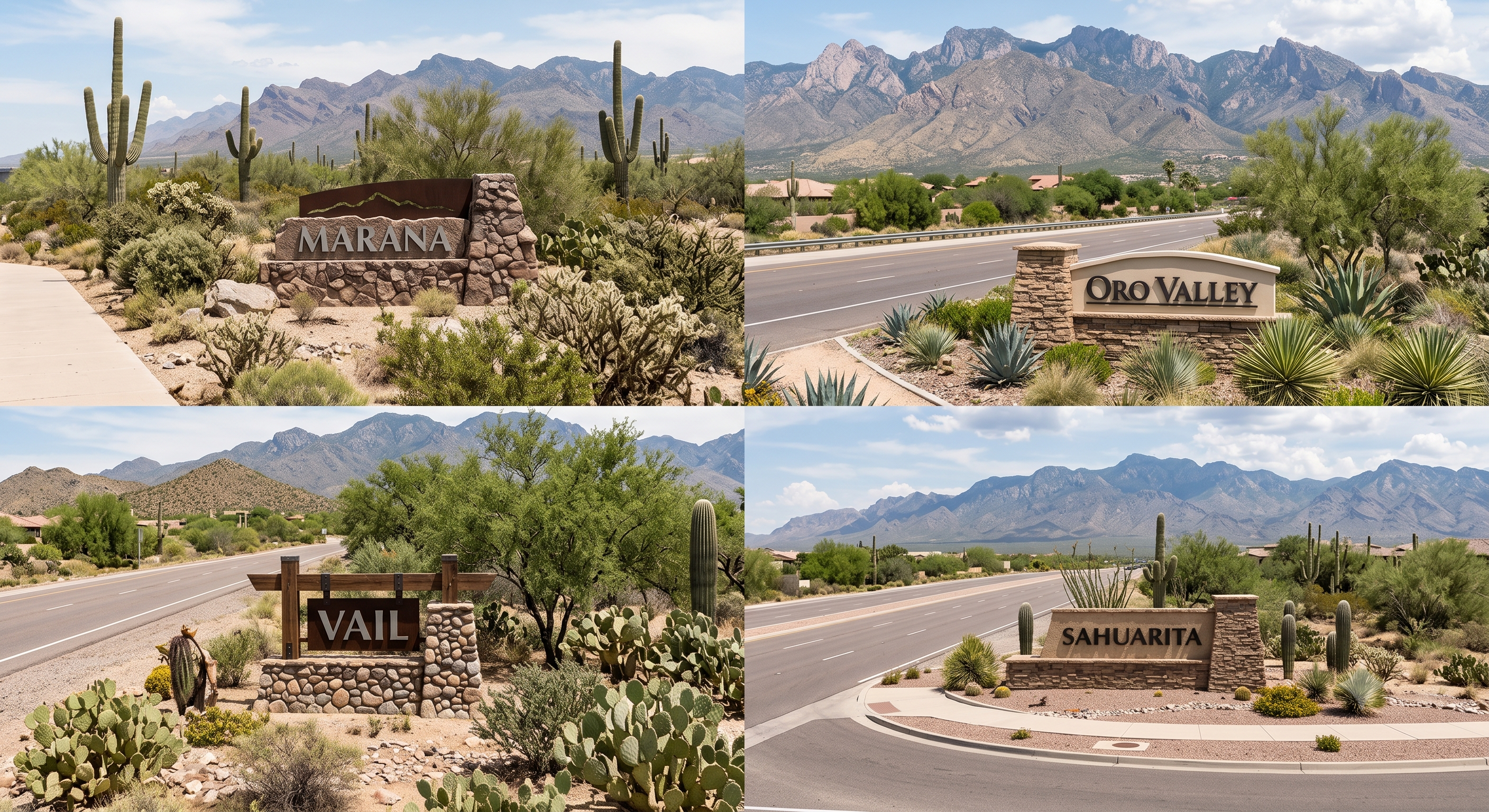
For families and professionals relocating to Southern Arizona in 2026, the region's most rapid residential and commercial expansion is happening outside the immediate city center. While the city of Tucson remains the cultural and historical core, surrounding municipalities like Marana, Vail, and Sahuarita are capturing the vast majority of new growth. Driven by steady net migration, top-rated school districts, and expanding employment hubs in aerospace and technology, the footprint of Southern Arizona is actively shifting.
Understanding these growth patterns—from the booming northwest corridor to the emerging southern employment hubs—is essential for anyone looking to purchase a home or invest in the region.
The Northwest Boom: Marana and Oro Valley
Marana
By almost every statistical measure, Marana is currently the fastest-growing municipality in Southern Arizona. With a population pushing toward 68,000 in 2026—a nearly 29% increase since the 2020 census—the town is a magnet for both first-time buyers and those seeking luxury estates. The bulk of the new residential permitting is concentrated in North Marana, where expansive master-planned communities like Gladden Farms, Mandarina, and Monarch are delivering hundreds of new homes. The appeal of Marana lies in its modern infrastructure, brand-new schools, and immediate freeway access, making it an easy commute to both downtown Tucson and the major employment centers to the north.
Oro Valley
Just to the east of Marana, Oro Valley presents a different type of growth. Known for its high-end golf communities, strict zoning, and sweeping views of the Santa Catalina Mountains, Oro Valley’s expansion is more deliberate. Rather than sprawling entry-level subdivisions, growth here is driven by luxury infill, active-adult communities, and the steady expansion of the local bioscience and technology sectors, anchored by facilities like Roche Tissue Diagnostics.
The Southeast Expansion: Vail, Rita Ranch, and East Tucson
Vail and Rita Ranch
If Marana is the star of the northwest, Vail is the undisputed engine of the southeast. Historically a quiet railroad town, Vail has exploded in popularity, primarily due to the Vail School District, which routinely ranks among the best in the state. Paired with the neighboring community of Rita Ranch, this area is seeing massive development tied to the Sonoran Corridor—a designated employment and infrastructure zone connecting Interstate 10 to Interstate 19. With proximity to major employers like Raytheon, Davis-Monthan Air Force Base, and the UA Tech Park, the southeast is capturing families who want newer homes and shorter commutes. Massive master-planned developments, such as the 2,000-home Camino Verano project, are actively shaping the future of this sector.
East Tucson
While largely built-out compared to the outer suburbs, East Tucson is experiencing a wave of targeted residential development. Builders are capitalizing on the remaining large tracts of land to create gated communities and infill neighborhoods. East Tucson appeals to buyers who want the energy efficiency and modern floor plans of newer construction without sacrificing the mature landscaping and established retail centers found closer to the city's core.
The Southern Reach: Sahuarita
Heading south down Interstate 19, the town of Sahuarita continues its steady, family-focused expansion. Anchored by the highly successful Rancho Sahuarita master plan, the town offers some of the most amenity-rich residential living in the region, featuring massive community pools, lakes, and extensive trail systems. Sahuarita’s growth is fueled by its relative affordability compared to the northern suburbs and its direct, traffic-free access to the aerospace and defense contractors located near Tucson International Airport.
Urban Evolution: Downtown Redevelopment
Growth isn't just about suburban subdivisions; it is also about urban revitalization. Downtown Tucson is not growing outward—it is building inward and upward. Over the past decade, downtown has transformed into a vibrant residential and entertainment district. In 2026, redevelopment continues with a focus on adaptive reuse and infill housing. Historic buildings are continuously being converted into modern lofts, boutique hotels, and subterranean dining concepts.
Furthermore, local zoning updates—such as the recent CODE Tucson '26 initiative—are making it easier for property owners to develop "middle housing," like duplexes and townhomes, within the central city. This allows for increased density and walkability without sacrificing the historic character of Tucson's urban core.
According to recent economic data, the Tucson Metropolitan Statistical Area relies heavily on net migration to sustain its population growth. While the raw percentages may seem modest compared to the Phoenix metro area, the localized impact is profound. The demand for housing is heavily concentrated in Marana, Vail, and Sahuarita, pushing builders to secure new lots and municipalities to expand roadways and utility services. For homebuyers, this means the outer suburbs will continue to offer the largest inventory of modern homes, while the central and foothills regions will see prices supported by high demand and geographic scarcity.
Frequently Asked Questions
What is the Sonoran Corridor?
The Sonoran Corridor is an employment, infrastructure, and transportation zone in Southeast Tucson, generally located between Interstate 10 and Interstate 19, south of the Tucson International Airport. It is designed to connect major logistics and technology employers, which in turn drives significant residential growth in Vail and Sahuarita.
Is it more expensive to buy a home in Oro Valley or Marana?
Generally, Oro Valley has a higher median home price due to its concentration of luxury golf communities, custom homes, and restricted land availability. Marana offers a wider variety of housing options, ranging from entry-level master-planned communities to multi-million-dollar estates in the Dove Mountain area.
Are there new schools being built in these fast-growing areas?
Yes. Both the Marana Unified School District and the Vail School District actively expand their footprints and build new campuses to accommodate the influx of families moving into these new subdivisions.
Is Downtown Tucson adding residential housing?
Yes. Downtown Tucson is adding residential units primarily through high-density projects, mid-rise apartment complexes, townhomes, and the adaptive reuse of historic commercial buildings into modern lofts.
Sources & Additional Resources
University of Arizona MAP Dashboard - Population Profile
https://mapazdashboard.arizona.edu
Town of Marana - Economic Development
https://www.maranaaz.gov
Pima County - Sonoran Corridor
https://www.pima.gov
City of Tucson - Planning and Development Services
https://www.tucsonaz.gov/pds

Tom Krieger
| The TJK Team - Realty Executives Arizona Territory
or another way