
Categories
Homeowner Guide, Home ImprovementPublished August 25, 2026
Why Don't Most Tucson Homes Have Basements?

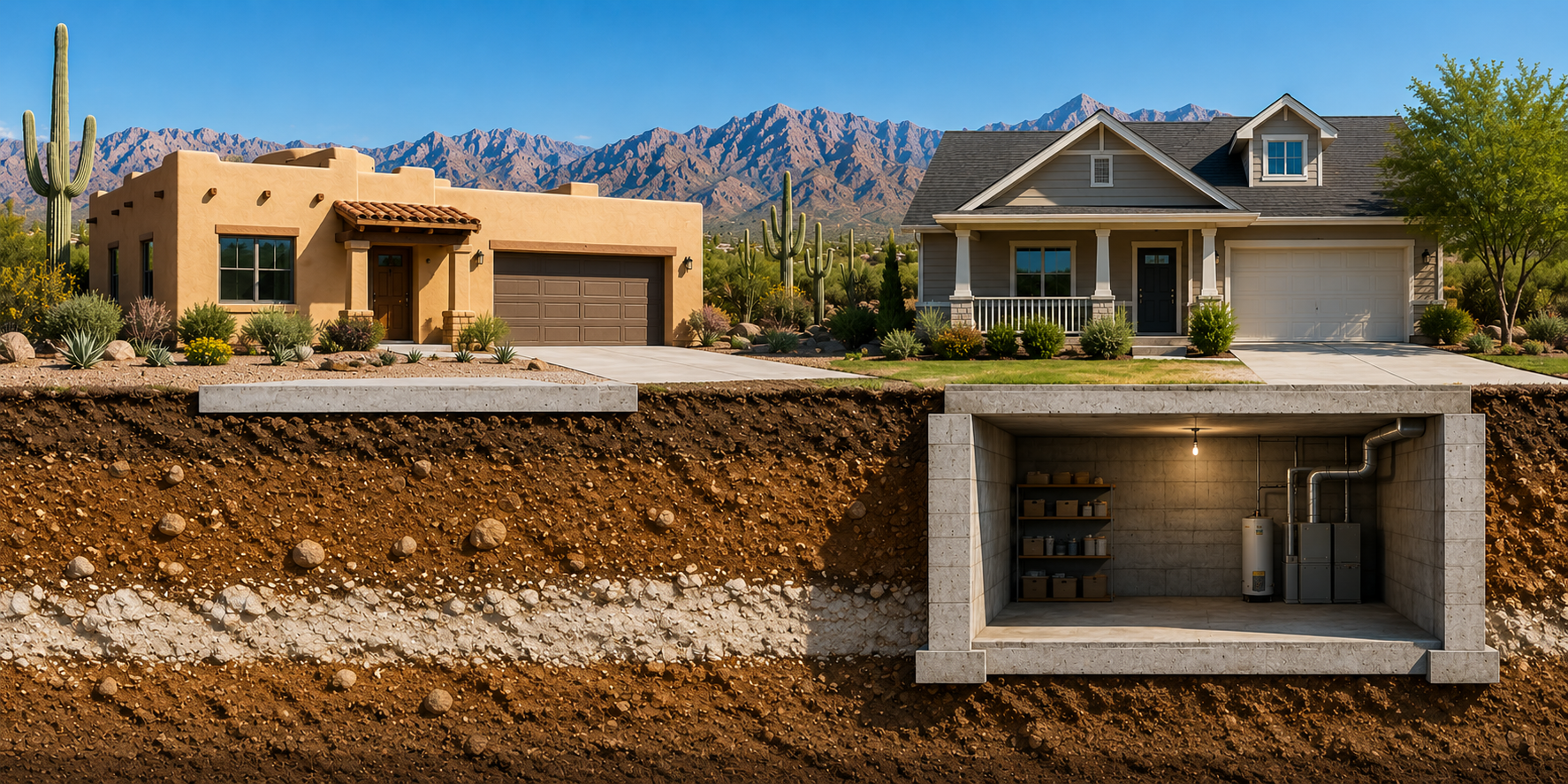
If you grew up somewhere like the Midwest or Northeast, one feature of Tucson homes can seem a little strange at first:
Where are all the basements?
In many parts of the country, a basement feels almost like a standard part of a house. It might hold the furnace and water heater, provide storage, contain a laundry room, or offer additional living space.
Then you come to Tucson and discover that most homes simply don't have one.
I've heard several explanations over the years. One of the most common is, “It's because the ground is too hard.” Another is, “You can't build basements because of caliche.”
There's some truth buried in those explanations—pun intended—but neither tells the whole story.
The real answer has much more to do with climate, foundation requirements, regional construction practices, excavation costs, and how Tucson homes evolved to use space above ground.
And yes, Tucson does have some homes with basements.
They're just the exception rather than the rule.
Why Are Basements Uncommon in Tucson?
Basements are uncommon in Tucson because local homes generally don't require the deep foundations associated with severe frost conditions in colder climates. Once builders don't already need to excavate several feet for frost protection, constructing an entire underground level becomes an additional project involving excavation, structure, drainage, waterproofing, access, and added construction cost.
This is the most important piece of the puzzle.
In colder parts of the country, foundations often need to extend below the local frost depth. That helps protect a structure from movement associated with freezing and thawing soil.
When you're already excavating deeply around much of a home's footprint, extending that construction into usable basement space can make more practical sense.
Tucson has a very different climate.
According to the National Weather Service Tucson, Tucson's 1991–2020 normal January high is 66.5°F and its normal January low is 40.8°F. Freezing nights certainly occur, but prolonged deep freezes aren't characteristic of Tucson's valley climate.
That changes the construction equation.
The City of Tucson currently uses the 2024 International Residential Code with local amendments for applicable residential construction. Foundation design still has to meet adopted building requirements, of course, but Tucson's climate doesn't create the same frost-driven incentive for deep excavation found in many colder regions.
If a house can be appropriately supported without excavating an entire story underground, a basement becomes an optional design choice rather than something construction already makes relatively convenient.
What Does Frost Have to Do With Basements?
In climates with significant ground freezing, foundation design generally accounts for frost-related soil movement by extending footings to an appropriate depth or using another code-compliant frost-protection method. This can make substantial excavation part of ordinary construction. Tucson's comparatively mild winters reduce that particular reason for digging deeply beneath a house.
This was the connection I didn't fully appreciate until I started learning more about how homes are built in different parts of the country.
Basements and cold weather aren't connected simply because people in cold climates want more indoor space.
They're also connected through foundations.
When moisture in susceptible soil freezes, it can expand and contribute to frost heave. Building codes therefore contain provisions designed to protect foundations from frost-related movement where those conditions apply.
In Tucson, winter looks very different.
National Weather Service climate records show that freezing temperatures do happen, and Tucson has experienced significant historical cold events. But its normal winter temperatures are much milder than those of many basement-heavy housing markets. National Weather Service Tucson climate records
So Tucson builders historically haven't faced the same widespread need to excavate deeply simply to get foundations below a substantial frost line.
That doesn't make basements impossible.
It simply removes one of the reasons they became so common elsewhere.
Is Caliche the Reason Tucson Homes Don't Have Basements?
Caliche can make excavation more difficult in some Southern Arizona locations, but saying Tucson doesn't have basements “because of caliche” oversimplifies the issue. Subsurface conditions vary considerably from property to property, and basement feasibility depends on actual site conditions, engineering, excavation requirements, drainage, design, and construction economics rather than one regional soil characteristic.
This might be Tucson's favorite basement explanation.
“We don't have basements because of caliche.”
Caliche is real, and it can absolutely matter during excavation.
In desert environments, calcium carbonate and other minerals can accumulate within soil and sediment and cement material together. Some layers can become quite hard.
But here's the important part:
Not every Tucson property has identical subsurface conditions.
The Tucson basin contains varied geological materials and soil conditions. The Arizona Geological Survey documents the region's complex geology, including basin sediments deposited over long periods by surrounding mountain systems.
That means a builder shouldn't assume what's underground based simply on the fact that the property is in Tucson.
One site might encounter relatively workable material.
Another might encounter strongly cemented soil, rock, expansive material, fill, groundwater considerations, or other conditions that affect excavation and foundation design.
That's why geotechnical investigation and engineering matter when subsurface conditions become relevant to a construction project.
Caliche can be part of the answer.
It just isn't the answer.
What Foundations Are More Common in Tucson?
Tucson's residential construction commonly uses foundation systems that keep most or all living space above grade rather than creating a full underground level. The appropriate foundation depends on the property's soils, engineering, home design, age, and applicable building requirements, so the foundation system of an individual home should be verified rather than assumed.
For many Tucson homeowners, the floor beneath their feet is much closer to grade than it would be in a traditional basement house.
Slab-on-grade construction is familiar throughout Southern Arizona, particularly in newer and postwar housing.
Other homes—especially older properties or buildings with particular site conditions—may use different foundation systems.
What matters is that the foundation be appropriate for the structure and site.
The City of Tucson currently adopts the 2024 International Residential Code, along with local amendments, for applicable residential construction. City of Tucson Building Codes
Pima County similarly administers adopted building codes and local requirements for construction within its jurisdiction. Pima County Development Services
For homeowners and buyers, architectural appearance isn't enough to determine exactly how a home is supported.
If foundation type or condition matters to a purchase, renovation, or repair, verify it through available records and the appropriate qualified professional.
Why Build Above Ground Instead?
When deep excavation isn't otherwise necessary, builders can often create living areas, storage, mechanical space, garages, and utility areas above grade. Tucson's historic development patterns and available land also allowed many homes to spread horizontally, making an underground floor less essential to the typical residential layout than it became in some denser or colder markets.
Think about the way many Tucson homes are arranged.
Single-story houses are everywhere.
Garages and carports are common.
Mechanical equipment doesn't necessarily need a basement utility room.
Storage can be incorporated into garages, closets, sheds, or other above-grade spaces.
And historically, Tucson had room to grow outward.
That combination matters.
If a builder wants another 500 square feet of usable space, there are generally two broad possibilities: put it underground or incorporate it somewhere above grade.
Once deep excavation isn't already required for the foundation, underground space means adding excavation, retaining walls or structural foundation walls, waterproofing, drainage considerations, stairs, emergency escape and rescue openings where applicable, and other design requirements.
Above-grade construction presents its own costs and constraints, but in Tucson there hasn't historically been the same structural or climatic reason to default to a basement.
Tucson vs. Colder-Climate Construction
Basement prevalence reflects regional construction conditions rather than a universal standard for how houses should be built. Colder climates often have deeper frost-related foundation requirements, while Tucson's mild desert climate generally allows different approaches. Local soil conditions, land patterns, building traditions, mechanical systems, and construction economics further influence whether underground space makes practical sense.
| Factor | Tucson | Many Colder-Climate Markets |
|---|---|---|
| Winter climate | Generally mild at valley elevations | Prolonged freezing can be common |
| Frost-related foundation needs | Less extensive in typical conditions | Deep frost protection may be necessary |
| Full basements | Uncommon | Common in many regions |
| Living space | Primarily above grade | Basement may provide additional space |
| Mechanical equipment | Commonly accommodated without basement | Frequently placed in basement |
| Excavation | Full-depth excavation is an added construction step | Deeper foundation excavation may already be required |
| Soil conditions | Vary significantly by property | Also vary by region and site |
| Regional tradition | Above-grade living dominates | Basement construction established in many markets |
This table is intentionally general.
There isn't one foundation system for Tucson, just as there isn't one foundation system for every cold-weather city.
Construction is always site-specific.
Can You Build a Basement in Tucson?
Yes. A basement can be built in Tucson when the site's conditions, design, engineering, drainage, permitting, and construction approach support it. Local building codes do not make basements inherently impossible. They are simply less common, and adding below-grade space introduces considerations that don't exist with a straightforward above-grade floor plan.
This is probably the biggest misconception worth correcting.
Tucson can have basements.
There are homes here that do.
The question isn't really, “Can you build one?”
It's:
Does building one make sense for this particular project and site?
A basement design may require consideration of:
- Excavation conditions
- Soil characteristics
- Structural engineering
- Foundation walls
- Waterproofing
- Drainage
- Stairs
- Ventilation
- Natural light
- Emergency escape and rescue requirements where applicable
- Utilities
- Permitting
- Construction access
Those aren't reasons not to build one.
They're simply part of the design and construction process.
Anyone considering adding below-grade space should work with appropriately licensed design, engineering, geotechnical, and construction professionals and verify current requirements with the applicable jurisdiction.
Does a Desert Basement Still Need Waterproofing and Drainage?
Yes. Tucson's low annual rainfall doesn't eliminate water or drainage considerations for below-grade construction. Monsoon thunderstorms can produce intense localized rainfall and runoff, while grading, drainage paths, soils, and site conditions affect how water behaves around a structure. Below-grade spaces therefore require appropriate site-specific drainage and moisture-management design.
This is another place where the word desert can create a false sense of simplicity.
Tucson doesn't receive rainfall the way Seattle does, but when it rains here, it can rain hard.
The National Weather Service lists Tucson's 1991–2020 normal annual rainfall at about 10.61 inches, with a substantial portion of the normal rainfall occurring during the summer monsoon months. National Weather Service Tucson
That means drainage still matters.
Water can move across a property through grading, natural drainage paths, streets, yards, and washes.
A below-grade wall is fundamentally different from an above-grade wall because soil and moisture are directly against it.
That's why waterproofing, drainage, grading, and site-specific engineering aren't optional details simply because the house happens to be in Arizona.
What Should Buyers Know If a Tucson Home Has a Basement?
A basement in a Tucson home isn't automatically a benefit or a problem. Buyers should evaluate it as part of the property itself, reviewing permits and available records while considering moisture, drainage, structural condition, ventilation, access, egress, and any alterations. Questions outside ordinary real estate expertise should be directed to qualified inspectors and specialists.
When you encounter a basement in Tucson, the novelty can make it easy to focus on the extra space.
I think the better approach is to treat it exactly like any other unusual or significant property feature:
Understand what you're looking at.
Depending on the property, buyers may want to investigate:
- Was the basement part of the original construction?
- Were later alterations permitted where required?
- Are there signs of moisture intrusion?
- How does exterior drainage work?
- Are there visible cracks or movement that warrant further evaluation?
- How is the space ventilated and conditioned?
- If rooms are being represented for a particular use, do applicable requirements support that use?
- Are appropriate emergency escape and rescue provisions present where required?
- What do available property and permit records show?
A real estate professional can help identify documents and questions, but shouldn't diagnose structural, geotechnical, moisture, or engineering conditions.
Those conclusions belong with the appropriate professionals.
Are Basements Better Than Homes Without Them?
Neither construction approach is inherently better. A basement can provide additional space, while an above-grade design may offer a simpler configuration for a particular property. Quality depends on design, construction, maintenance, site conditions, and how the home meets an owner's needs—not on whether part of the house happens to be underground.
This is where I think homeowner education is more useful than trying to rank features.
A basement might be valuable to one homeowner because they want storage, a workshop, or additional usable space.
Someone else might prefer everything on one level.
Neither preference tells us whether the house itself is well designed or well maintained.
And we shouldn't assume that a Tucson home with a basement is automatically more valuable simply because basements are uncommon.
Real estate value depends on many property- and market-specific factors.
The more useful question is whether the home's layout, construction, condition, and features make sense for the person evaluating it.
Common Tucson Basement Myths
Several common explanations for Tucson's lack of basements contain partial truths but miss the broader construction context. Caliche can affect excavation, desert homes still require drainage planning, and basements are legally and physically possible. Their rarity is better explained by the combination of climate, foundations, site conditions, construction practices, and economics.
“You can't build basements in Tucson.”
You can. They're simply uncommon.
“The ground is all solid rock.”
No. Subsurface conditions vary substantially across the Tucson region.
“It's all because of caliche.”
Caliche can complicate excavation at some sites, but it isn't present in the same form or depth everywhere and doesn't explain basement prevalence by itself.
“Basements aren't needed because Arizona never freezes.”
Tucson does experience freezing temperatures. The more accurate point is that its winter climate doesn't generally create the same deep frost-foundation conditions common in much colder regions.
“You don't need to worry about water underground because Tucson is a desert.”
Incorrect. Monsoon rainfall, runoff, drainage, grading, and site conditions still matter for below-grade construction.
“A basement automatically makes a Tucson home worth more.”
Not necessarily. Property value depends on numerous characteristics and current market conditions.
Frequently Asked Questions About Tucson Basements
Why don't most Tucson homes have basements?
Tucson's mild climate generally doesn't require the deep frost-protected foundations common in colder regions. Without that initial excavation requirement, constructing a basement becomes a separate design and construction decision. Regional building traditions, site conditions, costs, and above-grade space also contribute.
Is caliche the main reason Tucson doesn't have basements?
Not by itself. Caliche and other hard or cemented materials can make excavation more difficult at certain sites, but subsurface conditions vary. Tucson's climate, foundation requirements, construction practices, and economics are also important factors.
Are there homes with basements in Tucson?
Yes. Basements exist in Tucson, but they're much less common than in many colder parts of the United States.
Can a new home in Tucson be built with a basement?
Potentially, yes. Feasibility depends on the property, soils, engineering, design, drainage, permitting, construction requirements, and project economics.
Do Tucson basements have to worry about flooding or water intrusion?
Below-grade construction still requires appropriate drainage and moisture management. Tucson's desert climate includes intense rainfall events, particularly during the summer monsoon, so property-specific drainage conditions matter.
Are basements cooler in Tucson?
Below-grade spaces can experience different thermal conditions from above-grade rooms because surrounding soil moderates temperature changes, but actual comfort and energy performance depend on insulation, construction, ventilation, HVAC, moisture management, and design. A basement shouldn't automatically be assumed to remain comfortable without appropriate building systems.
Should I be concerned if I'm buying a Tucson home with a basement?
Not simply because it has a basement. Like any major property feature, it deserves appropriate inspection and due diligence. Buyers can review permits and records and consult qualified professionals when structural, drainage, moisture, geotechnical, or code questions arise.
Final Thoughts
The lack of basements in Tucson is one of those little details that tells a much bigger story about how regional housing develops.
Homes aren't constructed the same way everywhere because the conditions aren't the same everywhere.
Climate matters.
Soils and geology matter.
Building codes matter.
Available land matters.
Construction traditions matter.
And economics matter.
In Tucson, builders generally haven't needed to dig deeply simply to protect most residential foundations from severe frost conditions. Once you remove that reason for excavation, putting an entire floor underground becomes an additional construction choice rather than the natural next step.
Caliche can certainly make the job harder in some places, but it isn't the simple explanation it's sometimes made out to be.
And that's what I find most interesting about the question.
Something as ordinary as noticing that your Tucson home doesn't have a basement can lead to a much better understanding of how homes are adapted to the places where they're built.
Educational Note
This article provides general educational information and is not intended as structural, engineering, geotechnical, construction, legal, or code advice. Soil conditions, foundation systems, drainage requirements, permitting, and building requirements vary by property and jurisdiction. Property-specific questions should be evaluated using current records and the appropriate qualified professionals.

Tom Krieger
| The TJK Team - Realty Executives Arizona Territory
or another way