
Categories
Homeowner GuidePublished September 23, 2026
Renovate vs. Move: A Southern Arizona Homeowner’s Guide

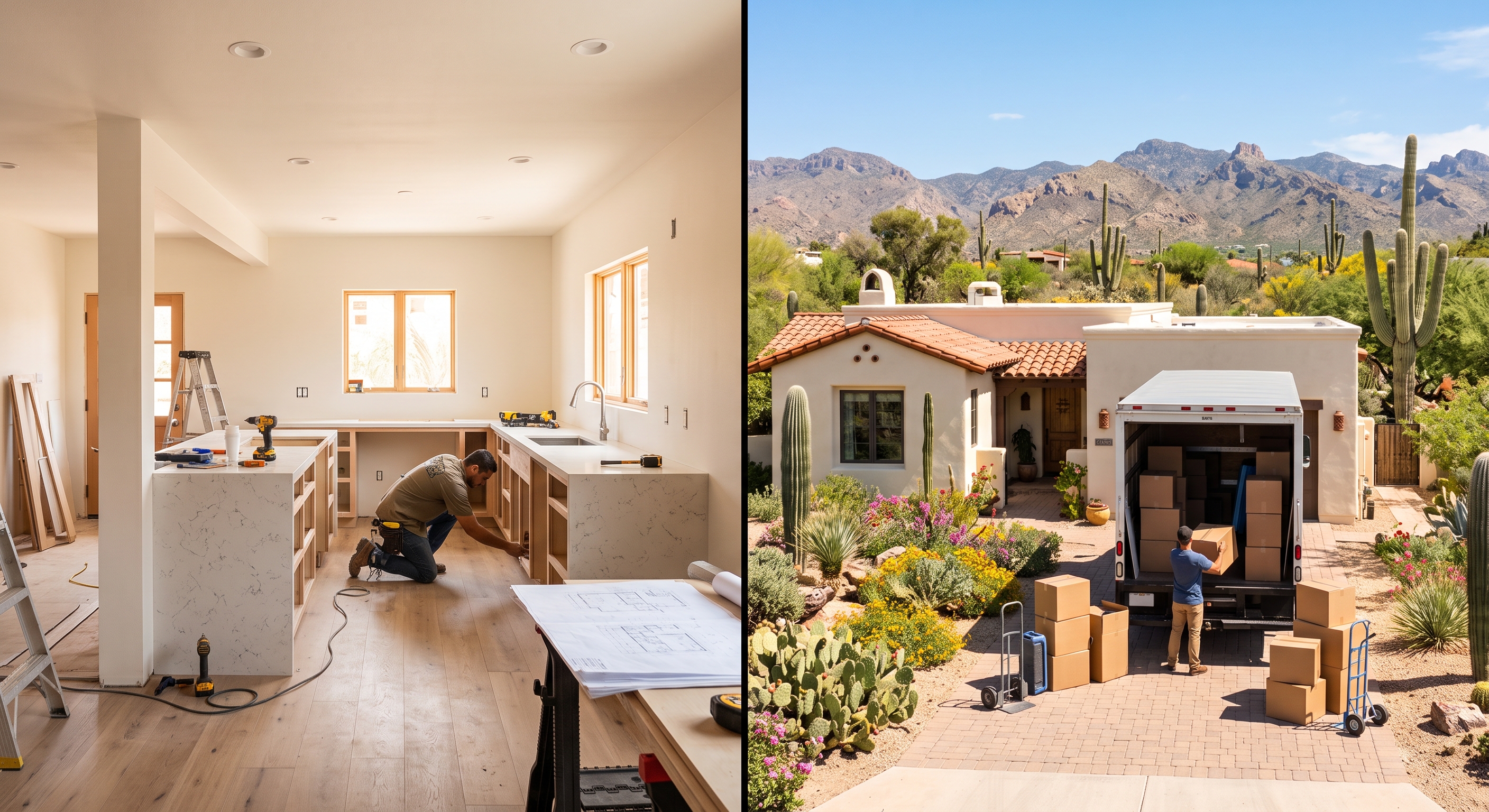
Deciding whether to update your current house or shop for a new one is one of the most significant financial and lifestyle choices a homeowner will face. In Southern Arizona, this choice involves distinct local factors—from the architectural character of established Tucson neighborhoods to local property tax structures and regional climate considerations. Evaluating your budget, everyday routine, long-term goals, and current market conditions will help clarify the best path forward.
Cost Considerations: Budgeting Beyond the Surface
Every housing decision begins with bottom-line finances, but the upfront price tag rarely tells the full story. Comparing real-world expenses requires looking at hidden costs, equity, and financing structures.
Renovating Your Current Home
- Direct Expenses: Construction labor, building permits, architectural drawings, and materials.
- Financing Options: Home Equity Lines of Credit (HELOCs), cash-out refinances, or home equity loans allow you to leverage existing equity.
- Hidden Costs: Budget overruns, unexpected structural or mechanical repairs, and temporary housing expenses if the project renders the home uninhabitable.
Moving to a New Home
- Direct Expenses: Real estate commissions, title and escrow fees, lender origination fees, moving services, and potential repairs requested by buyers on your current property.
- Financing Options: Porting current equity into a down payment on a new mortgage loan.
- Hidden Costs: Immediate out-of-pocket setup costs, including utility connection fees, window treatments, initial landscaping updates, and higher property tax baselines on a higher-priced home.
Lifestyle Changes: Daily Routine and Community
Where you live shapes how you live. Renovation allows you to preserve your established routines, while moving offers a fresh start in a new environment.
- Staying Put: Renovating keeps your family anchored in your current neighborhood. You retain existing school drop-off routes, familiar commute times, established relationships with neighbors, and proximity to local parks or shopping centers.
- Relocating: Moving allows you to fundamentally change your environment. This might mean shortening a daily commute, securing entry into a specific school district, moving closer to outdoor recreation like the Catalina or Tucson Mountain foothills, or shifting to a low-maintenance low-maintenance community with HOA-maintained common areas.
- Living Through Construction: Renovating requires enduring months of dust, noise, worker foot traffic, and supply-chain delays. Moving shifts the stress to packing, purging, closing timelines, and settling into an unfamiliar space.
Space Needs: Lot Constraints vs. Floor Plan Limits
Sometimes a home feels uncomfortable simply because the layout no longer fits your stage of life. The decision often hinges on whether your physical lot can accommodate expansion.
- When to Renovate: If your lot is large enough to allow for a room addition, converting an unused garage, or opening up closed-off interior walls, remodeling can solve functional space issues. It allows you to tailor the layout specifically to your lifestyle—such as adding a dedicated home office, expanding a cramped kitchen, or building an accessible primary suite.
- When to Move: Physical property boundaries, local zoning setbacks, or homeowners association (HOA) restrictive covenants can make expanding impossible. If you need a significantly larger yard, a multi-car garage, or a single-story floor plan to eliminate stairs, moving is usually the only practical solution.
Market Conditions: Interest Rates and Local Inventory
Current real estate market dynamics in Tucson and Pima County play a heavy role in determining which option makes financial sense.
- Interest Rate Environment: Homeowners who secured historically low mortgage interest rates in past years often find that selling and buying a new home at current prevailing rates results in a significantly higher monthly payment—even if the purchase price is similar. In this scenario, financing a remodel through a separate loan or cash may preserve overall monthly cash flow.
- Housing Inventory: When local housing inventory is limited, finding a home that meets your specific criteria, location preferences, and price point can be challenging. Renovating eliminates the competition of a seller's market, allowing you to invest directly into your existing property.
Long-Term Planning: Equity and Aging in Place
Your choice should align with your multi-year financial strategy and long-term personal mobility needs.
- Return on Investment (ROI): Not all renovation projects return dollar-for-dollar value upon resale. Kitchen and bathroom updates generally yield strong returns, whereas over-improving a home far beyond the average standard of your immediate neighborhood can cap your resale potential.
- Aging in Place: Renovating allows you to incorporate universal design elements—such as curbless showers, wider doorways, and zero-step entries—to ensure you can stay in your home comfortably for decades.
- Future Resale Value: Purchasing a home in a high-demand, growing corridor of Southern Arizona may yield greater equity appreciation over a ten-year horizon than remodeling an older home with structural limitations.
Frequently Asked Questions
Which option is generally less stressful: renovating or moving? Stress is subjective and depends on what you find more manageable. Renovating involves living in an active construction zone or managing temporary housing, along with handling unexpected project delays and dust. Moving involves the compressed pressure of listing your property, staging, packing, underwriting timelines, and coordinating closing dates.
How do I know if my home is risk of being "over-improved" for my neighborhood? A home is over-improved when the planned renovation costs push its total market value significantly above the highest comparable sales in your immediate subdivision. While you will enjoy the upgrades, you may not recoup the expenditure when you eventually sell. A local real estate professional or licensed appraiser can provide a comparative market analysis before major construction begins.
Can I include the cost of renovations in my existing mortgage? Standard existing mortgages cannot be modified to add renovation costs. However, homeowners can explore refinancing into a specialized renovation loan (such as a Fannie Mae Homestyle loan), utilizing a cash-out refinance, or taking out a separate Home Equity Line of Credit (HELOC) or second mortgage secured by their home equity.
How do property taxes differ between remodeling and moving in Pima County? Moving to a new, higher-valued home typically resets your primary tax assessment base to the current market purchase price. Renovating your existing home may trigger a reassessment only on the value added by new square footage or major structural additions, leaving the base assessment on the original structure largely intact under Arizona tax laws.
Sources & Additional Resources
Arizona Department of Real Estate
Pima County Assessor’s Office
Multiple Listing Service of Southern Arizona (MLSSAZ)
National Association of REALTORS® Research and Statistics

Tom Krieger
| The TJK Team - Realty Executives Arizona Territory
or another way