Categories
Homeowner Guide, Buyer GuidesPublished October 30, 2026
What Tucson Homeowners Should Know About Sewer Line Inspections

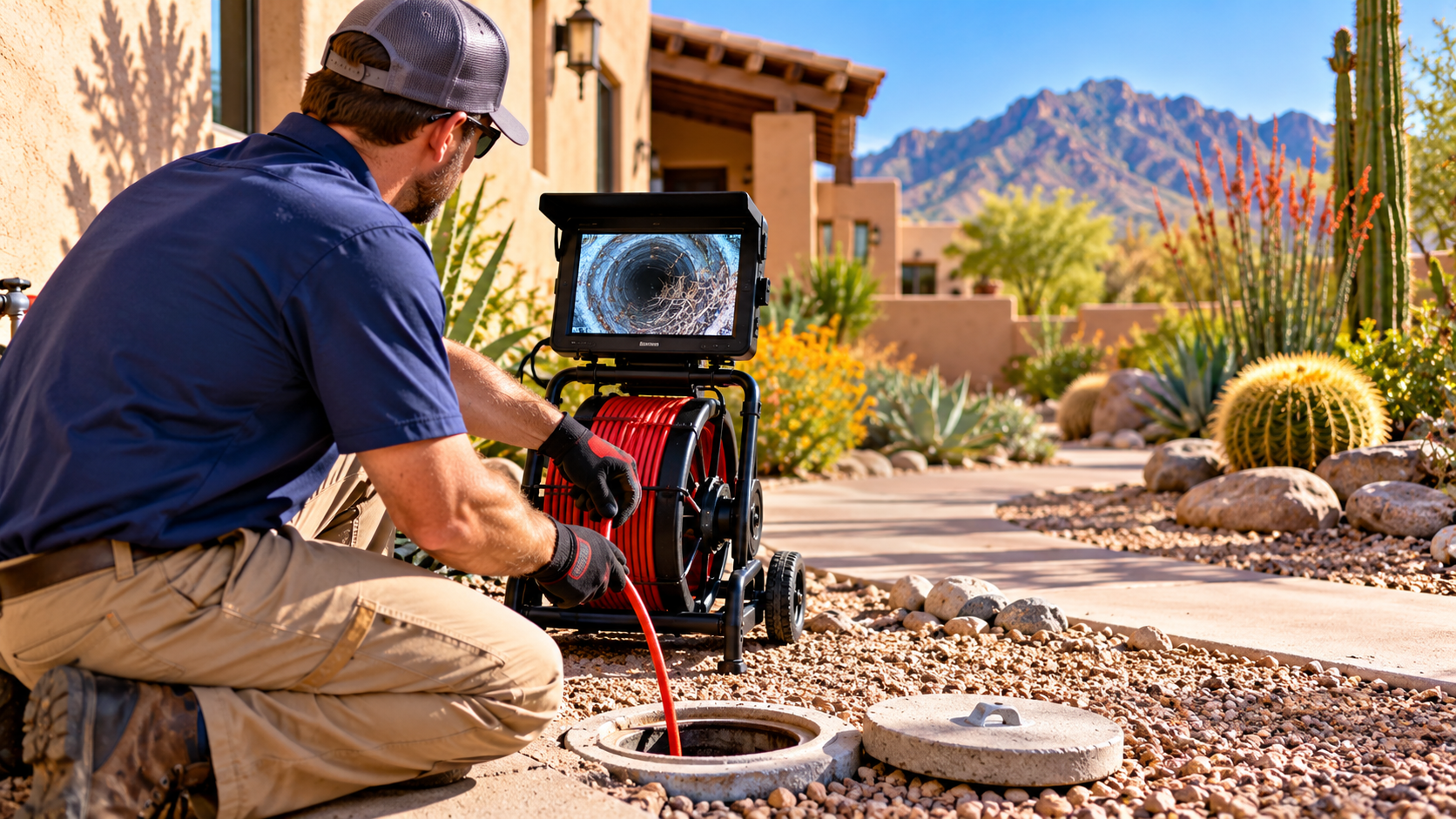
When we think about maintaining a home in Tucson, we usually focus on the things we can see. The roof, the air conditioner, the landscaping, and maybe the plumbing fixtures inside the house.
But there's another part of the home that deserves attention, even though it's mostly out of sight: the sewer line.
It's not exactly the most exciting homeownership topic, I know! But understanding how sewer line inspections work can be helpful, especially if you're buying a home, preparing to sell, or dealing with recurring plumbing concerns.
One thing I always want homeowners to understand is that a sewer line inspection isn't the same thing as a standard home inspection.
And just because a home is older—or because a camera reveals something worth investigating—doesn't automatically mean there's a major problem.
Let's walk through what Tucson homeowners should know.
What Is a Sewer Line Inspection?
A sewer line inspection, often called a sewer scope or sewer camera inspection, uses specialized video equipment to examine accessible portions of a home's sewer lateral. The inspection can reveal visible conditions such as cracks, root intrusion, blockages, and pipe separation. However, it is limited to what the camera can access and observe during the inspection.
A sewer line carries wastewater away from the home toward a public sewer connection or, where applicable, an onsite wastewater system.
During a sewer camera inspection, a qualified professional introduces a camera into an accessible opening, often called a cleanout, and guides it through the pipe.
The camera provides a view of the pipe's interior.
According to InterNACHI's Sewer Scope Inspection Standards of Practice, a sewer scope is intended to identify visible material defects in the accessible sewer lateral and document the portions inspected.
The inspector may also be able to identify the pipe material, although that isn't always possible.
What I think is especially useful about this process is that it gives homeowners information about a part of the property they otherwise wouldn't be able to see.
That said, a camera inspection is not a guarantee that every portion of the system is free of defects.
Is a Sewer Line Inspection Included in a Standard Home Inspection?
Homeowners should not assume a standard home inspection includes a sewer camera inspection. A sewer scope is a separate, specialized evaluation that may need to be scheduled independently. Before hiring an inspector, ask exactly which plumbing components will be examined and whether the underground sewer lateral is included in the agreed inspection services.
This is an important distinction for anyone buying a home.
A general home inspection provides valuable information about accessible systems and components, but it doesn't necessarily include a camera examination of the underground sewer pipe.
The InterNACHI sewer scope standards describe a specialized inspection with its own scope, procedures, and limitations.
So if you're purchasing a Tucson home and want the sewer lateral evaluated, ask about that service specifically.
A few questions worth asking include whether the inspection is included in the quoted price, whether the provider records the video, and what happens if the camera cannot reach the full intended length of the line.
It's much better to understand the scope before the appointment than to assume something was inspected when it wasn't.
Why Might Tucson Homeowners Consider a Sewer Camera Inspection?
Tucson homeowners may consider a sewer camera inspection when purchasing a property, investigating recurring drainage problems, reviewing an older home's maintenance needs, or following up on previous sewer repairs. These situations do not establish that a defect exists. An inspection can provide additional information to help determine whether further evaluation or maintenance is appropriate.
There isn't one universal situation that makes a sewer scope necessary for every home.
Instead, I think it's helpful to consider what you're trying to learn.
For example, if you're buying a home, you may want additional information about the underground sewer line before completing your due diligence.
If you already own the property and have experienced repeated drain backups or other recurring plumbing concerns, a professional may recommend a camera inspection as part of the investigation.
And if you're preparing to sell, you might decide to learn more about the condition of the line before the home goes on the market.
The age of a home can be part of that conversation, but it shouldn't be treated as a diagnosis.
An older Tucson home doesn't automatically have a damaged sewer line, and a newer home isn't automatically free of sewer concerns.
The decision should depend on the property's history, symptoms, available records, and guidance from an appropriately qualified professional.
What Can a Sewer Camera Inspection Reveal?
A sewer camera inspection may reveal visible pipe cracks, root intrusion, blockages, separated joints, standing water, deterioration, or other conditions within the accessible line. These observations can help a professional determine whether additional evaluation is needed.
Camera footage alone does not necessarily establish the underlying cause, severity, repair method, or total repair cost.
One reason homeowners schedule sewer scopes is to get a closer look at conditions that aren't visible from inside the house.
The InterNACHI sewer scope standards identify several observations that an inspector may report.
Here's a practical way to think about some of them:
| Possible Observation | What It May Indicate | Useful Follow-Up Question |
|---|---|---|
| Visible crack | An opening or damage in the pipe wall | Does this require additional evaluation or correction? |
| Root intrusion | Roots visible inside the pipe | How much of the pipe is affected, and what are the appropriate next steps? |
| Blockage or restriction | Material interfering with the pipe opening | What is causing the restriction, and how should it be addressed? |
| Offset or separated joint | Pipe sections that do not align or connect as expected | Is further evaluation needed to determine the extent of the condition? |
| Standing water | Water remaining in part of the line during inspection | What additional information is needed to understand why it is present? |
| Visible deterioration | Changes or damage affecting the pipe interior | What is the condition of the affected section, and what options should be evaluated? |
The important thing to remember is that an observation isn't always the same as a complete diagnosis.
For example, footage might show standing water, but determining why it's there could require additional investigation.
Similarly, seeing roots inside a pipe doesn't automatically tell you the extent of the issue or the appropriate repair method.
A qualified plumbing professional can help interpret findings and explain reasonable next steps.
What Can't a Sewer Line Inspection Tell You?
A sewer scope has important limitations. It generally documents visible conditions in accessible portions of the sewer lateral at the time of inspection. It may not identify concealed defects, determine every cause of a problem, evaluate inaccessible sections, or predict future performance. Homeowners should review the report's exclusions before relying on its conclusions.
This might be the most important part of the entire conversation.
A camera inspection can provide useful information, but it isn't a complete evaluation of every underground condition.
According to InterNACHI, a sewer scope is not technically exhaustive and does not identify every concealed or future defect.
The inspection may also be limited by access.
If there isn't a suitable cleanout, or if the camera encounters an obstruction, the inspector may not be able to evaluate the entire intended line.
That doesn't necessarily mean there's a major problem. It means part of the system wasn't inspected.
I would encourage homeowners to ask for a report that clearly explains which sections were evaluated, which sections weren't, and why.
That information matters just as much as the observations themselves.
Who Is Responsible for Sewer Lines in Pima County?
For properties connected to Pima County's public sewer system, the county states that the private sewer pipe connecting a home or business to the public sewer is owned by the property owner, up to and including the connection point. Property owners are responsible for maintaining that private pipe and protecting it from damage.
This is one of the most useful local details for Tucson homeowners.
According to Pima County's Sewer Connections information, the private pipe connecting a property to the public sewer is the property owner's responsibility through the point where it connects to the public system.
That means homeowners shouldn't automatically assume a sewer problem becomes the county's responsibility simply because part of the pipe runs outside the house or beneath a yard.
At the same time, every property should be evaluated according to its actual sewer connection and applicable circumstances.
Not all properties use the same wastewater arrangement, and some may have onsite wastewater systems rather than connections to the public sewer.
Pima County provides sewer connection records and additional information through its Sewer Connections page.
For public sewer concerns, the county also provides a wastewater service request system.
If you're unsure where a line connects or which agency is responsible for a particular issue, checking the official records is a good place to start.
When Should a Homeowner Contact a Plumbing Professional?
Homeowners should consider contacting a qualified plumbing professional when drainage problems recur, sewage backs up, or a sewer inspection identifies a condition requiring further evaluation. Symptoms alone do not establish the cause or location of a problem. Active sewage releases should be treated promptly, with appropriate precautions and professional assistance.
Sometimes a homeowner considers a sewer scope simply because they want more information.
Other times, something has already happened.
Maybe there's been a recurring drain backup, or a plumbing professional has noticed a condition that needs closer investigation.
In those situations, it's important not to guess at the cause.
A slow drain doesn't automatically mean the underground sewer lateral is damaged.
And a sewer backup doesn't necessarily identify which section of the plumbing or wastewater system is involved.
A qualified professional can determine whether a camera inspection is an appropriate part of the evaluation.
If sewage is actively backing up or being released, avoid contact with contaminated water and seek prompt assistance.
Pima County's Conveyance Division provides a 24-hour sewer emergency reporting number for county wastewater system concerns: 520-724-3400.
What Should You Ask Before Scheduling a Sewer Line Inspection?
Before scheduling a sewer scope, homeowners should ask what portion of the line will be inspected, how the camera will access it, whether video and a written report are included, and what limitations may apply. They should also clarify the provider's qualifications, inspection fee, and process for recommending further evaluation.
I always think a few questions upfront can make a service appointment much more useful.
For a sewer scope, I'd ask the provider to explain the intended inspection area and whether they expect to access the pipe through an existing cleanout.
I'd also want to know whether I'll receive the video footage and a written report.
If something unusual appears on the video, how will the provider document it?
And if the camera can't reach the full line, will the report explain where the inspection stopped?
These are reasonable questions because the InterNACHI sewer scope standards specifically address documenting visible conditions and inspection limitations.
If the findings lead to proposed repair or replacement work, that's a separate decision.
The Arizona Registrar of Contractors recommends checking a contractor's license status and classification, obtaining written estimates, and understanding the work described in a contract.
For homeowners, that means it's worth slowing down long enough to understand the findings and the proposed scope of work before authorizing major repairs.
What About Sewer Inspections When Buying or Selling a Tucson Home?
Buyers and sellers may use sewer camera inspections to gather additional information about a property's underground sewer lateral. Buyers can consider the service during their due-diligence process, while sellers may choose to investigate known concerns before listing. Inspection findings should be reviewed with qualified professionals and addressed according to the applicable transaction documents.
If you're buying a Tucson home, a sewer scope may be one of the specialized evaluations you consider during the inspection period.
The Arizona Department of Real Estate's Buyer Advisory is a useful resource for understanding the broader importance of researching a property before purchasing it.
A real estate agent can help you understand the inspection process and applicable contract timelines, while the sewer inspection provider explains the technical findings.
If you're selling, the same general principle applies: information is useful.
If you've experienced recurring sewer concerns or have documentation from previous work, it's worth discussing those records and any applicable disclosure obligations with the appropriate professionals.
A sewer scope also shouldn't be confused with a warranty.
It provides information about observed conditions on a particular date, not a promise about how the line will perform in the future.
Frequently Asked Questions About Sewer Line Inspections in Tucson
Tucson homeowners commonly ask whether sewer scopes are included in home inspections, whether older homes need them, what cameras can detect, and who maintains private sewer connections. The answers depend on the property's plumbing arrangement, inspection scope, and observed conditions. A qualified professional can help homeowners evaluate property-specific questions.
Is a sewer camera inspection included in a regular home inspection?
Not necessarily. A sewer scope is a specialized service, so homeowners and buyers should confirm whether it is included or needs to be scheduled separately.
Do all older Tucson homes need sewer line inspections?
Not automatically. Home age may be one factor to consider, but it doesn't establish the condition of the sewer line. A homeowner can discuss the property's history and any concerns with a qualified professional.
Can a sewer camera detect tree roots?
A sewer camera may reveal visible root intrusion inside an accessible pipe. The footage may not establish the full extent of the condition or the appropriate repair method.
Can a sewer scope identify every problem in the line?
No. The inspection is limited to accessible areas and visible conditions at the time of the inspection. Concealed or future defects may not be identified.
Who pays for sewer line repairs in Tucson?
For properties connected to Pima County's public sewer system, the county states that the property owner is responsible for the private sewer connection through the point where it joins the public sewer. Specific repair responsibilities and circumstances should be verified for the property.
How much does a sewer line inspection cost in Tucson?
Inspection fees vary by provider and scope. Rather than relying on a general estimate, request a written quote explaining what's included, whether video documentation is provided, and whether any additional charges may apply.
Does finding a crack mean the entire sewer line needs to be replaced?
Not necessarily. A visible crack should be evaluated by a qualified professional, but the appropriate response depends on the condition and extent of the issue. A camera observation alone doesn't establish that full replacement is necessary.
Should I get a sewer scope before buying a Tucson home?
It may be worth considering as part of your due diligence, particularly if you want additional information about the underground sewer lateral. Discuss the inspection scope and scheduling with your real estate agent and a qualified inspection provider.
Final Thoughts
Sewer line inspections probably aren't something most of us think about when we picture homeownership in Tucson.
But understanding what's happening below ground can be just as useful as paying attention to the parts of the home we see every day.
What I want homeowners to take away from this is that a sewer scope is an information-gathering tool.
It can help identify visible concerns, document conditions, and guide conversations with qualified professionals.
It doesn't automatically mean there's a problem, and it doesn't automatically mean a major repair is needed.
Whether you're buying, selling, or simply maintaining your Tucson home, knowing what a sewer line inspection involves can help you ask better questions and make more informed decisions.
And sometimes, that's the most valuable part of the process.
Homeowner Information Note: This article provides general educational information and is not a plumbing diagnosis, repair recommendation, legal opinion, or guarantee of a property's condition. Sewer systems, inspection access, maintenance responsibilities, and repair requirements can vary. Consult appropriately qualified professionals and the applicable local agency for property-specific guidance.

Tom Krieger
| The TJK Team - Realty Executives Arizona Territory
or another way