
Categories
Buyer EducationPublished September 16, 2026
What Happens Between Going Under Contract and Closing in Arizona?

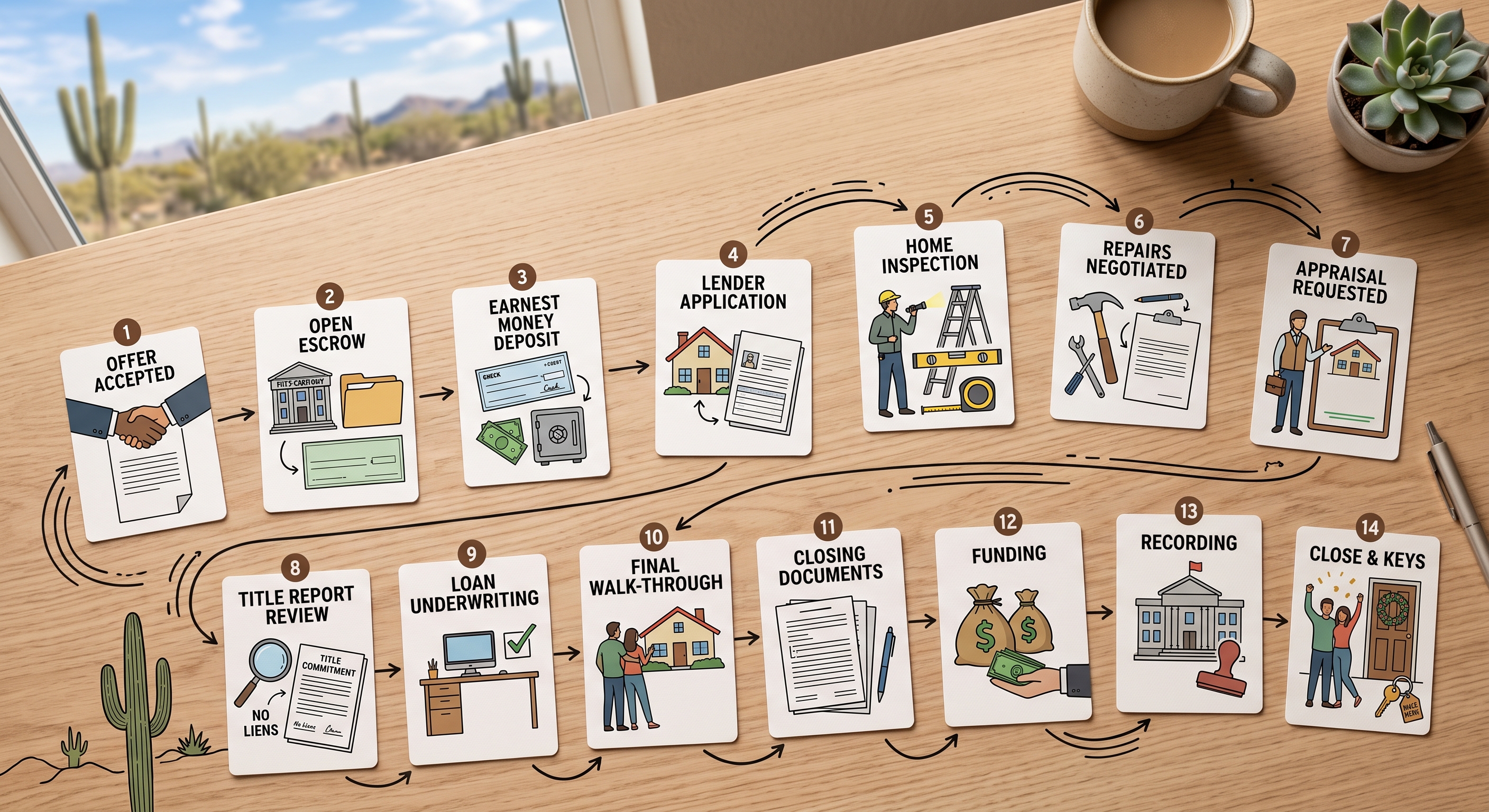
Accepting an offer on a home in Southern Arizona—whether in Tucson, Oro Valley, Marana, or Vail—is a major milestone. However, opening escrow is only the beginning of the transaction. The period between going under contract and closing day involves a structured sequence of inspections, valuations, legal verifications, and financial approvals.
Understanding this timeline helps both buyers and sellers navigate the transition smoothly and avoid preventable delays. Here is a step-by-step breakdown of what happens between going under contract and closing in Arizona.
1. Opening Escrow and Earnest Money
Once a purchase contract is fully executed by all parties, the transaction officially begins with the opening of escrow.
- Neutral Escrow Account: In Arizona, real estate transactions are processed through a neutral third-party title and escrow company rather than an attorney. Escrow acts as a neutral clearinghouse, holding funds and legal documents until all contract conditions are met.
- Earnest Money Deposit: Under standard Arizona purchase agreements, the buyer must deposit earnest money with the designated escrow company—typically within one to two business days. This deposit demonstrates good faith and is held in a neutral trust account, eventually applying toward the buyer's down payment and closing costs.
2. The Inspection Period (BINSR)
In Arizona, the standard inspection period is ten days from contract acceptance, unless negotiated otherwise.
- Buyer Due Diligence: During this window, the buyer has the right to conduct comprehensive physical and environmental inspections. Common inspections in Southern Arizona include general home inspections, termite (wood-destroying insect) inspections, roof evaluations, HVAC checks, and sewer scope or septic inspections.
- The BINSR Form: Following inspections, the buyer completes the Buyer Inspection Notice and Seller Response (BINSR). The buyer can elect to accept the property as-is, reject the property and cancel the contract, or request specific items for the seller to repair.
- Seller Response and Negotiation: The seller has five days to respond, agreeing to make some, all, or none of the requested repairs. Once terms are finalized, repairs must be performed by qualified contractors prior to closing.
3. The Appraisal
If the buyer is securing mortgage financing, the lender requires a professional real estate appraisal.
- Determining Market Value: The appraisal protects the lender's financial risk by confirming that the property's fair market value meets or exceeds the agreed-upon purchase price.
- Appraisal Contingencies: If the appraisal comes in equal to or higher than the purchase price, the loan process moves forward. If the property appraises for less than the purchase price, the buyer and seller must negotiate a resolution—such as a price reduction, a buyer cash bring-down, or a contract cancellation under the appraisal contingency.
4. Title Search and Title Insurance
Simultaneously, the title company conducts a thorough title search to verify the legal history of the property.
- Title Examination: The title examiner checks public records to verify legal ownership and search for existing liens, unpaid property taxes, easements, CC&Rs, or legal encumbrances that could affect ownership.
- Commitment for Title Insurance: The title company issues a Preliminary Title Report outlining the conditions under which title insurance will be issued.
- Title Insurance Policies: At closing, title insurance policies are issued to protect both the lender (Lender's Policy) and the buyer (Owner's Policy) against future claims or defects in the property's title.
5. Homeowners Insurance and Final Loan Approval
As the transaction moves closer to completion, the buyer secures final financial clearances.
- Securing Property Insurance: Buyers must secure a homeowners insurance policy (and flood insurance if the property is in a designated flood zone) prior to loan approval. Lenders require proof of coverage before releasing funds.
- Final Underwriting & Clear to Close: The buyer’s lender completes a final review of income, credit, asset verification, and property documentation. Once underwriting approves the entire package, the lender issues a "Clear to Close" and delivers the Closing Disclosure (CD) to the buyer.
6. The Final Walkthrough
Shortly before closing day—typically 1 to 3 days prior—the buyer and their agent conduct a final walkthrough of the property.
- Verification of Condition: The purpose of the walkthrough is to verify that the home is in substantially the same condition as when the contract was signed.
- Repair Confirmation: The buyer confirms that all repairs agreed upon during the BINSR process have been completed by the seller in a workmanlike manner, with invoices provided for verification.
7. Closing Day and Recording
In Arizona, "Closing Day" is defined as the official recording of the deed at the county recorder’s office, not merely the day signatures are provided.
- Signing Closing Documents: Buyers and sellers sign final loan and conveyance documents with the title company a day or two before the targeted close of escrow.
- Funding: The lender releases the loan funds to escrow, and the buyer delivers any remaining down payment or closing costs via wire transfer or cashier's check.
- County Recording: Once escrow receives all funds and cleared documents, the deed is submitted to the Pima County (or local) Recorder's Office.
- Keys Handover: Once the county officially records the deed, close of escrow is complete, and ownership officially transfers. Keys are delivered to the buyer immediately afterward.
Frequently Asked Questions
How long does the escrow process typically take in Arizona? A typical financed transaction in Southern Arizona takes 30 to 45 days from contract acceptance to close of escrow. Cash transactions can close faster, often within 7 to 14 days, depending on title search turnarounds and inspection timelines.
What is the standard inspection period in an Arizona purchase contract? The standard inspection period in the Arizona Association of REALTORS® purchase contract is 10 calendar days starting the day after contract acceptance, though this timeframe can be negotiated in the original offer.
When does the buyer get the keys to the home in Arizona? In Arizona, keys are transferred to the buyer only after the title company receives confirmation that the deed has been officially recorded at the county recorder's office, not at the signing appointment.
What happens if the home appraises for less than the contract price? If the appraisal comes in low, the buyer can request a price reduction from the seller, offer to pay the difference in cash, negotiate a middle ground, or cancel the contract under the financing/appraisal contingency and receive a refund of their earnest money deposit.
Who chooses the escrow company in Arizona? The choice of title and escrow company is negotiated between the buyer and seller as part of the initial purchase contract.
Sources & Additional Resources
- Arizona Department of Real Estate (ADRE)
- Arizona Association of REALTORS® (AAR)
- Pima County Recorder's Office

Tom Krieger
| The TJK Team - Realty Executives Arizona Territory
or another way